
AI Data Center Energy News
What's Happening Right Now and Why It Should Concern Everyone

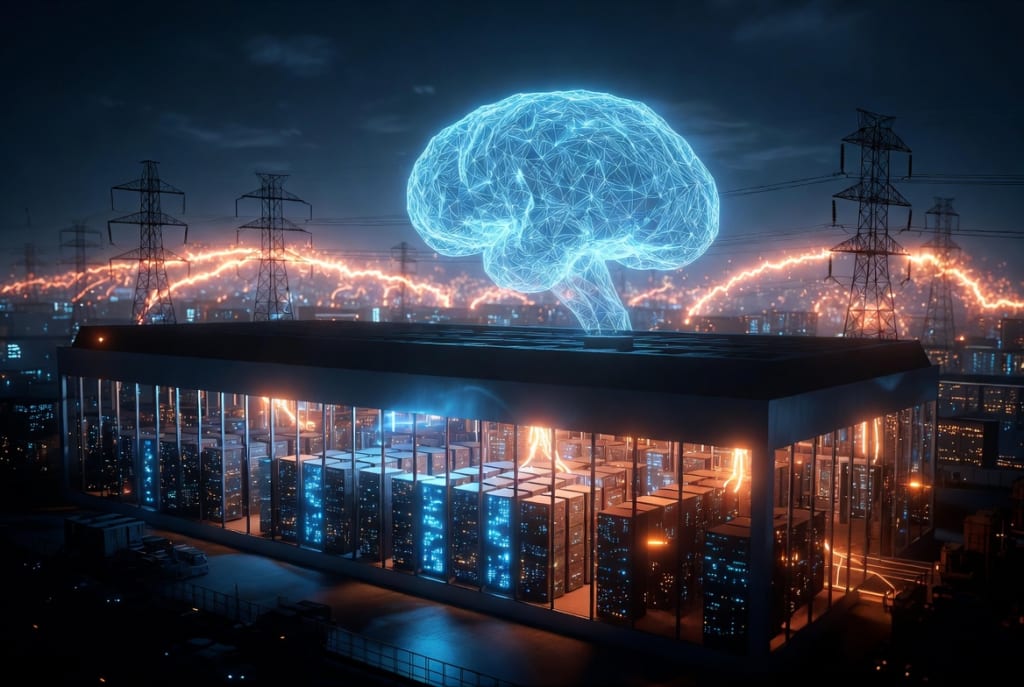
Created with the help from AI
There's a story unfolding in the energy sector that most people outside the tech industry haven't fully registered yet. It's moving fast, it's reshaping national infrastructure priorities, and it touches everything from your electricity bill to global climate commitments.The story is this: AI data centers are consuming energy at a scale that is rewriting the rules of power generation — and the industry is struggling to keep up. As an AI SEO consultant who tracks this space daily, I want to give you a clear, honest picture of what's happening right now in AI data center energy news — no hype, no corporate spin, just the facts and what they mean.
The Scale of the Problem, in Plain Numbers
Let's start with context.
A traditional Google search consumes roughly 0.3 watt-hours of electricity. A single ChatGPT query consumes approximately 10 times that amount. Now multiply that by billions of daily AI queries across dozens of major platforms — ChatGPT, Claude, Gemini, Perplexity, Copilot, and hundreds of enterprise AI deployments — and you begin to understand why energy grid operators are sounding alarms.
View the AI Water Usage Report
The International Energy Agency projects that data centers could consume 800 terawatt-hours of electricity annually by 2026 — roughly equal to the entire electricity consumption of Japan. AI workloads are the primary driver of that growth.
In the United States alone, data center electricity demand is expected to double by 2030 according to multiple utility and grid operator forecasts. Some analysts believe that estimate is conservative.
The Biggest AI Data Center Energy Stories Right Now
"Suppose life is a mess—let's get rid of it. Scour the whole thing with nuclear energy. Turn it into a star... becomes planets, and that develops all this corrupt life on it... and finally discovers the secret of nuclear energy and then blows itself up, and it becomes a star." Alan Watts
Microsoft Is Building Nuclear
In one of the most significant energy announcements in recent tech history, Microsoft struck a deal to restart Unit 1 of the Three Mile Island nuclear plant in Pennsylvania — the same facility that was partially involved in the 1979 accident that defined a generation's relationship with nuclear power.
The restarted plant, renamed the Crane Clean Energy Center, will supply carbon-free electricity directly to Microsoft's data center operations under a 20-year power purchase agreement. The deal signals how seriously hyperscale AI companies are taking the energy supply problem — and how far they're willing to go to solve it.
Google Is Going Nuclear Too
Not to be outdone, Google announced agreements with Kairos Power to purchase electricity from small modular reactors — a next-generation nuclear technology still in development. Google's stated goal is to have its first small modular reactor online by 2030, with additional units following through 2035.
The fact that two of the world's largest technology companies made major nuclear commitments within months of each other tells you everything about where the AI energy crisis is heading.
Amazon Is Building Its Own Transmission Lines
Amazon Web Services — which powers a significant portion of the world's AI infrastructure — has begun investing directly in electrical transmission infrastructure in some regions rather than waiting for utility companies to build capacity. When the world's largest cloud provider starts building its own power grid components, the energy situation has moved well beyond routine infrastructure planning.
Meta Is Targeting 2 Gigawatts of New Power
Meta announced plans to add approximately 2 gigawatts of new electricity capacity to support its AI infrastructure expansion — enough to power roughly 1.5 million American homes. The company is pursuing a mix of solar, wind, and grid purchases to meet the demand.
OpenAI's Stargate Project
The most ambitious AI energy initiative announced to date is the Stargate project — a joint venture involving OpenAI, SoftBank, and Oracle committed to investing $500 billion in AI infrastructure in the United States over four years. A significant portion of that investment is dedicated directly to energy infrastructure, including new data center campuses designed with dedicated power generation capacity.
The scale of Stargate alone — if fully realized — would represent one of the largest private infrastructure investments in American history.
Why the Grid Wasn't Built for This
Here's something that doesn't get discussed enough in mainstream AI coverage: the United States electrical grid was not designed to accommodate this level of sudden, concentrated demand growth.
The grid was built over decades around relatively predictable load patterns — residential demand peaks in the morning and evening, industrial demand is consistent during business hours, and utilities plan capacity around gradual, forecastable growth.
AI data centers break every one of those assumptions. They:
- Operate at maximum capacity 24 hours a day, 7 days a week
- Cluster geographically around fiber infrastructure and water sources
- Scale up demand faster than grid infrastructure can be built
- Require power reliability standards that exceed what most utility grids currently guarantee
Grid operators in Virginia — home to the largest concentration of data centers on earth, nicknamed "Data Center Alley" — have publicly stated that interconnection queues for new large power customers are years long. Some utilities have imposed temporary moratoriums on new large commercial connections while they assess capacity.
This isn't a hypothetical future problem. Data center developers in multiple states are encountering real grid constraints that are delaying or relocating planned facilities.
The Renewable Energy Tension
Every major AI company has made public commitments to 100% renewable energy. Microsoft, Google, Meta, and Amazon all have net-zero or carbon-neutral targets with specific timelines.
The tension is that renewable energy — particularly solar and wind — is intermittent. The sun doesn't shine at night. The wind doesn't blow on demand. And AI data centers need power that is constant, reliable, and available every second of every day regardless of weather conditions.
This is exactly why nuclear has re-emerged as the energy solution of choice for hyperscale AI infrastructure. Nuclear power is carbon-free and runs at near-constant output 24 hours a day — a profile that matches AI data center demand almost perfectly.
Battery storage technology is advancing rapidly, but not yet at the scale needed to buffer intermittent renewables for a facility consuming hundreds of megawatts continuously.
The practical result is a complicated picture where companies pursuing genuine renewable energy commitments are also signing long-term agreements with gas-fired "peaker" plants to guarantee reliability — a tension that sustainability advocates are increasingly scrutinizing.
What This Means for Electricity Prices
This is the part of the AI data center energy story that will eventually affect every household and business in regions with high data center density.
When large industrial customers — data centers consuming 100, 200, or 500 megawatts — connect to local grids, they change the economics of power generation and transmission for everyone on that grid. Utilities must build or procure additional generation capacity, upgrade transmission infrastructure, and maintain reliability across a larger and more demanding load profile.
Those infrastructure costs are typically recovered through rate cases — regulatory proceedings where utilities request permission to raise electricity rates for all customers to cover new capital expenditures.
In Virginia, where data center density is highest, electricity rate discussions have explicitly included data center growth as a driver of proposed increases. Similar conversations are beginning in Georgia, Texas, Indiana, and other states attracting large AI infrastructure investments.
The relationship between AI compute growth and residential electricity prices is not yet widely understood by the public — but it will be.
The Efficiency Counterargument
It's worth engaging honestly with the industry's counterargument, because it has real merit.
AI advocates — and many credible researchers — point out that AI-driven optimization of energy grids, industrial processes, transportation systems, and building management could reduce global energy consumption far more than AI data centers consume. Google has used AI to reduce its own data center cooling energy consumption by 30%. AI is being applied to optimize wind turbine placement, predict solar generation, and manage grid load balancing in ways that improve overall system efficiency.
The potential for AI to accelerate climate solutions — in materials science, carbon capture, energy storage chemistry, and grid management — is genuinely significant.
The honest position is that both things are true simultaneously: AI's energy footprint is large and growing, and AI's potential to reduce energy consumption and accelerate clean energy development is also large and real. The outcome depends entirely on choices being made right now about how AI infrastructure is built, powered, and governed.
What to Watch in the Coming Months
If you're tracking AI data center energy news, these are the developments worth following closely:
Small modular reactor progress — Google and Microsoft's nuclear bets depend on SMR technology being commercially viable on the timelines promised. Early deployment results from companies like Kairos Power, X-energy, and NuScale will be bellwether signals.
State-level grid legislation — Multiple states are considering legislation that would either accelerate or restrict data center development based on grid and water impacts. Virginia, Texas, Georgia, and Nevada are all active battlegrounds.
Federal permitting reform — The bottleneck for new energy infrastructure in the US is often permitting timelines rather than technology or financing. Any significant reform to transmission line permitting will have outsized effects on the AI energy equation.
Efficiency benchmarks — The industry metric to watch is Power Usage Effectiveness (PUE) — the ratio of total data center energy to energy used purely for computing. Industry leaders are approaching PUE of 1.1, meaning only 10% overhead. Widespread adoption of best practices here would meaningfully reduce the energy intensity of AI compute.
International data center development — As US and European grid constraints tighten, AI companies are increasingly evaluating data center locations in regions with abundant renewable energy and fewer grid constraints — Chile, Iceland, Norway, and parts of Southeast Asia are all on the map.
The Bottom Line
AI data center energy news is no longer a niche technology story. It's an infrastructure story, an economic story, a climate story, and increasingly a political story that will shape how communities, utilities, and governments relate to the AI industry for decades.
The energy demands of AI are real, they're growing faster than most forecasts anticipated, and the solutions — nuclear, renewable, efficiency, and grid modernization — are all in motion simultaneously at a scale the energy sector hasn't seen in a generation.
Staying informed about these developments isn't just interesting. For anyone building with AI, investing in tech, running a business that depends on electricity costs, or simply paying attention to where the world is heading — it's essential.
About the Creator
Sandy Rowley
AI SEO Expert Sandy Rowley helps businesses grow with cutting-edge search strategies, AI-driven content, technical SEO, and conversion-focused web design. 25+ years experience delivering high-ranking, revenue-generating digital solutions.
Keep reading
More stories from Sandy Rowley and writers in 01 and other communities.
What Is the Best DeFi Marketing Plan for Startups in 2026?
The decentralized finance (DeFi) sector is evolving at an unprecedented pace. Startups aiming to launch successful DeFi projects in 2026 must adopt comprehensive marketing strategies that combine community building, influencer partnerships, tokenomics promotion, and innovative campaigns. A structured marketing plan is crucial not only for attracting early investors but also for establishing long-term project credibility. Below, we explore a step-by-step approach for DeFi startups to achieve growth and visibility in 2026.
By Jack santo3 days ago in 01
The Dirty Secret No Real Estate App Development Company Will Tell You About Property Search Features
If you have ever hired — or considered hiring — a real estate app development company, there is a conversation that almost never happens in the sales process. It is the one conversation you actually need to have.
By Aarti Jangid2 days ago in 01
GRANDMA NELSON
Daddy pulled off the interstate, and I saw the all familiar red barn, and I knew we had arrived at Grandma Nelson's farm. I always had mixed feelings about seeing my Grandmother. It seemed she had as many Grandchildren as the old Mother in the shoe nursery rhyme. I saw her as different, but that is not why I hestiated. The truth be known I always got in trouble at her house, and ended up sitting in the car after I had been scolded.
By Susan Payton2 days ago in Fiction


Comments
There are no comments for this story
Be the first to respond and start the conversation.