
Modes of D for Guitar
D Major and Parallel D

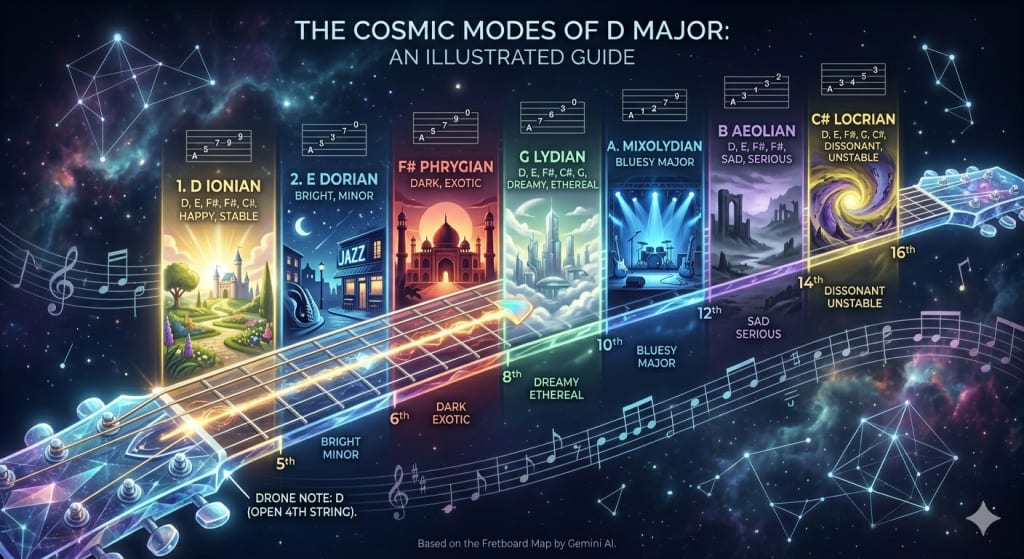
Understanding the modes in the Key of D Major involves using the same set of notes (D, E, F#, G, A, B, and C#) but starting and ending on a different note for each mode. This shift in the "center" changes the intervals and the overall emotional character of the music.
Below are the seven modes derived from the D Major scale, starting from the 5th fret of the A string (5th string). This is of course, one way of playing these, countless other variations can be made–use your imagination!! Or better yet, proceed to the next octave, so that you are playing 15 notes in total.
1. D Ionian (The Major Scale)
The "parent" scale. It sounds happy, stable, and resolved.
Intervals: 1, 2, 3, 4, 5, 6, 7
Notes: D, E, F#, G, A, B, C#
Plaintext
e|------------------------------|
B|------------------------------|
G|--------------------4--6--7---|
D|-----------4--5--7------------|
A|--5--7--9---------------------|
E|------------------------------|
2. E Dorian
Common in jazz and blues. It is a minor-sounding scale but with a "brighter" 6th interval.
Intervals: 1, 2, b3, 4, 5, 6, b7
Notes: E, F#, G, A, B, C#, D
Plaintext
e|------------------------------|
B|------------------------------|
G|--------------------4--6--7---|
D|-----------4--5--7------------|
A|--7--9--10--------------------|
E|------------------------------|
3. F# Phrygian
Sounds dark, exotic, and "Spanish." The flat 2nd gives it a very tense, haunting quality.
Intervals: 1, b2, b3, 4, 5, b6, b7
Notes: F#, G, A, B, C#, D, E
Plaintext
e|------------------------------|
B|------------------------------|
G|-----------------------7--9---|
D|--------------7--9--11--------|
A|--9--10--12-------------------|
E|------------------------------|
4. G Lydian
A major scale with a raised 4th. It sounds dreamy, ethereal, and often "spacey."
Intervals: 1, 2, 3, #4, 5, 6, 7
Notes: G, A, B, C#, D, E, F#
Plaintext
e|-------------------------------|
B|-------------------------------|
G|-----------------------9--11---|
D|--------------9--11--12--------|
A|--10--12--14-------------------|
E|-------------------------------|
5. A Mixolydian
The "bluesy" major scale. It’s a major scale with a flattened 7th, perfect for dominant 7th chords.
Intervals: 1, 2, 3, 4, 5, 6, b7
Notes: A, B, C#, D, E, F#, G
Plaintext
e|---------------------------------|
B|---------------------------------|
G|-----------------------11--12----|
D|--------------11--12--14---------|
A|--12--14--16---------------------|
E|---------------------------------|
6. B Aeolian (The Natural Minor Scale)
The relative minor of D Major. It sounds sad, serious, and grounded.
Intervals: 1, 2, b3, 4, 5, b6, b7
Notes: B, C#, D, E, F#, G, A
Plaintext
e|---------------------------------|
B|---------------------------------|
G|-----------------------12--14----|
D|--------------12--14--16---------|
A|--14--16--17---------------------|
E|---------------------------------|
7. C# Locrian
The most dissonant and unstable mode. It is used over diminished chords and rarely serves as a "home" key.
Intervals: 1, b2, b3, 4, b5, b6, b7
Notes: C#, D, E, F#, G, A, B
Plaintext
e|---------------------------------|
B|---------------------------------|
G|-----------------------14--16----|
D|--------------14--16--17---------|
A|--16--17--19---------------------|
E|---------------------------------|
Tips for Practice
Drone Note: Play a low D string (open 4th string) and play through all these modes. Even though the notes are the same, you will hear how the "mood" shifts drastically as you change the starting note.
Three Notes Per String: The tabs above use a "3-note-per-string" approach, which is excellent for building speed and fluidly moving across the fretboard.
To understand Parallel Modes, you keep the same root note (D) but change the scale intervals for each one. This is the best way to hear the unique "flavor" of each mode because the baseline (D) never moves.
Since you want these starting on the 5th string (A string), 5th fret, here is the fretboard breakdown for all 7 Parallel Modes of D.
The 7 Parallel Modes of D
1. D Ionian (Major Scale)
Formula: 1, 2, 3, 4, 5, 6, 7
Notes: D, E, F#, G, A, B, C#
Character: Bright, happy, satisfied.
Plaintext
e|------------------------------|
B|------------------------------|
G|--------------------4--6--7---|
D|-----------4--5--7------------|
A|--5--7--9---------------------|
E|------------------------------|
2. D Dorian
Formula: 1, 2, b3, 4, 5, 6, b7
Notes: D, E, F, G, A, B, C
Character: Sophisticated, jazzy, "cool" minor.
Plaintext
e|------------------------------|
B|------------------------------|
G|--------------------4--5--7---|
D|-----------3--5--7------------|
A|--5--7--8---------------------|
E|------------------------------|
3. D Phrygian
Formula: 1, b2, b3, 4, 5, b6, b7
Notes: D, Eb, F, G, A, Bb, C
Character: Dark, Spanish, tense.
Plaintext
e|------------------------------|
B|------------------------------|
G|--------------------3--5--7---|
D|-----------3--5--7------------|
A|--5--6--8---------------------|
E|------------------------------|
4. D Lydian
Formula: 1, 2, 3, #4, 5, 6, 7
Notes: D, E, F#, G#, A, B, C#
Character: Dreamy, spacey, ethereal.
Plaintext
e|------------------------------|
B|------------------------------|
G|--------------------4--6--7---|
D|-----------4--6--7------------|
A|--5--7--9---------------------|
E|------------------------------|
5. D Mixolydian
Formula: 1, 2, 3, 4, 5, 6, b7
Notes: D, E, F#, G, A, B, C
Character: Bluesy, rocking, dominant.
e|------------------------------|
B|------------------------------|
G|--------------------4--5--7---|
D|-----------4--5--7------------|
A|--5--7--9---------------------|
E|------------------------------|
6. D Aeolian (Natural Minor)
Formula: 1, 2, b3, 4, 5, b6, b7
Notes: D, E, F, G, A, Bb, C
Character: Sad, tragic, heavy.
e|------------------------------|
B|------------------------------|
G|--------------------3--5--7---|
D|-----------3--5--7------------|
A|--5--7--8---------------------|
E|------------------------------|
7. D Locrian
Formula: 1, b2, b3, 4, b5, b6, b7
Notes: D, Eb, F, G, Ab, Bb, C
Character: Dissonant, unstable, "scary."
e|------------------------------|
B|------------------------------|
G|--------------------3--5--7---|
D|-----------3--5--6------------|
A|--5--6--8---------------------|
E|------------------------------|
Comparison Table: How they differ from D Major
Mode
Alterations (vs. Major)
The "Vibe"
Lydian
#4
Dreamy
Ionian
None
Happy
Mixolydian
b7
Bluesy
Dorian
b3, b7
Cool/Jazz
Aeolian
b3, b6, b7
Sad
Phrygian
b2, b3, b6, b7
Dark/Exotic
Locrian
b2, b3, b5, b6, b7
Chaotic
Pro Tip: To really hear the difference, record yourself playing a low D power chord (D5) or just a low D drone note, then play these scales over it one after another. You’ll hear the "mood" shift instantly as you change the scale.
About the Creator
Nathan McAllister
I create content in the written form and musically as well. I like topics ranging from philosophy, music, cooking and travel. I hope to incorporate some of my music compositions into my writing compositions in this venue.
Cheers,
Nathan
Keep reading
More stories from Nathan McAllister and writers in Beat and other communities.
Pakistan’s Remote Village with a Unique System of Community Service
Nestled deep within the rugged mountains of northern Pakistan lies Shimshal, a remote village that stands as a powerful example of community spirit and selfless service. Isolated by geography yet rich in tradition, Shimshal has developed a unique system of collective responsibility that has helped its residents survive and thrive in one of the harshest environments on Earth.
By Irshad Abbasi 3 days ago in Beat




Comments
There are no comments for this story
Be the first to respond and start the conversation.