
Too Fast, Tough Enough to Last: Rediscovering Vanilla Ninja
A journey to discover a band I’ve always known — but never truly understood.


It's 2003. Eight-year-old me is watching the Estonian Eurovision national round. Then, this unknown girl band takes the stage. And just like that, the world became a little wider. Not only did I think they were the coolest thing ever at the time — and my first real sense that I might like rock music among other things — it was also the first time I remember being engaged with something in pop culture with that kind of passion. And I most certainly remember the national frustration, as well as my own, when they didn’t win and go on to represent Estonia at Eurovision.
But as it turned out, they went on to do a lot more. In just a few short years starting in the early 2000s, Vanilla Ninja carried themselves across borders into the wider European pop-rock conversation and delivered a string of strong albums at an insane pace. Somehow, they ended up representing Switzerland at Eurovision and even found success far beyond Europe — as far away as South America among other places.

On European level, they were a proper success. For Estonians, they were something more. They were part of the fabric, a source of pride for a small country — a band that ventured into waters previously uncharted by any of their compatriots. I remember cheering for them as a kid, when they broke new ground for Estonian artists. I remember their music playing non-stop from my little sister’s room, from TV, from commercials. And I remember going to their concert in late 2005 — the first real rock concert I ever experienced — and having the time of my life. In short, they defined an era.
But as that era passed, they seemed to quietly step away. And while their cultural presence never really left — one that, quite literally, still exists in Estonian supermarket freezers — I also moved on, having only engaged with their music sporadically over the years. The nostalgia remained, but over time I began to file them away in my head as this culturally important, well-executed project that captured an era — and seemed to end with it.
So, when they made their comeback in early 2020's with a calmer tone, I wasn’t particularly eager to re-engage. If anything, I assumed they had simply returned without the same bite and left it at that nostalgia I had.

Fast forward to 2026, and life did what it tends to do — it looped back. Not quite in the way one might expect, though. Twenty-three years after their famous near miss, the band returned to Eesti Laul (the current national Eurovision round) and finally won. But the narrative wasn’t quite the cathartic redemption one might expect. You see, back in 2003, they missed out because the jury decided the winner, much to the frustration of the Estonian public. Now, they made it through the public vote — but, somewhat ironically, to the frustration of many Estonian and wider Eurovision fans.
Some called the new material outdated. Others dismissed them as a legacy act, relying more on what they were than what they are. And I — well, I found myself in a bit of a conundrum. Because in a way, it seemed to confirm my view of them as this former well-oiled pop-rock project ultimately belonging to the past. And yet, at the same time, something didn’t sit right with this line of thought. In fact, I found myself, for the first time in years, genuinely curious about them again.
Now, I suppose it was simply because this recent flood of memories — sparked by their return to Eurovision — made me realize something: I’ve clearly underestimated just how much this band has meant to me. So, I figured that perhaps it’s time to go back and, for the first time, listen properly. To follow the music all the way through, from the very beginning to today, and finally understand what they were, who they are, and what they really represent to me. Let’s go.
Chapter 1 — The Origins: A Right Band in the Right Place at the Right Time (2002)

While it can be useful to separate music from the zeitgeist surrounding it, understanding Vanilla Ninja means understanding the moment they emerged into — and ultimately captured. And, since it just so happens to be a moment I often find myself mentally stuck in anyway, it made sense to start from there — the early '2000s.
For Estonia, this was a strange and exciting time. The country was still relatively fresh out of the 1990s transition period, but already rapidly integrating into the wider European cultural and economic space. There was a growing sense of openness — and with it, ambition. Music being one of the most visible ways to express that. And— mainly through Eurovision — it had already started to gain some serious momentum here. For a small country, the idea of breaking into international markets wasn’t just a commercial goal. It was symbolic.
At the same time, the broader musical landscape was also shifting. The late '90s had been dominated by polished pop acts, but by the early '2000s, guitar-driven music was pushing its way back into the mainstream. Pop-punk, alternative rock, nu-metal and melodic rock were all gaining ground (and teen comedy soundtracks), creating a huge and varied space for anything that sat between pop and rock.

Crucially, for the first time in a while, that space also opened up for female-fronted acts in that vein. The global breakthrough of Avril Lavigne in 2002 didn’t quite invent that category — but it legitimized it on this massive scale. Suddenly, labels and audiences alike were ready for young, female artists with guitars, attitude, and emotional directness.
That shift was felt everywhere — including Europe. But Europe had its own traditions as well. While American acts leaned more toward attitude and rebellion, European pop-rock often emphasized melody and atmosphere. Scenes across Scandinavia and Central Europe were already producing bands that blended rock instrumentation with cinematic, almost theatrical elements. This created a slightly different version of the same movement — one that valued big melodies and emotional resonance as much as raw energy. And that is exactly, where Vanilla Ninja entered the scene.

Formed in Tallinn in 2002 as a new Estonian pop-rock project, the band was shaped from the beginning by producer Sven Lõhmus. The original lineup brought together Maarja Kivi, Lenna Kuurmaa, Piret Järvis, and Katrin Siska, with Kivi and Kuurmaa already knowing each other beforehand, while Järvis and Siska were friends from school (at least from info what I was able to dig up).
So, in its earliest phase, the band was not just a spontaneous friendship group, but a carefully assembled act looking to capture that shifting landscape. With Lõhmus — already a proven figure in the Estonian music scene — helping define its early musical direction, and with Maarja Kivi’s visibility after Eurolaul 2002 (Estonia's Eurovision national round at the time), the group had an immediate public face.
And, well, as it didn’t exactly waste time in getting down to business, enough of talking about why Vanilla Ninja could happen. Let’s see how they actually shot out of the gate with their 2003 debut album.
Chapter 2 — Kicking the Door Open: Finding The Sound in Club Kung Fu (2003)

Now, in many ways, I expected their self-titled debut album to be a bit of a footnote in this exploration. I mean, I knew it had Club Kung Fu, which remains one of their most recognizable songs, as well as their first public apperance. But other than that, I didn’t expect this to be a particularly interesting listen.
However, I found myself having a lot of fun with it. Simply put, this is one cool example of a young band with huge potential finding its feet — throwing it in many different directions and seeing what sticks. There are songs here that feel like they’ve jumped straight out of the repertoire of a quality late-90s Estonian pop act. Some songs are in Estonian (to my knowledge, still the only time the band has sung in their native language). And then there are flashes of something heavier — moments where the songs feel like they’re reaching for a stronger, more guitar-driven identity, as if the band is still figuring out just how far it can push itself.

In other words, the ideas that would go on to define the band are clearly there. The direction just isn’t fully realized yet. And that’s exactly what makes it such a great time capsule. Opening tracks like Guitar and Old Blue Jeans and Why transport you into that specific era of early '00s effortlessly and the album just keeps going from there.
Now, in regards to Club Kung Fu — yeah, this is one of those cases, where a song was way bigger than the album. It was their debut, and as far as debuts go, it doesn’t get much better than that. It’s catchy. It’s not their peak, obviously — but that’s exactly how you shoot out of the gate. It also showed early on that the band had more to offer than just vocals, with Piret Järvis credited for writing the lyrics to their first hit.
Most importantly, this was the track with which they came close to representing Estonia at Eurovision — only to controversially miss out due to the jury, despite winning the public vote by a landslide. Now, at the time, that felt like a real disappointment. But in hindsight, it almost feels like a strange kind of blessing. Because instead of being locked into a single moment, the band was allowed to keep building — and what followed would be far bigger than one Eurovision appearance. What followed was, in hindsight, quite insane.
Chapter 3 — The Run: Going For The Fire (2004-2006)

And then it happened. Not gradually. Not carefully. Not with pauses in between. But all at once. Between 2003 and 2006, Vanilla Ninja released four albums. Four. In just over three years. And not as filler or contractual obligations, but as fully realized, high-energy, hook-filled records that just kept coming.
Looking back, it’s honestly a bit hard to believe. Many bands take a decade to find their sound, peak, and start figuring out what they even are. Vanilla Ninja did all of that in one continuous sprint. And the craziest part? They didn’t really miss. So, lets take a look at the three albums that would go on to define them.
Traces of Sadness (2004) — The Quintessential Vanilla Ninja
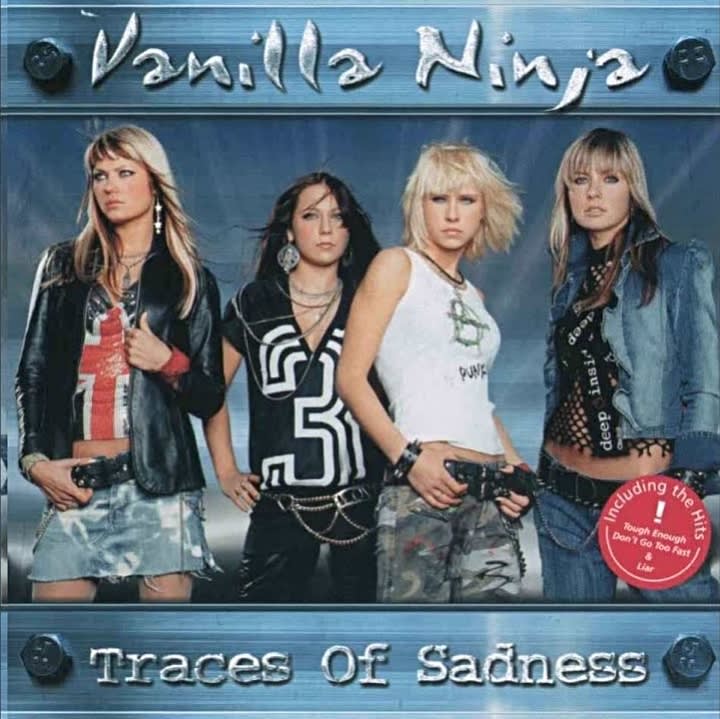
If the debut was about potential, then Traces of Sadness is where everything just clicks. And, ah screw it, I’ll say it straight — for me, this is one of the best pop-rock albums of the 2000s, period. And I didn’t even realize how much it had shaped my taste in music until now.
This album is punchy, atmospheric, emotional — and for the most part, just all killer, no filler really. Iconic songs like Liar, Don't Go Too Fast and Tough Enough are not just highlights, but part of a relentless run of bangers. Granted, some song structures repeat, but honestly, that’s a minor gripe, when everything lands this consistently. Simply put, this is the band firing on all cylinders — blending pop-punk energy with melodic rock and just enough of that early-2000s cinematic drama to make it feel even bigger than it is.

Perhaps more importantly, this is where the band’s thematic identity really comes into its own. Many of the songs revolve around resilience in one way or another — standing your ground, holding your own — whether in life or in relationships. A thread that clearly goes on to define much of their later work.
This is also the point at which Vanilla Ninja evolved from a domestic Estonian success story into a more internationally oriented, German-produced pop-rock project. Working with producer David Brandes, they broke into the German and Austrian markets to an impressive level and, from there, into other parts of Europe. A transition that not only cemented their status as cultural milestones in Estonian music history, but also as proper heavy-weights of the early to mid 2000s Europe pop-rock scene.
Now, of course, at its core, it was always an Estonian band consisting of Estonian artists. Speaking of whom, the members truly gel here, as it is on this album, where the vocal harmonization of all four members is at its peak and at its most energetic.
Leading that charge, of course, was the Maarja–Lenna co-lead dynamic. While a maybe a massive genralization, I always felt that in these early records, Maarja was the engine — the punch, the forward drive. The truest rocker of the group. Lenna the emotion — the vocal melody, the atmosphere. The most versatile one of the group. Whatever's the case, it worked beautifully. However, it did not last long.
Blue Tattoo (2005) — Thriving Through Setbacks
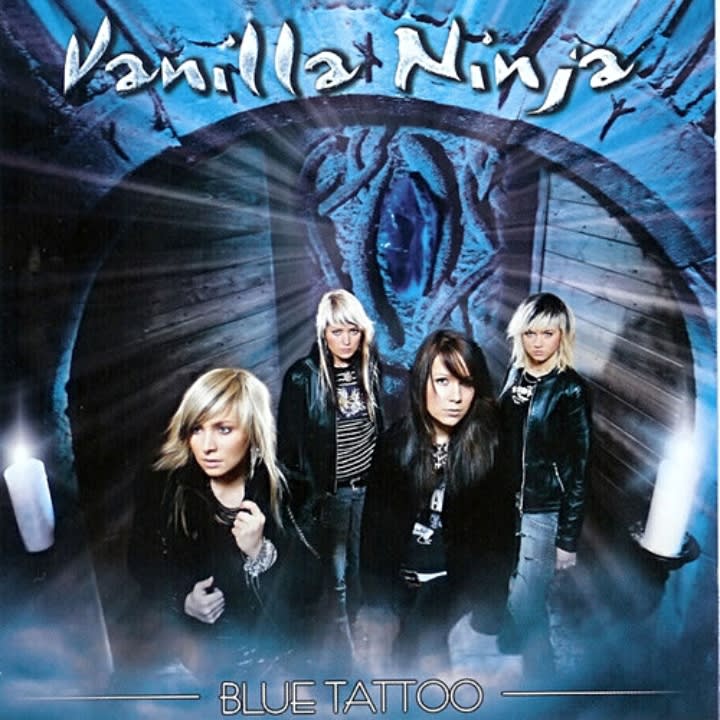
So, somewhere after the Traces of Sadness album cycle, the band faced its first real setback: Maarja left. Now, while it wasn’t a hostile departure from what I remember being said at the time, it must have still been a blow to a band that had just hit its stride. In fact, it would have been easy to assume this was where the momentum started to slip, as they released their third album right after. But Blue Tattoo just.. well, it doesn’t allow that.
If anything, it goes even harder. In fact, while not quite as iconic, it might even edge out its predecessor as a complete album. This is where the band leans fully into Lenna and what you get is something even more atmospheric, more melodic, and full of almost rock-opera-like qualities. There’s an even stronger sense of drama here — a more cinematic pull. It feels bigger, more expansive. Songs like Blue Tattoo, I Know, and Cool Vibes are massive in every sense — not just catchy, but emotionally loaded in a way that really sticks.

Yes, it’s different. Maarja could not be replaced — but Triinu Kivilaan steps in strongly, and Lenna is an absolute force of nature on this record. At the same time, Piret Järvis, on guitar and backing vocals, continues to be something of an underrated glue within the band — often tying together the powerhouse choures with steady, effective and just really cool verses. Additionally to being one of the most profilic lyricists of the group over the years.
And Katrin Siska, while easy to overlook at first glance, brings a subtle but essential layer to the band through keyboards and backing vocals. In fact, from what I’ve learned from my girlfriend, who was also following Ninjas as a kid, that quiet, almost understated presence was exactly what made Siska a favourite for more alternative girls— a little more mysterious, a little more off the general image.
So yes, the band definitely lost something with Maarja’s departure — but it didn't lose its step. If anything, this album feels like a smooth, natural evolution and, well, pretty much just a total tour de force. Additionally, with the band representing Switzerland at Eurovision and performing strongly there during this album cycle, it really did seem like there was no stopping the Ninjas.
Love Is War (2006) — A Fascinating Plateau

Now, this is where things got really interesting for me, listening to these albums back to back. Because, looking at how things played out, I genuinely expected Love is War to be underwhelming. I mean this was their last studio album in 15 years and also their first after all the drama and break up with Bros Music, and their manager David Brandes. But actually, it completely flipped that expectation. Because this is not a bad album. Not even close.
In fact, almost everything on it is commendable. The songs still hit, the energy is still there, and you can clearly hear the band continuing to evolve — keeping that cinematic, almost operatic sound, while also making things a bit punchier again. There’s more pop-punk energy coming through this time around, more playfulness. Case in point, Dangerzone.
At the same time though, there are also moments that feel sonically almost lifted from The Mask of Zorro or some other atmoshperic early '00s Hollwood films score. It feels confident. It’s top form all around. And, while the overall package isnt't maybe quite as iconic, it easily holds its own alongside the previous two.

Perhaps, even more crucially, with most of the songs being co-written by Lenna and Piret, there's also a lot to read into the lyrics here. Like for example, Kingdom Burning Down telling a story of their fight with Brandes.
On a personal note, it was also around this album cycle, when I went to see them live with my family. It was my first live rock concert experinece, I was maybe 11 at the time and I remember this one very clearly. They were awesome that night and it remains one of my favourite ever concert experiences to this day. One, I was happy to find and relive on YouTube all these years later.
And yet, this album is also, where one starts to feel the ceiling a bit. Yes, they’re doing everything right — but they’re not going somewhere particularly new. Not really breaking out of the structure that they had already built. And given the pace — how could they? There seemed to be no time to stop. No time to step back. Only to keep going.
Chapter 4 — The End of the Run: Running In Dreams (2007-2008)

And so, almost as quickly as it had all come together, it started to wind down. Not dramatically. Not with a collapse. Not with a clear breaking point. But, seemingly from the outside, more like something quietly reaching its natural limit. In fact, that’s the strange thing about Vanilla Ninja’s initial run — when you actually listen through it, there is no obvious “drop-off” moment. No album, where things fall apart. No clear sign that the band suddenly lost its touch. If anything, the opposite is true. Post-2006, they were still good. Still energetic. Still capable. So what happened?
Well, I mean, I don't know. I kind of feel like that part of the reason, why the band’s initial run ended is simply time. Simply put, this band burst onto the scene during the early-2000s pop-rock wave and really captured it. By the late 2000s, the musical landscape was already shifting again, with Ninjas, in many ways, very much a product of that previous era. Still clearly evolving and definitely not outdated. But the culture around them was changing.
And then there’s that aforementioned pace. Four albums in four years is not just productive — it must be exhausting. Creatively, structurally, personally. No reset. No moment to step back and ask: where do we go next? One can imagine that, at some point, that catches up with you.
Granted, I obviously don’t know much about the behind-the-scenes mechanics here — how much of what followed after 2006 was due to individual ambitions, collaborator changes, label decisions, financial expectations, creative deadends, fatigue or corporate greed towards the band (the latter being definitely a huge factor from what I understand). No clear idea. But from the outside, it feels less like a band falling apart — and more like a project that had reached the end of the road it was built to travel.
In fact, strangely, I also can’t help but feel that this is why Vanilla Ninja might be slightly underrated in a way. They gave so much. So fast. In so short a time that the audience almost got spoiled. There was no time for things to breathe. No time for songs to settle. Just constant output. Constant presence. Constant delivery. They seemed like troopers on a treadmill. Always moving forward. Never stopping long enough for people to fully take it in.
And that creates a strange paradox. The way they managed this pace and quality makes you respect the band even more — especially when you consider they did it despite setbacks on both the member, label and producer fronts. But at the time? It just kept coming. No long hiatus to build myth. No peaks and valleys. No singular defining moment that everything else revolves around. Just consistency. And weirdly, that can make a band’s efforts easier to overlook.

Yet, right at the edge of that ending, there’s no doubt that they were still delivering. Case in point — Birds of Peace. It’s just a song. It’s not on an album. It didn’t become a defining mainstream hit. It placed fourth in 2007 Estonia's Eurovision national final — respectable, but far from historic. Yet, listening to it now, it genuinely feels like one of the best things they ever did.
It has it all. The melody. The atmosphere. The emotional clarity. Lenna, now the sole lead vocalist, on absolute top form. It feels like a culmination of everything the band had been building toward — without the pressure of fitting into an album, a cycle, or a direction. Just a song that works. If you wanted to, you could almost argue that this is where Vanilla Ninja truly peaked. Not in the middle of the sprint. But right at the edge of it — when everything had already been learned, refined, and internalized.
They won the Best Artist Award at the 2008 Viña del Mar International Song Festival with it. And then, for a long time, they were gone.
Chapter 5 — The Legacy Era: Nostalgia and Reinvention (2021-present)

So, for well over a decade, Vanilla Ninja were simply not around. Not in the dramatic, tabloid sense. Not with a messy breakup or a definitive ending. Just absent — quietly stepping away after one of the most intense runs a band could have. And in that absence, they became a memory — a snapshot of the early 2000s, a symbol of a time, a sound, and, at least in Estonia, a kind of cultural breakthrough.
Then, in late 2020, after nearly 14 years without a new album, Katrin Siska announced that the band would return with new material, with Triinu Kivilaan rejoining the group. That album became Encore. And the question was no longer just how do they sound now? It was who are they now?
A Different Kind of Confidence — Encore (2021)

Soo, yeah, I remember almost instantly dismissing this album. I listened to the title track, when it became a single, appreciated that they were trying something new, but ultimately felt underwhelmed and kind of just checked out of their comeback entirely. I suppose, as irrational as it was, I expected them to come back rocking — a straight continuation from where they had left off. But Encore was simply not that. Now, however, after actually listening to it properly for the first time, I do find it just as interesting as their earlier work — just in a very different way and on a very different pace.
Thing is, when legacy bands return, they often fall into one of two traps: either chasing their old sound and falling short, or abandoning it completely and alienating their audience. Vanilla Ninja do neither here. Instead, they evolve — sonically, thematically, and even symbolically. And one has to respect that. The songs carry a quiet confidence. The melodies are strong, the vocals are genuinely excellent, and there’s a maturity to the whole record that feels earned.

In fact, as much as I'm still not quite onboard with the direction this album took, I have to admit that it was the slower songs like No Regrets and Driving Through the Night that really stayed with me. Besides, there are also still hints of their signature sound — subtle reminders that they could go heavier if they wanted to, but are consciously choosing not to. That choice is important. Because it signals not a band trying to reclaim what they were, but one that is comfortable with what they have become. Confident. Content.
Even the title Encore itself starts to feel meaningful in that context. It makes you wonder, whether this whole and still continuing comeback is, in some way, a quest to build up to a proper encore. One they never quite got the first time around.
Last but not least, that aforementioned core theme of reselience is still there. It's just that, where the early music was about resilience through confrontation — standing your ground, pushing back, intensity — Encore shifts that into something more reflective. Resilience through understanding. Less "I will fight this", more "I’ve lived through this." Different tone, same foundation. And that, more than anything, makes this album feel like a solid starting point for the band’s second life.

Of course, as ever, changes were afoot quickly. In early 2022, Kerli Kivilaan, the younger sister of Triinu Kivilaan, joined the group — adding a fresh voice and dynamic to the lineup, as Triinu and Katrin stepped down. And, well, I have to say, Kerli's presence works great, as she brings her own unique vocal color and energy to the tabel. She complements the existing voices, while helping the band feel renewed, as Lenna and Piret remain the anchors that tie all these different eras together.
And that brings us to the present — to the newer singles and, of course, their much-discussed Eurovision entry.
Loosening Up Again — The New Singles (2024-present)

Between 2024 and 2026, Vanilla Ninja have released three new singles. Now, what stands out immediately is that, after establishing a more mature, reflective direction with Encore, the band seems to have loosened up again.
Starting with the newest, Are You Ready to Go. This honestly feels like the closest thing to their original-era sound in forever. Yes, perhaps a bit formulaic, but also energetic, rocky, direct, and clearly built for the stage — something that really came alive during their excellent (and successful) 2026 Viña del Mar performances.

Sting of the Scorpion, on the other hand, feels like pure fun. Not forced, not nostalgic — just a band enjoying itself without needing to prove anything. And that, in many ways, seems to reflect, where they are now. They seem to feel freer. More relaxed. More present. Lenna moves more freely and energetically on stage these days, and there’s a sense that they are genuinely enjoying the process. In a way that perhaps wasn’t always possible during their intense original run.
It actually reminds me a bit of how My Chemical Romance — a contemporary band to Vanilla Ninja in many ways — have approached their return in recent years: not chasing charts or singles, but rediscovering the joy of playing music, while still fully capable of delivering at a high level. Of course, as is the case with MyChem, that’s not to say they’ve come back just to have fun. There is still intent here. Still direction. And that direction has taken them back to, where it all began.
The Eurovision Question — Too Epic to Be True

Okay, Too Epic to Be True — the song that brought everything back into focus for me and ultimately inspired this whole piece. First of all, looking at this song detached from all the Eurovision discussions, I want to commend it in the context of the band. The melody is there. The performances are there. The confidence is there. The joy is definitely there. And, most importantly, 23+ years after their initial formation, they are still trying new sounds for them.
But what’s missing a bit, at least for me, is the punch. Because going through this listening journey, I understood that one of the defining elements of Vanilla Ninja’s identity was also this ability to make songs hit: strong guitars, driving drums, atmosphere, a sense of forward motion — that feeling that the song doesn’t just exist, but pushes ahead with intent. In much of the newer material, that instrumental edge feels slightly softened.
In other words, take some of these newer singles, keep everything else the same, but give them stronger, more prominent and even rockier instrumentation, and suddenly you’re looking at something much more similar to the band at that iconic era — just in a new form. Of course, what do I know about song engineering and instrumental arranging (come to think of it, I don’t really know anything at all), but I just can’t shake that feeling.

So, in regards to the criticism of Too Epic To Be True in the context of winning Eesti Laul and going to Eurovision — too safe, too dated, simply coasting on legacy power (I think someone on YouTube called it “the best song of 2006”) — I kind of see where it’s coming from. I also see that it could very well face an uphill battle to do well at this year’s Eurovision. But after this exploration, I suppose my perspective has shifted — on both this song and their entire second run.
One might not agree with the direction they’ve taken. One might find this song sonically dated in terms of an Eurovision entry. But to say they are coasting on nostalgia, is simply not the case. Because creatively, emotionally, and vocally, they are still there. Still capable. Still compelling. They’ve definitely grown. They’ve evolved. More importantly, they are consciously trying to keep evolving. Yes, maybe they might need to let it all hit a little harder — dare I say, a little more epic — instrumentally again, but there is no doubting their intent or their enjoyment.
In fact, while looking at their reactions after winning Eesti Laul, what struck me was just how much it all still clearly means to them emotionally. They are 100% in it. Still engaged to keep writing their story. Therefore, regardless of how it goes for them in Vienna, I simply wish them luck and hope they enjoy this full-circle moment — going to Eurovision with Sven Lõhmus after missing out all those years ago back in 03. And, well, that also brings us to where we began this article.
What Does Vanilla Ninja Represent to Me?

Yeah, I feel like it’s probably best not to drag this part out — this article hasn’t exactly been short. More importantly, I don’t really need to, because for me, the answer is quite simple. What Vanilla Ninja represents to me — more than their cultural legacy or nostalgic effect — is what happens when talent meets resilience and intent.
I think it’s that combination, which has enabled this band to push through their early unlikely success at breakneck pace. Through member changes, label fights, corporate bullshit, highs that defied odds, disappointments, dead ends, a monster hiatus, and much more. It’s also what has allowed them to keep evolving. Even, when some feel they now sit behind a culture they once helped to lead. So no — Vanilla Ninja are not just a project that had its moment, like I used to think until fairly recently. They are a band that has always tried to make the most of every moment they’ve gotten.
Thank you for the music, Ninjas — and keep on kicking & going for the fire (whatever direction that means nowadays), because you’ve clearly always been tough enough.
About the Creator
Art-Peeter Roosve
So, to put it simply (and slightly cheesily) I'm fascinated with life. And, well, writing about films, TV shows, video games, music, travelling, philosophy and Formula 1 among other is a fun way to explore it.
Keep reading
More stories from Art-Peeter Roosve and writers in Beat and other communities.
The Death Of Slim Shady (Coup de Grâce): Eminem's Dance With His Shadow
"You're not f---ing Taylor Swift. You had one era that mattered, mine. Everything that people think of when they think of Eminem is f---ing yours truly. From the blond hair, to the middle finger, to the f---ing jokes, all of it — me."
By Art-Peeter Roosve2 years ago in Beat




Comments
There are no comments for this story
Be the first to respond and start the conversation.