
POLITICAL LANGUAGE OF ENTROPY, THE MISCOMMUNICATION TRILOGY, “The Entropy of Communication, Vol. II”, part 4
Book Review

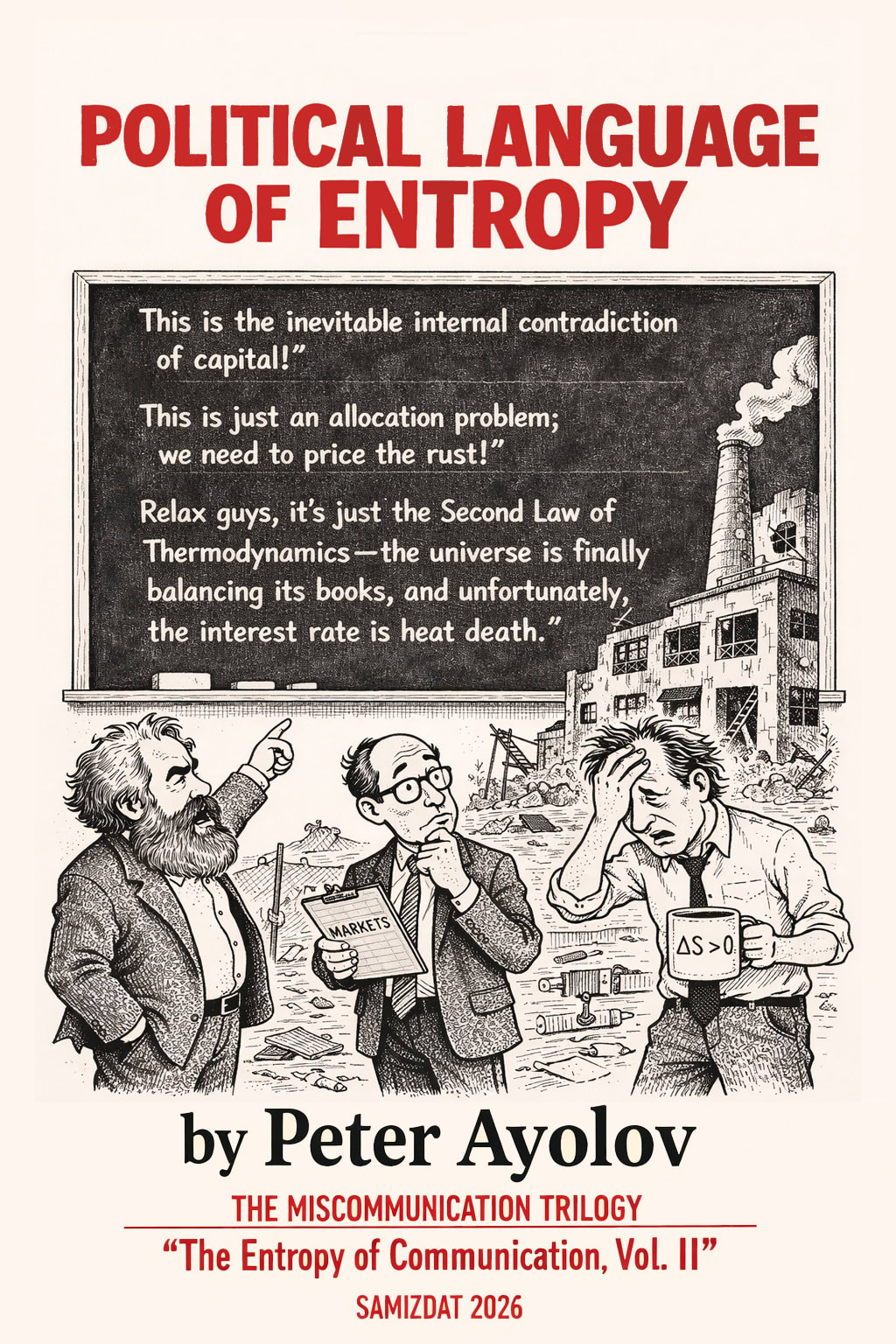
Review-Political Language of Entropy
Civilisation and the Entropy of Speech: When Political Language Wears Out
Political Language of Entropy is a sweeping intellectual exploration of the gradual degradation of political discourse in modern societies. Situated within a broader theoretical framework that examines communication as a dynamic system subject to historical and structural pressures, the book offers a profound reflection on how language—once the principal medium through which societies organised power, law, and collective identity—can slowly lose its capacity to stabilise meaning. The central thesis is disarmingly simple yet philosophically rich: political language, like any complex symbolic system, is vulnerable to entropy. As words circulate through institutions, media networks, ideological conflicts, and digital platforms, they accumulate layers of competing interpretations until their semantic coherence begins to dissolve.
The work approaches this problem not merely as a linguistic curiosity but as a civilisational phenomenon. Modern societies communicate more intensely than any previous civilisation in history. Political speeches, media commentary, online debates, institutional reports, academic discourse, and algorithmically amplified social media content create an environment of permanent communication. Yet this abundance of speech does not necessarily produce greater understanding. On the contrary, the book suggests that the expansion of communication systems often produces the opposite effect: the multiplication of messages generates semantic overload, transforming language from a medium of clarification into a field of noise. Political Language of Entropy therefore proposes a paradox at the heart of contemporary culture. The more societies speak, the less they appear capable of understanding themselves.
One of the book’s major strengths lies in the breadth of its intellectual scope. Rather than limiting itself to contemporary politics, the analysis unfolds across a long historical arc that stretches from mythological thought to digital communication. The early chapters explore how ancient societies used myth as a symbolic language through which communities organised their relationship with nature, the divine, and social hierarchy. Drawing on thinkers such as Ernst Cassirer, the book shows how myth functioned as a powerful system of symbolic integration. Rituals, narratives, and shared cosmologies created a framework in which collective life could be interpreted as part of a coherent order. Myth did not simply describe the world; it structured experience and gave meaning to social existence.
From this starting point the narrative traces the transition from mythos to logos, the classical Greek movement toward rational explanation and philosophical inquiry. Greek thinkers gradually replaced mythological storytelling with the search for universal principles governing nature and society. The emergence of rational discourse, exemplified by philosophers such as Thales, Heraclitus, and Socrates, marked the beginning of a new intellectual tradition in which political order could be analysed rather than merely narrated. Yet the book avoids presenting this transformation as a simple triumph of reason over superstition. Instead, it emphasises that myth never entirely disappeared. Symbolic narratives continued to shape political imagination even within societies that celebrated rational inquiry.
This historical sensitivity allows the book to frame modern political language within a much deeper cultural context. The medieval period, for example, is presented as an era in which political authority was embedded within a theological cosmology. The state did not merely administer territory; it participated in a divine order that linked earthly institutions with transcendent authority. Augustine’s reinterpretation of Platonic philosophy illustrates how classical metaphysics was absorbed into Christian theology, transforming the idea of the ideal state into a reflection of divine providence. Political language in this period therefore carried a sacred dimension. Words such as order, justice, and authority were anchored in metaphysical beliefs that provided them with stable meaning.
The emergence of modern political thought gradually altered this symbolic landscape. Thinkers such as Machiavelli introduced a more secular understanding of power, describing political action in terms of strategy, necessity, and the management of conflict. In this new framework the language of politics began to detach itself from theological certainty and align more closely with pragmatic considerations of statecraft. Yet the shift toward realism did not eliminate the symbolic dimension of political language. Instead, it created new forms of myth, often embedded within ideological narratives that justified the actions of modern states.
A particularly compelling aspect of the book is its exploration of political deception. Drawing on analyses of international relations, the author examines how leaders manipulate language to mobilise public opinion or conceal strategic intentions. The discussion of political lying illustrates how deception functions not as an occasional aberration but as a recurring feature of political communication. Governments frequently mislead their own citizens in order to justify policies that might otherwise face resistance. In democratic societies this practice introduces a dangerous tension between the rhetoric of transparency and the reality of strategic narrative construction.
Yet the book does not simply condemn political deception as a moral failing. Instead, it situates deception within the structural conditions of international politics. States operate in an environment characterised by uncertainty, competition, and the absence of a central authority capable of enforcing rules. Within such a system leaders often perceive deception as a necessary instrument of survival. The ethical dilemma lies in the fact that strategies designed to protect national interests may simultaneously erode public trust. When governments repeatedly manipulate information, citizens begin to doubt the credibility of political language itself. The resulting cynicism contributes directly to the entropic process described throughout the book.
The analysis of language and nationalism offers another important dimension of the work. Debates about linguistic identity reveal how language functions as a marker of belonging and exclusion within modern states. The book examines how societies often construct myths of linguistic homogeneity even when historical evidence demonstrates persistent multilingual diversity. Language becomes a symbolic boundary through which communities define the limits of national identity. In this context political campaigns defending a dominant language often express deeper anxieties about immigration, cultural change, and shifting social hierarchies.
These themes lead naturally to the book’s central theoretical contribution: the concept of the planned obsolescence of political language. Borrowing an analogy from industrial production, the author argues that political vocabularies are constantly consumed and replaced. Words such as democracy, reform, security, and justice circulate through ideological conflicts until their meanings become saturated with contradictory interpretations. Once a concept loses credibility, political actors introduce new expressions designed to capture the same symbolic territory. Yet these replacements quickly follow the same trajectory toward semantic exhaustion. Political language thus becomes trapped in a cycle of continuous consumption.
This argument resonates strongly with contemporary debates about media and digital communication. In the modern communication environment messages travel at unprecedented speed through networks designed to maximise engagement rather than comprehension. Algorithms amplify emotionally charged content because outrage, fear, and moral condemnation attract attention. Political language adapts to these incentives by becoming shorter, more dramatic, and more polarised. Nuance disappears, replaced by slogans optimised for rapid circulation. The book’s description of political discourse as a system drifting toward entropy therefore captures an important aspect of the digital age.
Another striking element of the analysis is its attention to the relationship between knowledge and language. Scientific revolutions, the book suggests, reveal a similar dynamic of conceptual transformation. Drawing on the philosophy of science, the author describes how established paradigms eventually reach a point of crisis when existing vocabularies can no longer adequately explain new phenomena. At such moments scientific communities develop new conceptual frameworks that reorganise knowledge. Political language, however, rarely undergoes such systematic renewal. Instead it accumulates layers of rhetorical usage without establishing stable criteria for conceptual revision. The result is a discursive environment where words retain their emotional power even as their explanatory value declines.
The later sections of the book extend this analysis to contemporary forms of economic and technological power. Concepts such as surveillance capitalism, audit culture, and algorithmic governance illustrate how language continues to shape the interpretation of social reality. Institutions produce elaborate vocabularies that describe their activities in neutral or technical terms, masking the underlying political implications. Corporate platforms collect behavioural data while presenting themselves as providers of digital services. Bureaucratic systems generate endless reports and metrics that create the appearance of rational administration while often obscuring the real dynamics of power.
Despite its critical tone, Political Language of Entropy does not lapse into pessimism. The author repeatedly emphasises that entropy is not simply a story of decline. It also reveals the limits of symbolic systems and invites reflection on how language might be renewed. Political communication cannot function without shared concepts capable of mediating disagreement. The challenge facing modern societies is therefore not to abandon political language but to recognise the forces that erode its credibility. Understanding these forces may create the conditions for a more reflective and responsible use of words.
Stylistically the book combines philosophical argument with historical narrative and cultural analysis. The prose often moves fluidly between intellectual history and contemporary observation, creating a sense that the crisis of political language emerges from long-term transformations rather than sudden disruption. Readers encounter discussions of ancient mythology alongside reflections on digital media, illustrating how symbolic systems evolve across centuries. This interdisciplinary approach makes the book accessible to a wide audience while preserving the analytical depth expected of serious political theory.
For scholars of communication, political philosophy, and cultural studies, the book offers a valuable conceptual framework for understanding the transformation of public discourse. It invites readers to reconsider familiar political terms not as neutral descriptors but as contested symbolic instruments. Words that appear stable in everyday usage may conceal complex histories of ideological struggle and semantic drift. Recognising this instability is essential for interpreting contemporary political debates, where the same vocabulary often carries radically different meanings for different audiences.
At the same time, the book raises broader philosophical questions about the relationship between language and reality. If political speech becomes increasingly detached from stable meaning, what remains of democratic deliberation? Can societies sustain shared institutions when the words that describe those institutions lose credibility? These questions extend beyond the boundaries of political science into the realms of philosophy, sociology, and media theory. The crisis of political language becomes a symptom of a deeper cultural transformation in which communication itself has become an autonomous system, circulating messages without guaranteeing understanding.
Political Language of Entropy therefore deserves attention not only as a critique of contemporary rhetoric but also as a meditation on the future of communication in complex societies. By tracing the historical evolution of political speech and analysing the structural forces that shape its transformation, the book provides a powerful lens through which to examine the current condition of public discourse. Its central insight—that political language can become exhausted through its own success—offers a provocative explanation for the growing sense that modern politics speaks endlessly yet says increasingly little.
In the end the book leaves readers with an unsettling but necessary reflection. Civilisations rely on language to organise power, coordinate action, and imagine collective futures. When that language begins to wear out, the stability of the entire political order may come into question. Political Language of Entropy invites readers to confront this possibility and to recognise that the health of democratic life depends not only on institutions and laws but also on the fragile symbolic systems through which societies understand themselves.
About the Creator
Peter Ayolov
Peter Ayolov’s key contribution to media theory is the development of the "Propaganda 2.0" or the "manufacture of dissent" model, which he details in his 2024 book, The Economic Policy of Online Media: Manufacture of Dissent.
Keep reading
More stories from Peter Ayolov and writers in BookClub and other communities.
THE ENTROPY OF COMMUNICATION, THE MISCOMMUNICATION TRILOGY, “The Entropy of Communication, Vol. II”, part 3
Review-The Entropy of Communication Civilisation Against Language: A Review of The Entropy of Communication Modern civilisation prides itself on an unprecedented abundance of communication. Messages travel across continents in seconds, political speeches are instantly translated into global narratives, and statistical graphs promise to transform complex realities into clear visual truths. Yet this immense expansion of communicative capacity has not produced a parallel increase in understanding. Instead, a paradox has emerged: the more language circulates, the more uncertain meaning becomes. The Entropy of Communication confronts this paradox directly and develops a sweeping diagnosis of the crisis of language in contemporary public life.
By Peter Ayolovabout 8 hours ago in BookClub
7 Books With Multiple Endings You Should Read in 2026
In the ever-evolving world of literature, books with multiple endings offer readers a unique blend of storytelling, interactivity, and intellectual engagement. Unlike traditional narratives with a single conclusion, these books allow readers to explore alternative storylines, make choices that influence outcomes, and even uncover hidden layers of meaning. If you've ever wondered what it’s like to hold the fate of a character in your hands, these books provide an unparalleled literary adventure.
By Diana Meresc2 days ago in BookClub



Comments
There are no comments for this story
Be the first to respond and start the conversation.