
Kashmir’s Silent Waters
Once a symbol of serenity and life, Srinagar’s iconic Dal Lake now mirrors anxiety, uncertainty, and the fading rhythm of a troubled paradise

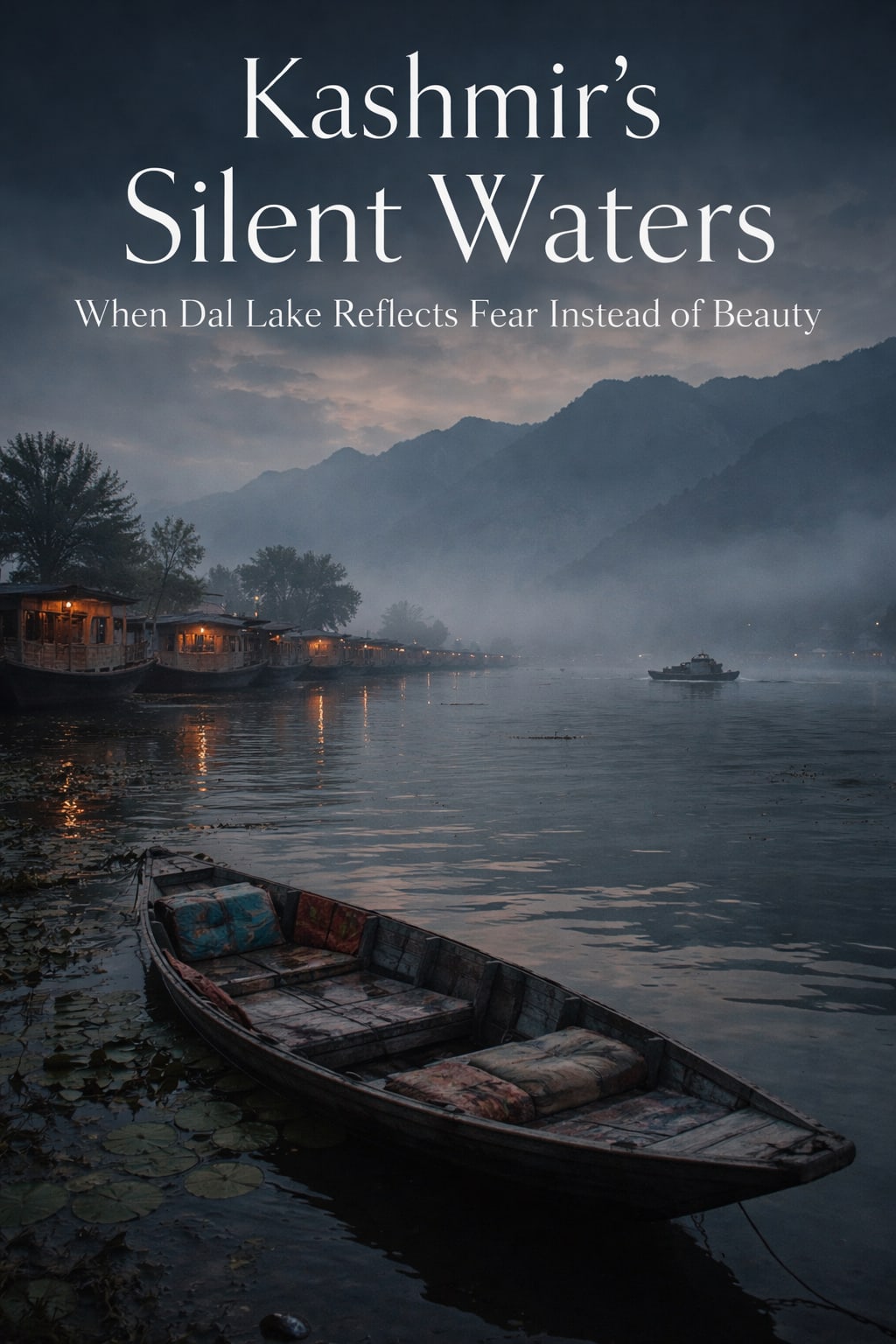
For centuries, Dal Lake has been the beating heart of Kashmir—a place where shimmering waters, floating gardens, and wooden houseboats created an image of timeless beauty. Tourists once described it as paradise on earth, a peaceful retreat nestled within the majestic Himalayas. But today, many locals whisper a different story. “I have never seen Dal Lake this sad and fearful,” says a longtime resident of Srinagar, capturing a sentiment that has quietly spread across the region.
The lake, usually alive with the gentle paddling of shikaras and the cheerful chatter of visitors, has taken on an eerie stillness. The colorful boats, once symbols of Kashmiri culture and hospitality, now sit idle for long stretches of time. Their owners, many of whom depend entirely on tourism, face growing uncertainty as fewer travelers arrive. The absence of laughter and life has turned the lake into a silent witness to the anxieties gripping the valley.
Much of this unease stems from the region’s long-standing political tensions. Kashmir has witnessed decades of conflict, shifting policies, and a heavy security presence that often disrupts everyday life. While there have been periods of relative calm, sudden changes in the situation can quickly alter the mood of the entire region. Restrictions, communication blackouts, and heightened security measures have, at times, made residents feel cut off from the outside world.
For those who live and work on Dal Lake, the impact is deeply personal. Houseboat owners, many of whom inherited their businesses through generations, now struggle to keep their livelihoods afloat. “Our families have lived on these waters for decades,” says one boat owner. “But now, it feels like the lake itself is losing hope.” The decline in tourism not only affects income but also erodes a way of life that has defined Kashmiri identity for generations.
The emotional toll is equally significant. Dal Lake has always been more than just a body of water—it is a symbol of memory, tradition, and belonging. Weddings, festivals, and daily routines once revolved around its shores. Children learned to row before they could ride bicycles, and elders spent evenings watching the sunset reflect off the mountains. Now, that sense of normalcy feels distant.
Environmental challenges add another layer of concern. Over the years, pollution, encroachment, and unregulated construction have threatened the lake’s ecosystem. Efforts have been made to restore its health, but progress has been slow. In times of instability, environmental priorities often take a backseat, further accelerating the lake’s decline. The once-crystal waters have, in places, become clouded, symbolizing both ecological and emotional distress.
Despite these hardships, the people of Kashmir continue to show remarkable resilience. There are still moments when the old spirit of Dal Lake shines through—when a lone shikara glides across the water at sunrise, or when a visitor pauses to take in the breathtaking view of snow-capped peaks. These glimpses of beauty serve as reminders of what the lake once was and what it could be again.
Local communities and environmental groups have also stepped forward, organizing clean-up drives and advocating for sustainable tourism. They believe that preserving Dal Lake is not just about protecting nature, but also about safeguarding a cultural heritage that defines Kashmir. Their efforts, though often overshadowed by larger political issues, reflect a deep-rooted love for the lake and a determination to keep its legacy alive.
Ultimately, Dal Lake’s sadness is not just about empty boats or fewer tourists—it is about the collective emotional state of a region longing for peace and stability. The lake, in its quiet way, mirrors the hopes and fears of the people who call Kashmir home.
As the sun sets over Srinagar, casting golden hues across the still waters, one cannot help but feel a mix of beauty and sorrow. Dal Lake remains breathtaking, but its silence speaks volumes. It is a reminder that even the most beautiful places in the world can carry the weight of uncertainty—and that behind every postcard image lies a deeper, more complex story waiting to be heard.
Make cover pic
About the Creator
Irshad Abbasi
Ali ibn Abi Talib (RA) said 📚
“Knowledge is better than wealth, because knowledge protects you, while you have to protect wealth.
Keep reading
More stories from Irshad Abbasi and writers in Chapters and other communities.
Cuba’s Unusual Offer Paying Off Debt with Rum Diplomacy
In a world driven by complex financial systems, global trade agreements, and strict monetary policies, Cuba has introduced an unconventional yet culturally rich idea: offering its renowned rum as a means to repay international debt. This proposal, while surprising at first glance, reflects both the island nation’s economic challenges and its creative approach to navigating them.
By Irshad Abbasi about 8 hours ago in Chapters
Life will find a way
One cocoon twitches; my screaming must have disturbed it. It’s followed by a sound like the shaking of a cobra’s tail. A dry rattle sends a shiver down my spine. The rest of the cocoons respond the same way, as if communicating with one another; the cave fills with rattling. The glow becomes stronger as they vibrate and bathes the cave floor in an eerie blue light.
By N J Delmasa day ago in Chapters
A Land Where All Things Always Seemed The Same, Chapter Three
A monorail train glided by overhead and Mini-Flash Juniper followed its track, keeping the high concrete struts to one side and letting the line lead her seaward. Here lay a manmade watercourse lit by brighter orbs than those behind, and by the ramp that led to the gate which was Mini-Flash Juniper’s destination, some sort of indoor sports complex glowed.
By Doc Sherwoodabout 14 hours ago in Chapters
Microsoft's Purposeful Marketing Deception About AI's Ability To Beat Physicians In Diagnosis
When you look at the world of scientific research... If you are not careful... You will be fooled into believing things that are not actually supported by the data.
By Dr. Cody Dakota Wooten, DFM, DHM, DAS (hc)5 days ago in Longevity


Comments
There are no comments for this story
Be the first to respond and start the conversation.