
Wheat and weeds, Part 2
Or, in shorter words, creating an aura of authority without exposing the weakness of the source for a video, who wants to be, {as it were possible something like that!}, a destroyer of faith and of Christians in general.

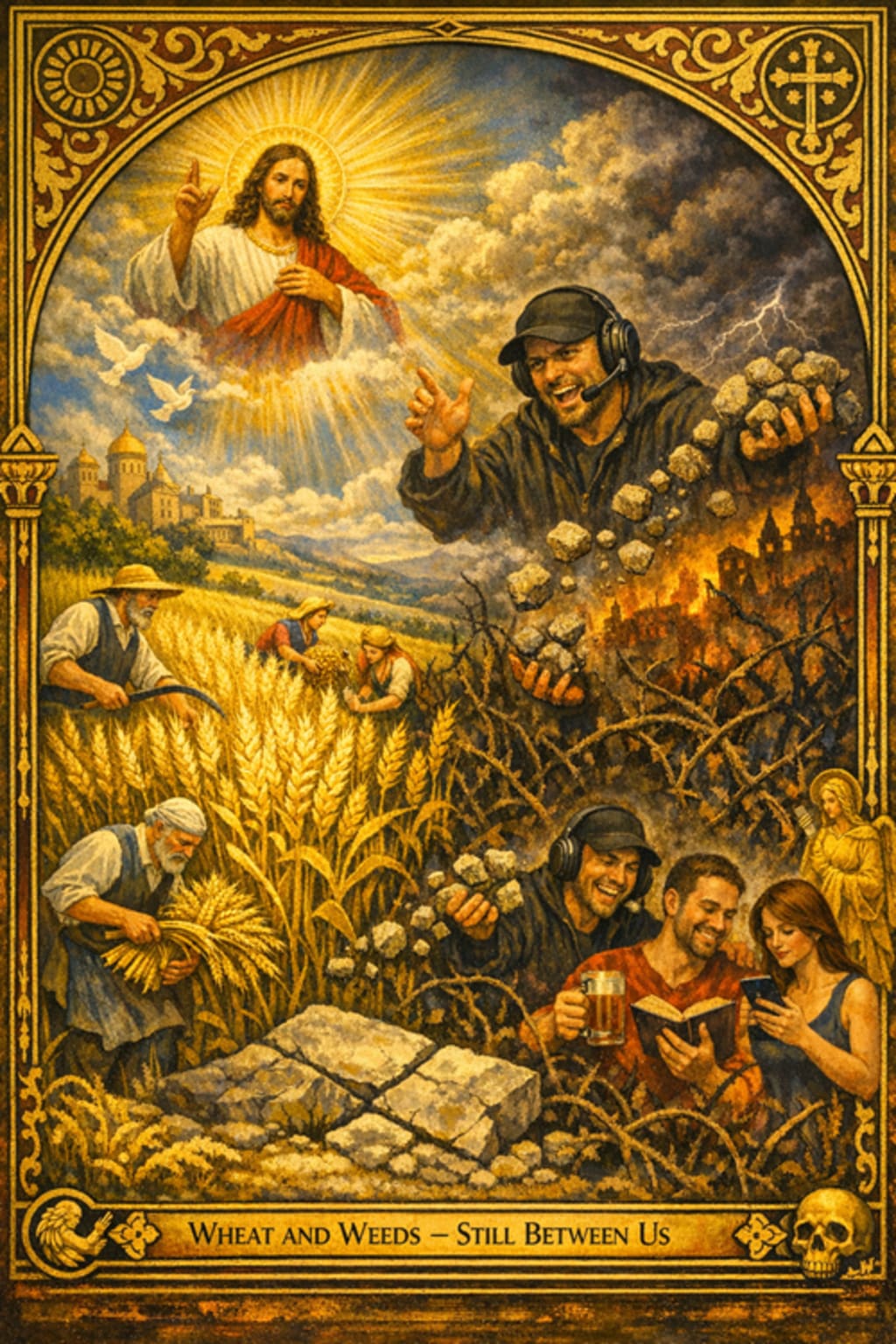
Why Epiphanius looks “clean” online but sounds extreme in the video
Epiphanius lived in the 4th century, long after Jesus, long after Paul, and long after the earliest Christian communities. By his time, Christianity had become institutionalized, and the Church was trying to define orthodoxy and eliminate competing interpretations.
Epiphanius wrote a massive work called Panarion, which literally means “medicine chest.” He believed he was giving the Church “antidotes” against heresies. To do that, he described 80 different groups — some real, some exaggerated, some misunderstood — and he portrayed them in the worst possible light.
This is why his writing is full of:
- accusations of sexual immorality
- accusations of cannibalism
- accusations of magic
- accusations of bizarre rituals
- accusations of blasphemy
This was a standard rhetorical style in antiquity. Pagans accused Christians of the same things. Christians accused pagans. Gnostics accused orthodox Christians. Orthodox Christians accused Gnostics.
It was the ancient version of political smear campaigns. So when someone reads Wikipedia, will get the “official biography” of a saint. When a person read Panarion, will see and get the raw polemics of a man trying to destroy rival groups. Both are true — but they serve different purposes.
No one “corrected” Epiphanius. So, there will appear the expected question: why not? The speaker in the video says:
“If Epiphanius was wrong, someone would have written against him.”
This sounds logical, but it misunderstands how ancient writing worked. Here’s the reality:
- Most writings from antiquity are lost. We only have a tiny fraction of what was written.
- Heretical groups didn’t have the power to preserve their books. The Church controlled copying, libraries, and manuscript survival.
- If a group died out, no one was left to defend them.
- The Church had no interest in preserving rebuttals to its own polemics.
So the absence of a rebuttal doesn’t mean Epiphanius was accurate. It simply means the people he attacked didn’t survive long enough — or didn’t have the institutional power — to preserve their side of the story. This is why modern scholars treat Epiphanius with caution. He is a source, but not a neutral on. So not entirely reliable!
When he describes the Borborites and related sects as engaging in sexual rituals, consuming bodily fluids, or even using aborted fetuses in rites, we are reading a hostile, late, theological attack, not courtroom evidence. The only sources we have for the Borborites are Epiphanius and Theodoret, both opponents of the group, and modern reference works explicitly warn that it is difficult to know their actual practices because our only witnesses are their enemies. The video I watched takes Epiphanius’ most lurid accusations and treats them as if they were straightforward reportage about “what early Christians did.” That is not how historians read him.
Serious scholars treat his descriptions as a mixture of possible kernels of truth, misunderstanding, rumor, and deliberate demonization. The fact that we don’t have surviving rebuttals from the groups he attacked proves nothing; most ancient texts are lost, and heretical groups had little power to preserve their own writings once orthodoxy controlled copying and libraries.
So what’s real, what’s hypothesis, and what’s false?
Ok, Epiphanius is a real historical figure, and his book Panarion is a real source. He genuinely describes groups like the Borborites, Sethians, and Nicolaitans. But his descriptions are not objective reporting. They are polemical attacks written by a bishop who wanted to portray these groups as dangerous, immoral, and spiritually corrupt. Modern scholars recognize that he often exaggerated, misunderstood, or repeated rumors. Some of what he says may contain a kernel of truth, but much of it is shaped by his agenda.
So when the video uses Epiphanius as if he were a neutral historian describing “what early Christians really did,” it is misusing the source. Epiphanius is describing fringe sects from the second to fourth centuries, not the original followers of Jesus. And even then, he is describing them through the lens of hostility.
The fact that Wikipedia presents him as a saint and a Church Father doesn’t contradict this. It simply reflects the way the Church remembers him — as a defender of orthodoxy. But being a defender of orthodoxy does not make someone a reliable reporter of what their enemies believed or practiced.
**********************************************************************
Now, about the Eleusinian Mysteries and psychedelics. The Eleusinian Mysteries were indeed one of the most important religious cults in the Greek world, centered on Demeter and Persephone near Athens. Initiation was prestigious; many famous figures of classical antiquity were said to have been initiated. The drink called kykeon is mentioned in ancient sources. Modern scholars have debated whether it contained psychoactive substances such as ergot derivatives or other plant‑based psychedelics.
This is where Brian Muraresku’s book “The Immortality Key” comes in: it argues that there is archaeological and chemical evidence for psychoactive components in some ancient ritual beverages, and that such practices may have influenced later religious traditions. But this is a hypothesis, not a consensus. The core facts — that Eleusis was important, that initiation was secret, that initiates claimed a transformed view of death — are well attested. The specific claim that the Mysteries were definitively psychedelic in the modern sense remains debated.
The video then tries to draw a line from Eleusis to Christianity: salvation language, a blessed afterlife (Elysium vs. heaven), ritual meals, and so on. It is true that Greek and Roman religious ideas about the afterlife, Hades, Tartarus, and Elysium were part of the cultural air of the Mediterranean world, and that some New Testament imagery (for example, the parable of the rich man and Lazarus with a chasm between places of torment and comfort) resonates with that broader cosmological imagination. But similarity of imagery does not mean direct borrowing, and certainly not identity.
Judaism had its own evolving ideas about Sheol, resurrection, judgment, and the world to come, and early Christianity grew out of that Jewish matrix. The claim that “salvation” as a concept is “definitely credited” to the Eleusinian Mysteries is an overstatement. Salvation language in Christianity is deeply rooted in the Hebrew Bible: deliverance from enemies, from sin, from exile, from death. The Greek world had its own soteriological themes, but that does not erase the Jewish roots of Christian soteriology.
The same pattern appears in the discussion of early Christian art. It is true that some of the earliest surviving images of Jesus in the Roman catacombs show him as a youthful, beardless figure performing miracles, sometimes with what looks like a staff or rod in his hand. These images are usually interpreted as Christ the Good Shepherd, Christ healing, or Christ raising Lazarus. In late antique art, miracle‑workers, philosophers, and even Moses are sometimes depicted with a staff or rod as a symbol of authority or power. Some modern writers have called this a “magic wand,” but that is a modern label.
The fact that Jesus is shown with a rod in some third‑century frescoes does not mean early Christians thought of him as a Dionysian magician. It means they used the visual language available in their culture to express his power. The video takes a real artistic detail and loads it with speculative meaning.
The claim that early Christians depicted Jesus with a “magic wand” because he was a magician like Dionysus;
This is historically incorrect. The rod in early Christian art is a standard late‑antique symbol of miracle‑working, used for Moses, philosophers, teachers, and healers. It is not a Dionysian thyrsus. It is not a wand in the modern sense. Art historians such as Fabrizio Bisconti (Pontifical Commission for Sacred Archaeology) and Robin Jensen (Notre Dame) explain this clearly. The video confuses shared artistic vocabulary with shared theology, which is a basic methodological error.
The pine cone and pineal gland connection is another example. Yes, the thyrsus of Dionysus is often depicted with a pine cone at the top. Yes, the pineal gland is named for its pine‑cone‑like shape. Yes, ancient anatomists like Galen dissected bodies and described internal organs in considerable detail, and Galen’s medical writings were enormously influential for many centuries. But there is no ancient text that explicitly links the thyrsus to the pineal gland as an inner “wand.” That is a modern esoteric speculation. It might be poetically suggestive, but it is not historically grounded.
The video also makes sweeping claims about the so‑called Dark Ages and Christianity “causing” a thousand‑year intellectual blackout. This is another area where modern scholarship is much more nuanced. The term “Dark Ages” is now widely criticized because it oversimplifies a complex period. While it is true that the classical Greco‑Roman world produced an extraordinary burst of philosophical and literary creativity, and that many classical texts were lost or neglected in parts of Western Europe after the fall of the Western Roman Empire, it is also true that Christian monasteries preserved a great deal of classical literature, that Byzantine and Islamic scholars transmitted and commented on Aristotle, Galen, and others, and that there were important intellectual developments in medieval theology, law, and science. To say “Christianity caused the Dark Ages” is a polemical slogan, not a balanced historical judgment.
If we zoom out, a pattern emerges. The video takes real elements — Gnostic sects described by Epiphanius, the Eleusinian Mysteries and kykeon, early catacomb art, the brutality of Roman warfare and famine, the existence of psychedelics, the preservation and loss of ancient texts — and then strings them together into a narrative that implies: Jesus was basically a psychedelic mystery‑cult magician; Christianity is just a repackaged pagan mystery religion; Yahweh is a lower or evil deity; and the Church then suppressed all this and plunged the world into darkness.
That narrative is emotionally powerful, especially if you already feel suspicious of institutional religion, but it is not how mainstream historians, classicists, or biblical scholars read the evidence. What is real is that the ancient Mediterranean was a religiously and intellectually diverse world. Jews, Greeks, Romans, Egyptians, and many others interacted, borrowed imagery, argued, and sometimes blended ideas. Mystery cults like Eleusis and Samothrace were important. Philosophical schools like Stoicism and Platonism shaped the intellectual climate.
Gnostic movements arose in the second century and offered alternative mythologies and interpretations of Jesus. Church Fathers like Epiphanius fought those movements fiercely and sometimes unfairly. Early Christian art used the visual vocabulary of its time. Medical writers like Galen and historians like Eusebius preserved fragments of older works that would otherwise be lost. Much has been lost; much survives only indirectly. All of that is true.
What is speculative is the attempt to turn Jesus into a direct product of Eleusinian psychedelics, or to claim that Christian salvation is simply a copy of Elysium, or that early Christians secretly practiced the kinds of sexual‑ritual Eucharists Epiphanius attributes to the Borborites. There is no direct evidence for Jesus using psychedelics, no evidence that the apostles were initiated at Eleusis, and no evidence that mainstream Christian communities practiced the kinds of rites Epiphanius describes. Those ideas are modern reconstructions built on suggestive parallels, not on hard data.
What is misleading or simply wrong are claims like “Yahweh is just Dionysus,” “no one knew Moses before 300 BCE,” “early Christians believed Yahweh was Satan,” or “Epiphanius proves that Christianity was originally a sex‑magic cult.” Those go beyond speculation into distortion.
So where does that leave the Christians and their belief? It means no one is wrong to trust that Christianity has deep Jewish roots, that Jesus was a first‑century Jewish teacher, that the New Testament reflects a real historical movement, and that later fringe groups and hostile polemicists do not define the core of the faith. It also means that no one should be afraid to learn about Gnosticism, mystery cults, or the messy history of how texts survived. None of that automatically “destroys” Christianity. It just shows that God, if any of you readers believe in God, has always worked in a very complicated human world.
******************************************************************
©Ca De Luce> MINDFUL MIND Medium Blog 2025. Unauthorized use of text or media is not allowed. All images and photo are fulfilling the copyrights regulations. Much obliged to you all!
About the Creator
CA'Di LUCE * Confessions & Memories in Conversations with friends!/ It’s not a revolution—it’s a quiet evolution.
I speak of spirit, soul, and flame,
Of humanity’s quest, our endless aim.
*Please, support this author, effortless for you:
https://buymeacoffee.com/ca_de_luce_blog/
https://ko-fi.com/cadeluce/
.
Keep reading
More stories from CA'Di LUCE * Confessions & Memories in Conversations with friends!/ It’s not a revolution—it’s a quiet evolution. and writers in Confessions and other communities.
Ways To Nourish The Soul
No one matters. Children or young people out there, you will learn this later, but it's better to learn this now, is self-confidence. It does not matter what anyone thinks of you. What does matter is what your parents think of you, what your best friend only thinks of you, what your siblings think of you, and what you think of yourself. There's maybe like five people on that list. No one matters. Your happiness is in your own hands. You cannot get it from anywhere else. Only you have the power. Remember to be kind. Be the one that is the savior of the bullies. Be the one that is confident to go without makeup somewhere or didn't get time to dress up and go to a party. Enjoy the moment. Don't care about what you're wearing and who thinks what you are because I swear to God when you're older, you'll be like, what was I doing? You have your whole life to be a grown-up. Enjoy being young. Enjoy being silly. Enjoy not getting dressed and makeup. Spend time in nature. Take up a sport. You must play a sport, an instrument, and teach the adults who have missed out on that life because your adults did live that life, but they've also gotten into this Insta life and this like technological life. So you kids remind your parents, hey, come on, let's go to the beach. Let's go to the mountains. Let's do some nature activities. Go spend time in charities. Give your time to charity. Go to SOS village. Go give your time to underprivileged kids. These are all really nourishing for your soul and you will be so happy that you did this because at the end, peace and happiness is all you want. So find that within yourself and never care about what anyone thinks of you. Be kind, be honest, and have fun.
By Ibrahim Shah 4 days ago in Confessions



Comments
There are no comments for this story
Be the first to respond and start the conversation.