
Hormuz on Fire
Rising tensions between Iran, Israel, and the United States place the world’s most critical oil route at the center of a dangerous geopolitical crisis.

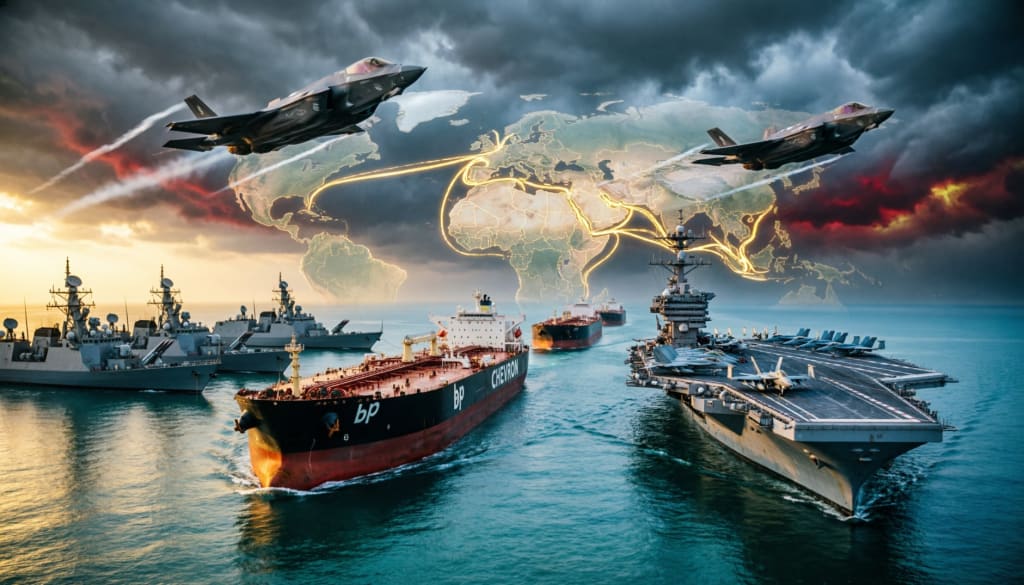
Hormuz on Fire
The narrow waters of the Strait of Hormuz have once again become one of the most dangerous flashpoints on Earth. Located between Iran and the Arabian Peninsula, this strategic passage connects the Persian Gulf to the Gulf of Oman and ultimately to the global ocean. Though small in size, the strait carries enormous global importance. Nearly one-fifth of the world’s oil supply passes through this narrow corridor every day.
Today, that vital lifeline is under threat.
Escalating tensions between Iran, Israel, and the United States have raised fears that the region could slide toward a wider conflict. Military activity in and around the Persian Gulf has increased dramatically. Warships patrol the waters, fighter jets monitor the skies, and international shipping companies are watching the situation closely.
For global energy markets, the stakes could not be higher.
Why the Strait Matters
The Strait of Hormuz is often described as the most important energy chokepoint in the world. Oil tankers carrying millions of barrels of crude oil pass through it daily on their way to international markets. Major oil-producing countries—including Saudi Arabia, Iraq, Kuwait, and the United Arab Emirates—rely heavily on this route to export their energy.
If shipping through the strait were disrupted, even temporarily, global oil prices could surge dramatically.
The economies of countries like China, India, and Japan depend heavily on oil transported through these waters. Any disruption could ripple across industries worldwide—from transportation and manufacturing to food prices and inflation.
A Strategic Pressure Point
For Iran, the Strait of Hormuz represents a powerful strategic lever. Because of its geographic position along the northern coast of the strait, Iran has the capability to influence shipping movements in the region.
Over the years, Iranian leaders have repeatedly warned that if their country faces major military pressure or economic isolation, the strait could become a battleground. Such warnings have raised concern among global leaders and energy analysts.
For the United States and its allies, keeping the shipping route open is a top priority. The United States maintains a strong naval presence in the region, working with international partners to ensure freedom of navigation through the Gulf.
Israel, meanwhile, views Iran’s growing military capabilities as a major regional threat and has closely aligned with the United States on security concerns in the Middle East.
The Risk of Escalation
The current crisis highlights how quickly regional tensions can escalate into a global concern. A single attack on a tanker, a naval confrontation, or a missile strike could spark a chain reaction of military responses.
Even rumors of conflict can trigger panic in oil markets. Investors and traders react quickly to any sign that shipping lanes might be threatened. When tensions rise in the Strait of Hormuz, oil prices often follow.
Beyond economics, there is also the fear of a broader regional war. The Middle East already faces multiple rivalries and conflicts. If direct fighting were to break out between Iran and the United States or Israel, other regional actors could become involved.
A Global Concern
The world’s dependence on energy has turned the Strait of Hormuz into one of the most strategically important locations on the planet. What happens in this narrow waterway can affect economies thousands of miles away.
For now, international leaders are urging diplomacy and restraint. But the growing tension in the Persian Gulf shows how fragile global stability can be when energy security and geopolitical rivalry collide.
The waters of Hormuz remain calm on the surface—but beneath them lies the potential for a crisis that could reshape global politics and the world economy.
About the Creator
Wings of Time
I'm Wings of Time—a storyteller from Swat, Pakistan. I write immersive, researched tales of war, aviation, and history that bring the past roaring back to life
Keep reading
More stories from Wings of Time and writers in Earth and other communities.
The Rise of Military Artificial Intelligence
The Rise of Military Artificial Intelligence In today’s rapidly changing world, one of the most important developments in global affairs is the rise of Artificial Intelligence in military systems. Many powerful countries are investing billions of dollars into AI technology to strengthen their defense capabilities and gain strategic advantages over their rivals. This new technological race is not only changing how wars are fought, but it is also reshaping the balance of global power.
By Wings of Time 12 days ago in Earth
Heavy Snow Warning: When Winter Turns Dangerous Overnight
A quiet winter evening can quickly turn into something far more serious. The sky grows darker, the wind sharpens, and snow begins falling faster than anyone expected. What starts as a peaceful snowfall can suddenly lead to closed roads, power outages, and difficult travel conditions. This is when a heavy snow warning becomes more than just a weather alert. It becomes a signal that daily life may soon slow down or even stop. For many communities, these warnings bring both beauty and concern. Snow can cover the world in silence, but it can also create dangerous conditions if people are not prepared. Understanding what a heavy snow warning means and how it affects daily life can help individuals and families stay safe when winter becomes unpredictable.
By Muqadas khan7 days ago in Earth


Comments
There are no comments for this story
Be the first to respond and start the conversation.