
How to Determine If Your Biochar is High Quality: A Guide to the Key Indicators
What is "Good" Biochar? A Practical Guide

Biochar production is surging in popularity, driven by its applications in agriculture, carbon sequestration, and industrial filtration. However, not all biochar is created equal. If you have just pulled a batch from your kiln or received a shipment from a supplier, how can you tell if it is actually high quality?
While laboratory analysis provides the most accurate data, understanding the core indicators of biochar quality helps you select the right material for your specific needs. Whether you intend to use it as a soil amendment, a livestock feed additive, or a filtration medium, here are the five critical parameters you need to know.
1. Fixed Carbon Content: The Energy and Structure Backbone
What it is:
Fixed carbon is the solid combustible residue that remains after volatile materials are driven off. It represents the actual "char" content of the biochar.
Why it matters:
The higher the fixed carbon content, the more stable the biochar. For energy applications (like using biochar as a fuel or in metallurgy), a high fixed carbon percentage means a higher calorific value and longer burn time. For soil applications, high fixed carbon indicates a greater potential for long-term carbon sequestration, as it is the fraction most resistant to microbial decomposition.
Quality Indicator: Higher is generally better. Premium biochars from modern biochar production equipment typically boast a fixed carbon content of 75% or more (on a dry ash-free basis).
2. Ash Content: The Inorganic Leftovers
What it is:
Ash is the inorganic mineral residue left after complete combustion of the biochar. It includes minerals like silica, calcium, potassium, and magnesium.
Why it matters:
While minerals can be beneficial in soil, high ash content dilutes the amount of fixed carbon. The source material heavily influences ash levels.
- Wood-based biochar usually has low ash content (1-5%).
- Grass or straw-based biochar can have moderate ash (10-20%).
- Manure or sludge-based biochar often has very high ash (30%+).
Quality Indicator: Lower is usually preferable for high-carbon applications like filtration or metallurgy. However, for soil remediation, a moderate ash content can provide valuable plant nutrients. High ash can also sometimes lead to the formation of clinkers or slag in industrial equipment.
3. pH Value: The Acid Neutralizer
What it is:
Biochar is almost always alkaline (having a pH greater than 7). During the pyrolysis process, acidic functional groups are driven off, leaving behind alkaline salts and carbonates.
Why it matters:
This alkalinity is one of the primary reasons biochar is so effective at amending acidic agricultural soils. It acts as a liming agent, raising the pH of the soil to levels more suitable for crop growth.
- Low-temperature biochars (around 400-500°C) may have a pH between 7 and 8.
- High-temperature biochars (600°C+) can have a pH as high as 9 or 10.
Quality Indicator: There is no "good" or "bad" pH; it depends on your soil. If you are treating acidic soil, a higher pH is beneficial. If you are applying it to alkaline soil, you may need a lower-temperature biochar or a different amendment entirely.
4. Specific Surface Area: The Microscopic Sponge
What it is:
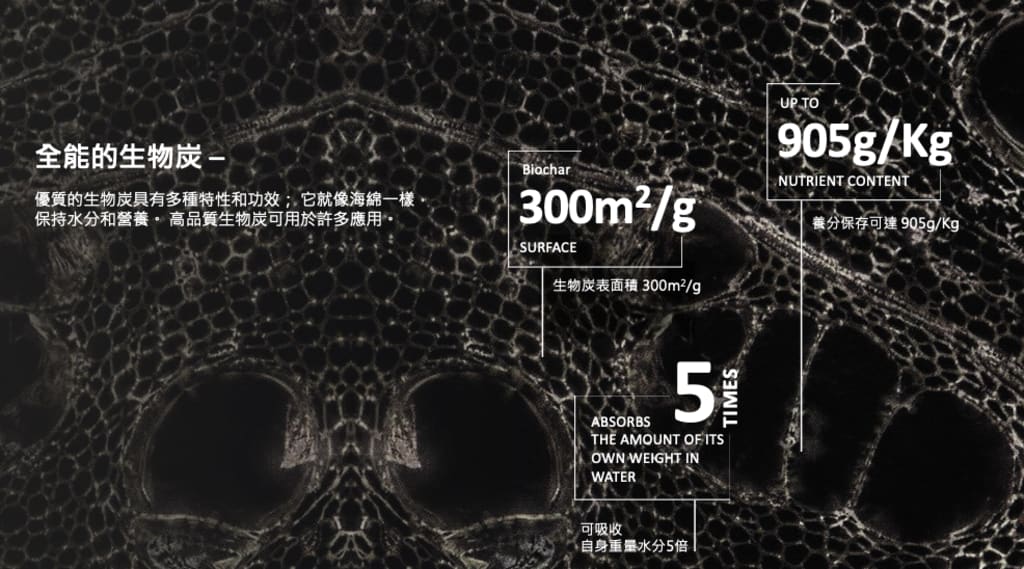
This measures the total surface area of all the particles and pores within a gram of biochar. It is typically expressed in square meters per gram (m²/g) . To put it in perspective, one gram of high-quality biochar can have a surface area equivalent to a football field.
Why it matters:
This is the most critical indicator for adsorption capacity. The porous structure allows biochar to trap water, nutrients, heavy metals, and pollutants. A high surface area means more sites available for adsorption.
Standard biochar: 50 – 200 m²/g.
High-quality activated biochar: 500 – 1500 m²/g.
Quality Indicator: Higher is better if you are using biochar to filter water, retain soil nutrients (to prevent leaching), or remediate contaminated land. The standard test for this is the BET (Brunauer-Emmett-Teller) method.
5. Water Holding Capacity (WHC): The Drought Defender
What it is:
This measures the amount of water a given volume of biochar can retain against gravity.
Why it matters:
For agricultural and horticultural uses, WHC is arguably the most practical metric. When mixed into soil, biochar acts like a sponge. It absorbs excess rainwater or irrigation and holds it in the root zone, making it available to plants during dry periods. This improves soil resilience to drought and reduces the need for frequent watering.
Quality Indicator: Higher is better for agriculture. A high WHC indicates a well-developed pore structure (specifically meso-pores and micro-pores) that can store water and make it accessible to plant roots and soil microbes.
Conclusion: Matching the Metrics to the Mission
Ultimately, judging biochar quality is about fitness for purpose.
For a soil farmer, you likely want a balance of high WHC, moderate pH, and decent surface area.
For a water filtration company, you need an exceptionally high BET surface area and low ash content.
For a carbon credit project, you are most interested in high fixed carbon content to prove long-term stability.
By understanding these five key indicators—Fixed Carbon, Ash, pH, Surface Area, and Water Holding Capacity—you can move beyond simply looking at a pile of black material and start evaluating biochar as the sophisticated, engineered material it truly is.
About the Creator
Bestonpyrolysis
Engaged in waste plastic/tyre/rubber recycling, oil sludge treatment, biomass recycling, sewage sludge management and paper recycling…
https://bestonpyrolysisplant.com/
Keep reading
More stories from Bestonpyrolysis and writers in Earth and other communities.
Why Pyrolysis Oil Must Carry ISCC PLUS Certification:
As the global economy shifts toward renewable energy and circular solutions, pyrolysis oil—a liquid derived from the thermal decomposition of waste plastics, biomass, or other organic materials—has emerged as a promising alternative to fossil fuels. However, its role in sustainable energy systems comes with regulatory and ethical responsibilities. One of the most critical requirements is that pyrolysis oil must possess ISCC PLUS certification, a standard ensuring its sustainable origin and responsible use in industrial and energy applications.
By Bestonpyrolysis8 days ago in Earth
Microsoft's Purposeful Marketing Deception About AI's Ability To Beat Physicians In Diagnosis
When you look at the world of scientific research... If you are not careful... You will be fooled into believing things that are not actually supported by the data.
By Dr. Cody Dakota Wooten, DFM, DHM, DAS (hc)2 days ago in Longevity


Comments
There are no comments for this story
Be the first to respond and start the conversation.