
The Squirrel Mirror:
Altruism, Cruelty, and What Nature Tries to Teach Us

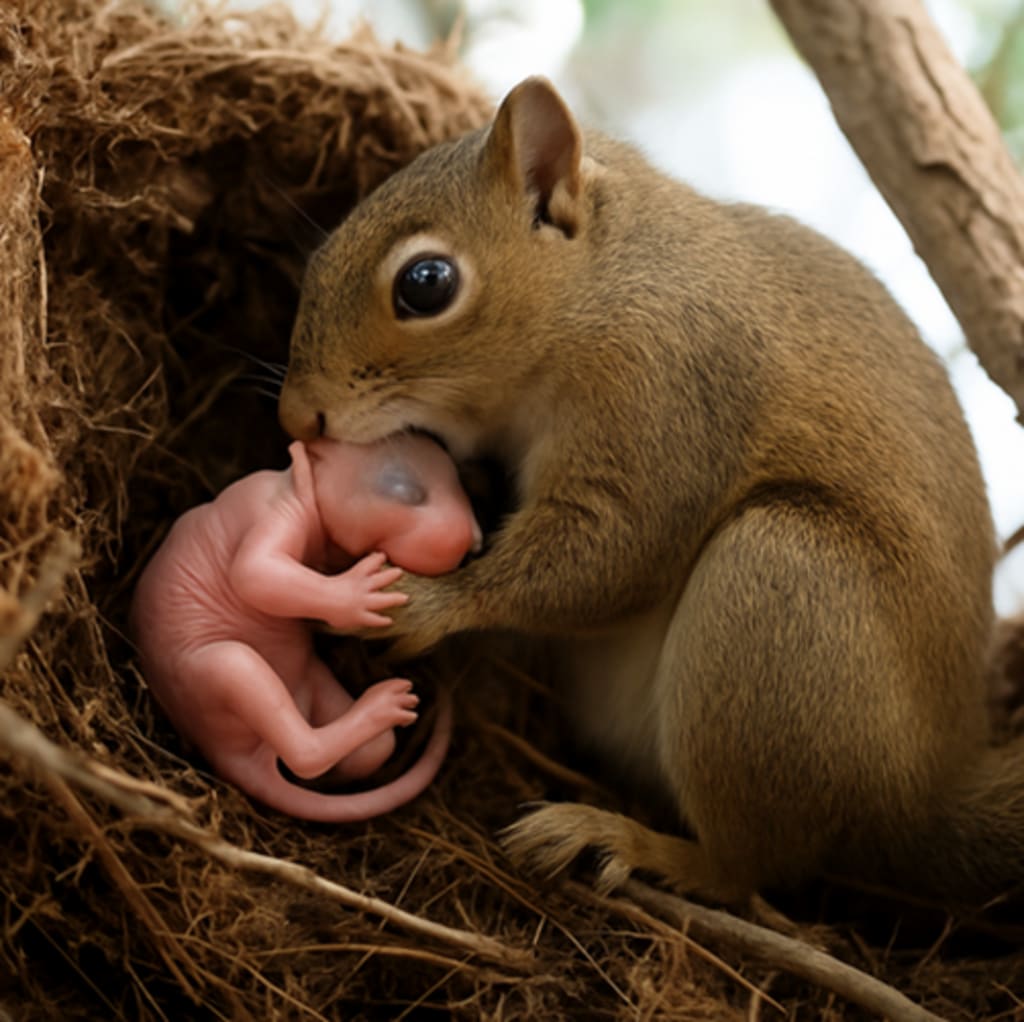
Humans love the idea of animals behaving nobly. The image of a squirrel cradling a tiny pink newborn seems to confirm our deepest hope—that love and care transcend instinct, species, and bloodlines. Social media amplifies this comforting myth with the same captioned claim: “Squirrels will adopt another squirrel baby if its parents die or can’t care for them.” It’s sweet, shareable, and slightly anthropomorphic.
But is it true?
Behaviorally, yes—sometimes. Biologically, rarely. And psychologically, it tells us as much about us as it does about them.
The Science of Squirrel Altruism
For two decades, field biologists in the Yukon tracked thousands of red squirrel litters across overlapping territories. Amid years of data, researchers found just five confirmed cases in which a female adopted orphaned young. Five—in 20 years. That made the behavior real, but statistically exceptional.
Every adoptive mother shared close kinship with the orphan—niece, nephew, sibling, or grandchild. This pattern supports the principle of inclusive fitness: a cornerstone of behavioral ecology suggesting that individuals sometimes help relatives reproduce because doing so indirectly preserves shared genes.
No squirrel performs genetic math in her head; her instincts simply reflect generations of calibrated survival. If the genetic link is strong and the energy cost manageable, adoption may occur. It isn’t charity. It’s kinship-driven logic wrapped in hormonal instinct.
Why Adoption Is the Exception
Squirrels are solitary, fiercely territorial animals. A female invests heavily in her own offspring—milk production, warmth, nest defense, and constant vigilance. Taking on an extra mouth can jeopardize her entire litter. In evolutionary accounting, that’s a poor return. Only when resources are abundant or her litter is small does she assume the additional risk.
The two controlling variables are relatedness and cost. If the orphan is unrelated, the probability of acceptance falls to nearly zero. If caring threatens her own survival, empathy evaporates. Nature’s compassion is contingent, not unconditional. The natural world runs on equilibrium, not emotion.
The Stories That Melt Us
Still, human hearts cling to exceptions. Viral clips occasionally show a rehabilitated mother squirrel carrying an orphan back to her nest.
- To the public, it’s proof of mammalian kindness.
- To a behavioral scientist, it’s a confluence of hormonal priming and situational cues—perhaps a response to familiar distress calls.
Yet even mistaken identity can save a life, and that outcome is enough to keep the myth alive.
Our fascination with these rare acts reveals our longing for validation—that empathy is not uniquely human, that nature mirrors our best qualities. Evolution did not invent compassion whole-cloth; it sculpted it molecule by molecule through the advantages of cooperative survival.
When a squirrel nurtures an orphan, she repeats that ancient blueprint. She just does so without sentimentality.
From Altruism to Apathy
For every rare instance of adoption, there are countless acts of neglect, avoidance, or aggression. And when cruelty comes from humans, the mirror inverts entirely.
When a teenager shoots a squirrel for sport, most adults shrug. It’s “just a squirrel.” It’s “just curiosity.” But in forensic psychology, there’s no such thing as just cruelty.
Small acts toward defenseless creatures carry large diagnostic value. They mark the boundary between empathy intact and empathy failed.
Animal cruelty is not a phase. It’s a behavioral data point. Every unnecessary act of harm leaves a physiological trace—not only on the victim but on the perpetrator’s nervous system. That’s why criminologists and clinicians treat early cruelty as a predictive marker, not an isolated event. The capacity to enjoy another being’s pain or distress does not emerge from nowhere; it forms when empathy fails to integrate.
The Forensic Profile of Harm Without Guilt
Behavioral forensics identifies three overlapping mechanisms behind animal cruelty: desensitization, dominance rehearsal, and displaced control.
- Desensitization occurs when repeated exposure to pain dulls the body’s distress response. The mirror-neuron network—responsible for shared emotional resonance—weakens through misuse. Distress becomes stimulation.
- Dominance rehearsal occurs when cruelty becomes practice for control. Children deprived of agency learn to assert power where it’s safe—in the powerless.
- Displaced control arises when unresolved fear transforms into outward aggression. Causing pain interrupts their own helplessness, providing relief instead of remorse.
Each of these patterns can be interrupted early, but only if adults recognize cruelty for what it is: a developmental alarm.
Empathy as Neurobiology
Empathy is not moral decoration. It is a biological regulation system requiring early conditioning and repair. Children learn empathy through cause and effect, accountability, and modeled compassion. When caregivers minimize animal suffering or mock emotional responses, they teach that vulnerability is irrelevant—or worse, amusing. That message corrodes conscience from the inside out.
The same neural circuitry that fuels a squirrel’s protective reflex under favorable conditions fuels a human’s capacity for compassion under stable social conditions. When those circuits misfire or are suppressed, cruelty fills the vacuum.
The Legal Lag
Despite decades of data linking animal cruelty to interpersonal violence, the justice system still treats most cruelty to animal offenses as property crimes or misdemeanors. The result is cultural blindness.
- Prosecutors overlook motive,
- Judges downplay impact, and
- Society forfeits the chance for prevention.
The FBI’s inclusion of animal cruelty in the National Incident-Based Reporting System was a step forward, but moral recognition remains behind the curve. Until cruelty is treated as a human crime—not merely an animal one—rehabilitation will remain reactive instead of preventive.
The Symbolism of the Squirrel
Squirrels occupy a strange emotional niche in human psychology: wild yet approachable, visible yet disposable. Their perceived triviality makes them convenient targets. When someone harms a squirrel, it’s rarely about hatred toward the animal—it’s an expression of displaced control. The act offers a counterfeit sense of dominance over internal chaos. In symbolism, the squirrel becomes projection: harmless, available, and easily sacrificed to human discomfort.
Relearning Compassion
Rehabilitation requires reconditioning, not sermons. Programs like P.E.T. VR will use multisensory empathy training to rewire emotional association—pairing the sight and sound of distress with physiological feedback that rebuilds empathic congruence. When the nervous system re-experiences another’s fear as its own, the moral circuit reactivates. That isn’t philosophy; that’s neuroscience. Rehabilitation is not forgiveness—it’s rewiring. And the rewiring of cruelty isn’t just therapeutic; it’s a matter of public safety. Every offender who relearns empathy through physiological feedback represents one fewer unpredictable variable in the social environment. Compassion training protects communities as much as it restores conscience.
The Behavioral Bottom Line
The next time you see a photo of a squirrel cradling a pink newborn, admire it, but also understand it. Nature’s compassion has boundaries. So does ours. The real measure of civilization isn’t whether empathy exists; it’s how often we choose to protect it from extinction.
When a person kills a squirrel for entertainment, it’s not nature that’s dying. It’s conscience—one tiny pulse at a time.
Sources That Don’t Suck
• University of Alberta / ScienceDaily – “Red Squirrels Adopt Orphans When They’re Close Kin” (2010)
• EurekAlert – “Adoption Among Red Squirrels Explained by Kin Selection” (2010)
• National Link Coalition – “Animal Abuse and Human Violence Connection Studies”
• FBI Behavioral Science Unit – “Animal Cruelty as a Predictor of Violent Offending”
• Journal of Forensic Psychiatry – “Neurobiology of Empathy Deficits in Offenders”
• Oxford Handbook of Behavioral Criminology – “Early Aggression and Moral Conditioning”
• Greater Good Science Center – “The Kindness of Squirrels” (2018)
• Squirrel Refuge – Raising Orphaned Squirrels for Release (wildlife rehabilitation manual)
About the Creator
Dr. Mozelle Martin
Behavioral analyst and investigative writer examining how people, institutions, and narratives behave under pressure—and what remains when systems fail.
Keep reading
More stories from Dr. Mozelle Martin and writers in Earth and other communities.
When Behavior Walks Away:
I have spent decades watching how behavior changes when the environment stops making sense. That skill came from forensics, trauma science, and animal work in the field. Patterns never break cleanly. They stretch first. They warp. Then the organism abandons the behavior that once kept it stable. I see that pattern now across animals that have nothing in common except the world they live in.
By Dr. Mozelle Martinabout a month ago in Earth
Pakistan is Now the World’s “Guru”
Pakistan is Now the World’s “Guru” In recent years, Pakistan has quietly transformed its global image. Once viewed mainly through the lens of regional conflicts and economic challenges, Pakistan is now increasingly seen as a country offering diplomatic balance, strategic wisdom, and peace-focused leadership. This shift has led many analysts and observers to describe Pakistan as becoming a "world’s guru" — a nation offering guidance in an increasingly unstable global environment.
By Wings of Time 4 days ago in Earth



Comments
There are no comments for this story
Be the first to respond and start the conversation.