
How Stellar Classification Works: The System Astronomers Use to Classify Stars
Learn how stellar classification works, including star types O, B, A, F, G, K, and M. Discover how astronomers classify stars by temperature, color, and spectra.

How Stellar Classification Works
The Night Sky Is Not as Simple as It Looks
On a clear night, when you look up at the sky, the stars appear almost identical. They shine as tiny points of light, forming constellations that humans have recognized for thousands of years. To ancient observers, stars were fixed, unchanging, and nearly identical objects scattered across the sky.
But modern astronomy tells a very different story.
Stars are not all the same. Some are extremely hot and blue, while others are cool and red. Some are massive giants, and others are small dwarfs. Some are young, while others are billions of years old and nearing the end of their lives.
With billions of stars in the universe, astronomers needed a way to organize them. This led to the development of one of the most important systems in astronomy: stellar classification.
Stellar classification allows scientists to categorize stars based on their temperature, color, brightness, and spectral features. This system helps astronomers understand how stars form, evolve, and eventually die.
________________________________________
What Is Stellar Classification?
Stellar classification is a system used by astronomers to group stars according to their physical properties, especially their surface temperature and spectral characteristics.
The classification of a star is mainly based on:
• Surface temperature
• Color
• Spectral lines
• Luminosity
• Size
By studying these characteristics, astronomers can determine important information about a star, including:
• Its mass
• Its age
• Its chemical composition
• Its stage of life
• Its future evolution
In simple terms, stellar classification is like a catalog system for stars, helping scientists organize and understand the enormous variety of stars in the universe.
________________________________________
The Discovery of Stellar Spectra
Stellar classification began in the 19th century when astronomers started studying stellar spectra.
When starlight passes through a prism or spectroscope, it splits into a spectrum of colors, similar to a rainbow. But the spectrum is not continuous—there are dark lines where specific wavelengths are missing.
These dark lines are called absorption lines, and they occur when elements in a star’s atmosphere absorb certain wavelengths of light.
Each element produces a unique pattern of lines. By studying these lines, astronomers can determine the chemical composition and temperature of a star.
This discovery allowed astronomers to classify stars scientifically rather than just by brightness or position in the sky.
________________________________________
The Spectral Classification System (OBAFGKM)
The most important stellar classification system organizes stars into seven main categories based on temperature. The sequence is:
O – B – A – F – G – K – M
These letters represent stars arranged from hottest to coolest.
Astronomers often remember this sequence using the mnemonic:
“Oh Be A Fine Girl/Guy, Kiss Me.”
Although the phrase is old, it is still widely used to remember the order of star classes.
________________________________________
The Seven Types of Stars
O-Type Stars
O-type stars are the hottest stars.
Characteristics:
• Blue color
• Extremely high temperature (above 30,000°C)
• Very bright
• Very massive
• Short lifespan
These stars emit enormous amounts of ultraviolet radiation and often exist in star-forming regions.
________________________________________
B-Type Stars
B-type stars are slightly cooler than O-type stars but still very hot.
Characteristics:
• Blue-white color
• Temperatures between 10,000°C and 30,000°C
• Very bright
• Large mass
These stars are often found in young star clusters.
________________________________________
A-Type Stars
A-type stars are white stars.
Characteristics:
• Strong hydrogen spectral lines
• Temperatures around 7,500–10,000°C
• Bright and visible from great distances
These stars are common in the night sky.
________________________________________
F-Type Stars
F-type stars are yellow-white stars.
Characteristics:
• Temperatures around 6,000–7,500°C
• Moderate brightness
• Slightly hotter than the Sun
These stars are similar to Sun-like stars but somewhat hotter.
________________________________________
G-Type Stars
G-type stars are yellow stars, including our Sun.
Characteristics:
• Temperatures around 5,500–6,000°C
• Stable nuclear fusion
• Long lifespans
• Often host planetary systems
G-type stars are particularly important because they may support habitable planets.
________________________________________
K-Type Stars
K-type stars are orange stars.
Characteristics:
• Temperatures around 4,000–5,000°C
• Cooler than the Sun
• Very stable
• Long lifespans
These stars are considered good candidates for hosting habitable planets.
________________________________________
M-Type Stars
M-type stars are red stars, also known as red dwarfs.
Characteristics:
• Temperatures around 2,500–3,500°C
• Small and dim
• Extremely long lifespans
• Most common stars in the universe
Red dwarfs can live for trillions of years, much longer than the Sun.
________________________________________
Luminosity Classes: Star Size and Brightness
Stellar classification does not only include temperature. Astronomers also classify stars based on luminosity, which relates to size and brightness.
Luminosity classes include:
Luminosity Class Star Type
I Supergiants
II Bright giants
III Giants
IV Subgiants
V Main sequence (dwarf stars)
For example, the Sun is classified as G2V:
• G2 = temperature class
• V = main sequence star
This full classification gives astronomers a very detailed understanding of a star.
________________________________________
The Hertzsprung–Russell Diagram
One of the most important tools in stellar classification is the Hertzsprung–Russell diagram, often called the H–R diagram.
This diagram plots stars based on:
• Temperature (horizontal axis)
• Luminosity or brightness (vertical axis)
When stars are plotted on this graph, they form distinct groups:
• Main sequence stars
• Giants
• Supergiants
• White dwarfs
The H–R diagram helps astronomers understand stellar evolution, showing how stars change over time.
________________________________________
Why Stellar Classification Is Important
Stellar classification is extremely important in astronomy because it helps scientists understand the life cycles of stars.
By knowing a star’s classification, astronomers can estimate:
• Its mass
• Its temperature
• Its brightness
• Its lifespan
• Its stage of life
• Its future evolution
This information helps scientists study galaxies, star clusters, and planetary systems.
Without stellar classification, studying the universe would be much more difficult.
________________________________________
Stellar Evolution and Classification
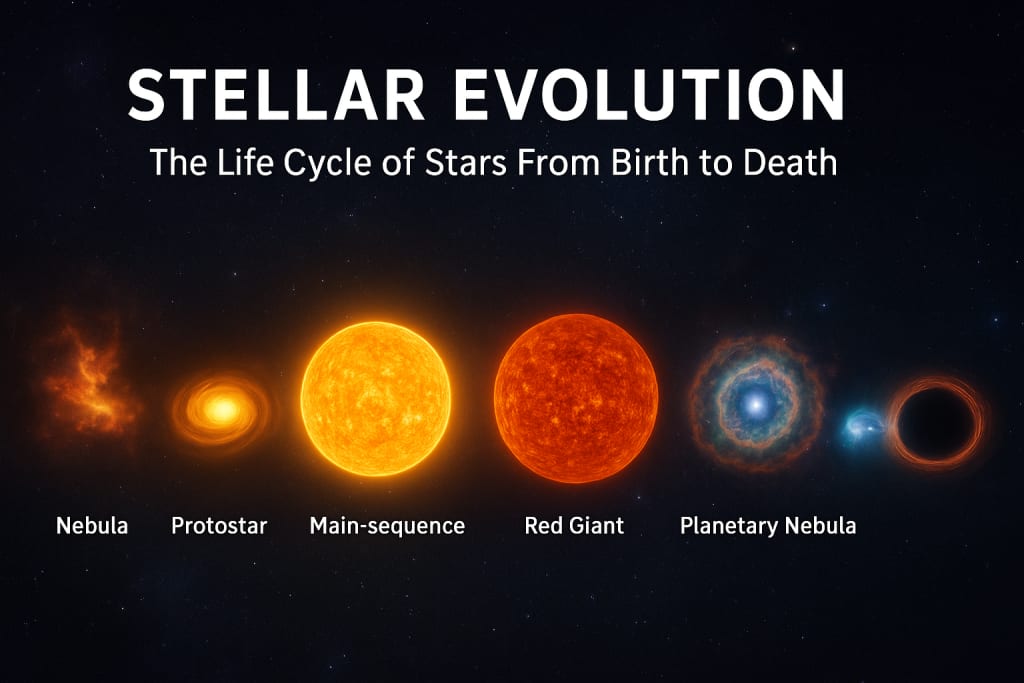
Stars do not stay in the same classification forever. Over millions or billions of years, stars evolve and change.
For example:
• Sun-like stars eventually become red giants
• Massive stars become supergiants
• Some stars end their lives as white dwarfs
• Others become neutron stars or black holes
As stars evolve, their temperature and brightness change, which moves them to different positions on the H–R diagram.
This means stellar classification also helps astronomers track the life story of a star.
________________________________________
The Universe Organized by Light
Stellar classification is one of the most powerful tools in astronomy because it transforms the night sky from a random collection of lights into an organized system.
Instead of seeing just stars, astronomers see:
• Blue supergiants
• Yellow main-sequence stars
• Red giants
• White dwarfs
Each classification tells a story about the star’s temperature, size, age, and future.
What looks like a simple sky full of dots is actually a complex and organized universe full of different types of stars.
________________________________________
Final Thoughts
Stellar classification is the system astronomers use to categorize stars based on their temperature, color, spectral lines, and luminosity. The main classification sequence—O, B, A, F, G, K, M—organizes stars from hottest to coolest.
This system allows astronomers to understand how stars form, evolve, and eventually die. It also helps scientists study galaxies, planetary systems, and the structure of the universe.
The next time you look at the night sky, remember that each star belongs to a specific class. Each one has its own temperature, size, and life story, and astronomers can determine all of this just by studying the light that reaches Earth.
Stellar classification shows us that the universe is not random—it is organized, structured, and full of fascinating cosmic diversity.
About the Creator
Keep reading
More stories from shahkar jalal and writers in Education and other communities.
Why Some Stars Are Hotter Than the Sun: The Science Behind Stellar Temperature
Why Some Stars Are Hotter Than the Sun A Night Sky That Hides Powerful Secrets On a clear night, far from city lights, the sky fills with thousands of stars. They look calm, distant, and almost identical—tiny white dots shining silently in the darkness. To the naked eye, it seems like every star is similar to our Sun, just much farther away.
By shahkar jalalabout 13 hours ago in Education



Comments
There are no comments for this story
Be the first to respond and start the conversation.