
A Parent Who Didn’t Know They Could Apply for a Child Arrangements Order
How one simple discovery about the court process changed the way he saw his role as a parent.

I remember standing outside the school gates one Tuesday afternoon, watching the other parents collect their kids, and thinking: this might be the last time I do this. Not because I wanted it to be. Because I'd been told, in so many words, that it wasn't really up to me anymore.
My name's not important. What matters is that I'm a dad. Three years ago, my marriage ended, and my whole world quietly collapsed in on itself. Not dramatically. Not with shouting, or at least not much. More like a slow deflation. Two people who had once been a team, suddenly unable to be in the same room without the air going heavy.
We had two children. Jake was nine at the time, Mia was six. They were, and still are, my everything.
When my wife and I separated, I moved into a rented flat about twenty minutes away. I kept telling myself that was fine, twenty minutes is nothing, but twenty minutes when you're used to hearing your kids downstairs every morning is not nothing at all. You notice every quiet. You notice the absence of cereal bowls, of cartoons, of arguing over who had the remote.
We'd agreed, loosely, that I'd see the children at weekends. Every other Saturday, maybe a Sunday. It wasn't written down anywhere. It was just a conversation we'd had in the kitchen one evening, both of us exhausted and trying not to make things worse. I thought we were being sensible. I thought that was what co-parenting looked like.
For a while, it worked well enough. And then it didn't.
It started small. A weekend cancelled because Jake had a birthday party. Fine. Then another because Mia was ill. Of course, that happens. But then it started happening more, and when I pushed back, gently, the response was always something that made it hard to argue without feeling like the bad guy. I wasn't trying to be difficult. I just wanted to see my children.
By the time six months had passed, I was seeing them roughly once a fortnight, sometimes less. I didn't even fully clock it at first. I kept making excuses in my head. She's busy. She's stressed. This is hard for everyone. But one evening I was sitting in my flat with a takeaway I hadn't really wanted, and I counted back through my phone calendar, and the reality of it hit me properly.
I'd seen my kids eleven times in five months.
A friend suggested I get some advice. He'd been through something similar a couple of years before and had come out the other side with a proper arrangement in place. He mentioned there were legal routes available to me, that I didn't have to just wait and hope things improved. I'll be honest, I didn't really know what he meant. I think I'd assumed that unless you had money for lawyers and court battles, you were stuck. That it was somehow the other parent's decision, and your job was just to accept whatever access you were given.
That's not how it works. I know that now.
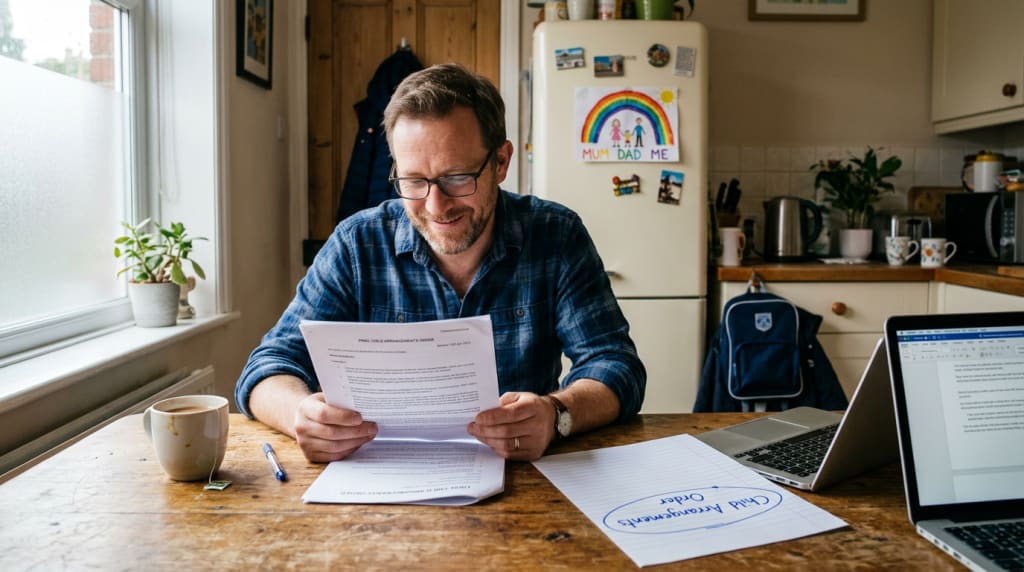
I looked into it and found that there's something called a Child Arrangements Order, a court order that sets out where children live and when they spend time with each parent. I genuinely hadn't known this existed as something I could apply for. I'd heard the phrase somewhere in the past, but I'd mentally filed it away as something only people in really bitter, litigious situations did. I also learned that if things did go to court, there would likely be a CAFCASS meeting, where a children's welfare officer gets involved to make sure the children's needs are at the centre of everything. I didn't want to go to war with my ex. I just wanted a proper arrangement that both of us had to stick to.
Before anything went near a court, though, I was told I'd need to try mediation first. That surprised me too. I'd imagined mediation as something couples did when they were still being reasonable with each other, as a way of avoiding any official process. I hadn't realised it was the step before the official process, not instead of it.
I nearly didn't go. I was anxious about sitting in a room with my ex, with someone else there, talking about our children like it was a formal meeting. It felt exposing. But the mediator, when we met, was nothing like I'd expected. She was calm and practical. She wasn't there to take sides or decide anything. She was there to help us both say what we actually needed, and to help the other person hear it.
What came out of those sessions surprised me. My ex had her own set of worries that I hadn't known about. She was struggling too, differently, but struggling. There were things she needed from me that she hadn't felt able to ask for directly, and there were things I needed from her that I'd been communicating badly, or not at all. We were two people who had stopped listening to each other a long time before the marriage ended, and we'd carried that into the separation.
It took three sessions. In the end, we reached an agreement between us. Jake and Mia would spend every other weekend with me, Friday to Sunday. I'd have them on Wednesday evenings too. School holidays would be split roughly equally, with a bit of flexibility built in for things like birthdays and family events. It was written up properly, not just a kitchen conversation this time.
We never did need to go to the family court in the end. But knowing I could, knowing there was a process available to me and that I wasn't just at the mercy of whatever arrangement my ex felt like maintaining, changed something. I stopped feeling powerless. That matters more than I can really explain.
I think about that Tuesday at the school gates sometimes. I still do school pick-ups now, most Wednesdays, and a fair number of Fridays too. Jake is twelve and barely acknowledges me in public, which his teacher tells me is completely normal for his age and which I find both funny and quietly devastating. Mia still takes my hand on the walk home, at least when she's in the right mood.
Last week she told me she liked that she had two houses. "It means I have two sets of everything," she said, very matter-of-factly. I'm not sure that's the profound philosophical acceptance I'd like to read into it. But I'll take it.
If there's one thing I wish I'd known earlier, it's simply that there were options. That feeling stuck, feeling like the arrangement was just whatever one person decided and the other had to accept, wasn't the only way. There were people who could help, and processes that existed specifically for this, and I didn't have to keep counting back through my phone calendar in a flat on my own, wondering where my time with my children had gone.
I wish someone had told me sooner. So if you're reading this and recognising any part of it, consider this me telling you.
This story is based on real experiences, with details changed to protect confidentiality.
About the Creator
Family Law Service
Family Law Service is a UK-based online family law support provider helping people across England and Wales with divorce, child and financial matters, offering clear, practical guidance without the high cost of traditional solicitors.
Keep reading
More stories from Family Law Service and writers in Families and other communities.
A Grandparent Who Couldn’t See Their Grandchildren After Divorce
I still set the table for five every Christmas Eve. Force of habit, I suppose. My husband Malcolm tells me I do it without thinking, and he's probably right. Two years of quiet Christmases and my hands still reach for the small plates, the ones with the holly border that Lily and Sam used to eat their turkey from. Lily would separate everything on her plate so nothing touched. Sam would pile it all up like a mountain and eat from the top down. I could tell you what they'd say when they walked through the door. I could tell you exactly how the afternoon would go.
By Family Law Service13 days ago in Families
A System That Isn’t Working Challenge Winners
Systems promise order. They organize behavior, distribute opportunity, and suggest that if everyone follows the rules, things will work. The entries in A System That Isn’t Working look closely at what happens when that promise begins to slip.
By Vocal Curation Team5 days ago in Resources




Comments
There are no comments for this story
Be the first to respond and start the conversation.