
City of plague: A New Yorker’s pandemic chronicle Pt 15.
A Second Job During the Pandemic

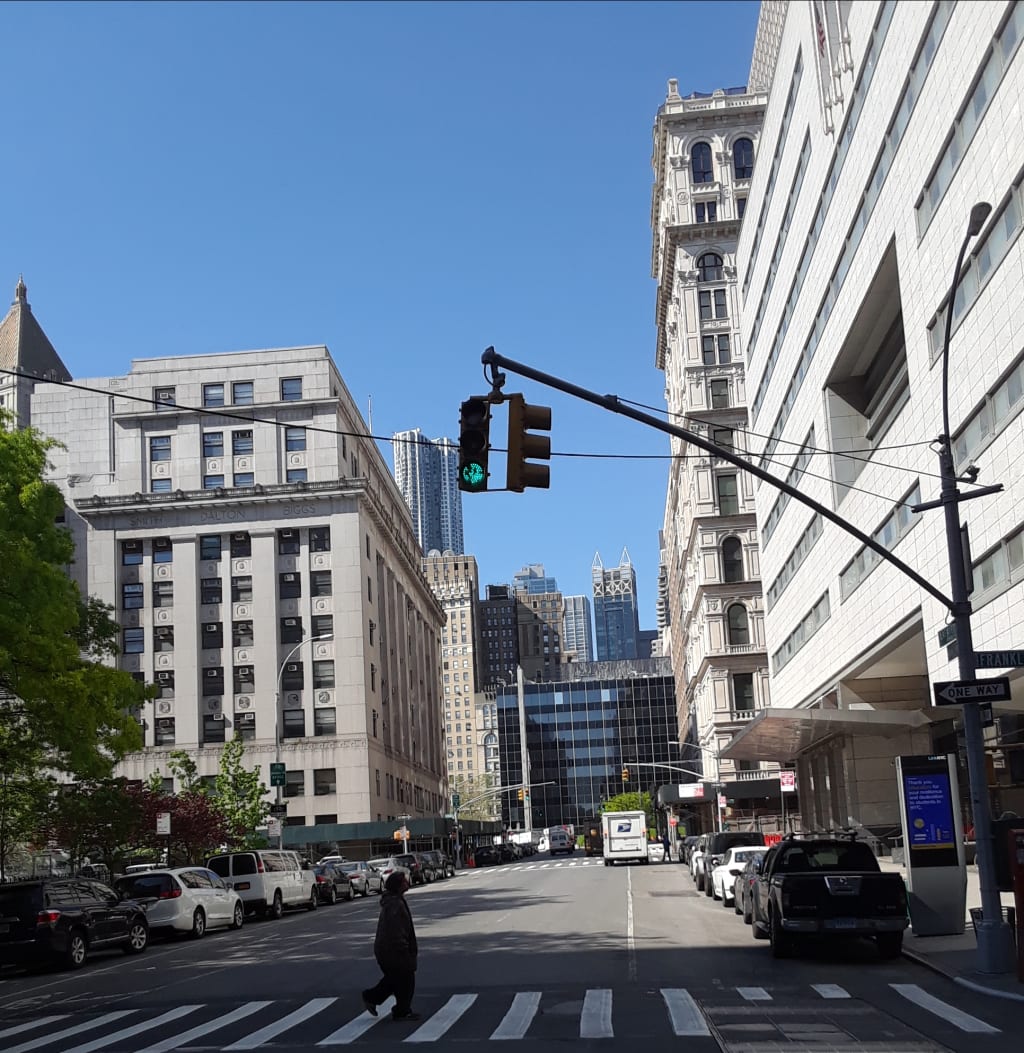
During the long months of lockdown, when people were asked to stay home to avoid the virus, the city seemed to lose its heartbeat.
Businesses closed one after another.
Restaurants pulled down their metal gates.
Small stores turned off their lights indefinitely.
For many small business owners, the future suddenly looked bleak. Workers who had relied on daily wages found themselves without income almost overnight. Some went home quietly, carrying their uniforms in plastic bags, unsure when—or if—they would ever return.
Of course, there was unemployment assistance. The government encouraged people to apply through the labor department. But the reality was not as simple as the announcement suggested.
Not everyone qualified.
Even for those who did qualify, the application process was long and complicated. Many people were discouraged halfway through the paperwork and simply gave up.
There was another problem as well—one that many people rarely talked about openly.
In places like restaurants, grocery stores, and small shops, most employees were paid legally and paid taxes on their income. But there were also workers who preferred to receive a large portion of their wages in cash, reporting only a small amount of taxable income.
It seemed like a clever strategy at the time.
But unemployment benefits are calculated based on previously reported income. So when the pandemic struck, some people discovered that the benefits they received were painfully small.
It was a classic case of being too clever for one’s own good.
At a moment like this, the safest industries were those considered essential services. These jobs suddenly became the closest thing to a “golden rice bowl,” as we say in Chinese—a job that could not easily disappear.
Among all these essential services, one stood out more than any other.
The post office.
If my memory serves me correctly, the local post offices in our community never stopped operating. While countless businesses closed their doors, the postal service remained open, quietly continuing its daily mission.
In those uncertain days, the post office became a pillar of stability.
It was as if the postal workers had silently taken on the responsibility of keeping the city connected, refusing to let hope disappear from New York City.
And their determination inspired me deeply.
I am not exaggerating when I say this.
Because during my spare time, I ran a small online business selling items through the internet. Without the postal service, my little side business would have been impossible.
Customers and sellers were separated by thousands of miles. If postal workers had not continued delivering packages faithfully every day, people like me would have had no way to send products to customers.
Our online stores would have closed immediately.
Even giant e-commerce companies depended heavily on the postal system for the “last mile” of delivery.
It reminded me of the debates that often appeared in the news during those years. Former U.S. President Donald Trump once argued that large e-commerce companies benefited greatly from low postal rates.
According to him, companies like Amazon could ship goods cheaply because of the postal system, while the postal service itself struggled financially.
He believed postage prices should increase.
Higher postal fees, he argued, would reduce the losses of the postal service and also weaken the price advantage of online retailers. If online prices rose, physical stores might regain some customers.
Empty storefronts across the city might fill again.
Landlords could survive.
And property tax revenue would continue flowing into government budgets.
Whether people agreed with his views or not, one thing was undeniable: delivering mail was an incredibly complicated and expensive process.
Even sending a simple letter that cost less than a dollar involved a remarkable journey.
A postal worker might earn over twenty dollars an hour. Yet a letter might travel hundreds or even thousands of miles before reaching its destination. If you calculated the labor and transportation costs carefully, it was easy to see that many deliveries probably lost money.
The farther the mail traveled, the greater the loss.
Only expensive express services could reliably generate profit.
For this reason, postal services in many countries operate at a financial deficit. They survive mainly because governments support them as a public service.
Anyone who thought seriously about it could see this reality.
As someone who dealt with the post office almost every day, I was extremely sensitive to postage prices.
Every year I carefully calculated the shipping cost before setting the price of my products.
If postage increased, my prices had to rise as well.
Five years earlier, shipping a six-ounce package cost only $1.98.
Now it had climbed to more than three dollars.
The increase might not sound dramatic, but for small online sellers, it made a big difference. Profit margins grew thinner each year.
Many small sellers eventually gave up.
Only companies with strong brands and unique products could survive without direct competition.
Still, compared with many countries, running an online business in the United States was surprisingly convenient.
You didn’t even have to visit the post office to pay for postage.
From home, you could purchase a shipping label online using PayPal, a credit card, or a bank account.
After entering the package’s weight and size, you could choose between regular mail, priority delivery, or express shipping.
Within a minute, a postage label would appear on the screen.
The label included the tracking code, sender’s address, and recipient’s address.
All you had to do was print it and attach it to the package.
Many post offices even had special drop-off counters for prepaid packages.
Usually you didn’t have to wait in line at all.
One morning, I walked ten minutes from my house to our neighborhood post office.
But the moment I entered, I was stunned.
The prepaid-package counter had been closed.
The tiny thirty-square-meter lobby was already packed with people.
A long line twisted through the room like a snake.
Some customers leaned against the wall impatiently.
Others sighed loudly.
I had not expected this at all.
The pandemic was raging outside, yet the post office was more crowded than ever.
It showed how essential the service truly was.
Judging from the slow pace of the clerks and the shortage of staff, I estimated it would take at least two hours before my turn came.
That was impossible.
I still had to get to my full-time job.
With a sigh, I decided to postpone mailing my packages.
Work came first.
I took the subway toward Chinatown, Manhattan.
To my surprise, the train ran unusually fast that morning. The journey was twenty minutes shorter than usual.
When I exited the station, I still had nearly half an hour before my shift started.
Suddenly I had an idea.
There was another post office near my workplace.
Maybe I could try my luck there.
This second post office was larger—an official city branch with several service windows and experienced staff.
When I walked in, however, I noticed something disappointing again.
The prepaid-package drop-off counter was closed here too.
But fortunately, only a few customers were waiting.
Within ten minutes, I reached the front of the line.
A small electronic bell rang.
I hurried to the service window.
And then I froze.
The entire window had been sealed with a thick sheet of transparent plastic.
It looked like a barrier in a hospital isolation ward.
The clerk noticed my hesitation.
“Lift the plastic sheet first,” she said. “Then slide your package under the window.”
I followed her instructions quickly.
“I don’t need a receipt,” I added.
But just as I was about to leave, the clerk suddenly pushed the package back.
“You need to put it over there,” she said, pointing to the side.
Confused, I asked why.
“Because of the pandemic,” she replied. “You already paid the postage. Just drop it off at the other window.”
I didn’t argue.
Talking too much during a pandemic felt risky enough.
Following another customer who had received the same instructions, I walked about fifty feet down the hallway.
He stopped at an unattended slot in the wall and quietly pushed his package through.
Then he left.
I waited until he was far away to maintain social distance.
Then I slid my own packages through the slot one by one.
Mission accomplished.
I hurried out of the building feeling strangely triumphant, as if I had just completed an important mission.
Back at work, I checked the clock.
10:00 a.m.
Exactly on time.
Relief washed over me.
But I quickly reached for the bottle of hand sanitizer in my pocket.
After touching door handles, plastic curtains, and glass counters, I could not take any chances.
I rubbed the sanitizer over my hands again and again until I felt confident they were completely clean.
Only then did I begin my regular job for the day.
The next morning, heavy rain pounded against the windows of my house.
Strong winds pushed the raindrops against the glass with relentless force.
The world outside looked dark and cold.
The pandemic had already filled my mind with worries.
Now the storm made everything feel even heavier.
Fortunately, it was my day off.
I sat at my computer writing when a strange smell reached my nose.
At first it was faint.
Then stronger.
It was coming from the basement.
Alarmed, I ran downstairs.
And immediately froze.
The sewer pipe had backed up.
Dirty water was bubbling out of the basement toilet.
The floor was already covered with a shallow layer of filthy water.
The pandemic outside.
A flooded basement inside.
I stood there staring in disbelief.
Common sense told me not to panic.
The first step was obvious: call a plumber.
I searched through newspaper classified ads and began dialing numbers.
One after another, plumbers told me the same thing.
They were busy.
The earliest appointment was two days away.
And because of the pandemic, every single one of them added the same message:
“Thirty percent emergency surcharge.”
I nearly dropped the phone in frustration.
My wife covered her nose with her hand and said quietly,
“If no one can come today, why don’t you try fixing it yourself?”
Her suggestion both frightened and motivated me.
I had never unclogged a sewer pipe in my life.
But perhaps there was no other choice.
After calling a friend for advice, I finally discovered a secondary drainage port near the pipe.
But first we had to remove the standing water from the basement.
There was no pump in the house.
So we wore knee-high rubber boots and used buckets.
My wife stood outside near the street drain.
I carried bucket after bucket of filthy water upstairs and dumped it outside.
Back and forth.
Again and again.
Two exhausting hours later, the basement floor was finally visible again.
Sweat soaked my clothes.
My back ached.
But I grabbed a wrench and unscrewed the drainage cap.
Inside the pipe, I found the culprit.
A tangled mass of long hair and fallen leaves had blocked the U-shaped pipe.
After removing the debris, the water suddenly began flowing again.
The sewer was clear.
At that exact moment, heavy rain returned outside.
Water rushed through the pipes freely.
My wife looked at me and laughed.
“Good thing we fixed it ourselves,” she said.
“Otherwise the basement would be a swimming pool by now.”
I looked at her gratefully.
“You were the brave one,” I said.
“Without your idea, we would be in real trouble.”
That night, thinking about everything we had endured—the pandemic, the storm, the flooded basement—I felt an unexpected sense of gratitude.
The virus was ruthless.
Disasters came without warning.
But as long as two people faced them together, life somehow continued.
And sometimes, that was enough.
About the Creator
Peter
Hello, these collection of articles and passages are about weight loss and dieting tips. Hope you will enjoy these collections of dieting and weight loss articles and tips! Have fun reading!!! Thank you.
Pandora’s Burden
“My brother warned me to not accept gifts from the one who commissioned you,” said Epimetheus to the woman clad in silvery raiments standing at the entrance to the temple. Her silver tiara and the silver rings on her fingers and toes glinted in the firelight cast by torches set on either side of the doorway. Lingering in the shadows, beyond the reach of the flames as she was, he could not tell what she held in her hands. At first what appeared to be a box was perhaps a funerary urn, or maybe merely an apple.
By J. Otis Haas3 days ago in Fiction
The Edge of Something
She kissed me. She kissed me, and I just stood there. I didn't understand what was happening until it was already over. Did I lean in? I don't know. She did — I know that much — because I would never have been the one to close the distance. I had only been thinking that I was having a nice time with a girl I met in class. A nice time. That's all.
By Eddamar González6 days ago in Fiction
A System That Isn’t Working Challenge Winners
Systems promise order. They organize behavior, distribute opportunity, and suggest that if everyone follows the rules, things will work. The entries in A System That Isn’t Working look closely at what happens when that promise begins to slip.
By Vocal Curation Team6 days ago in Resources



Comments
There are no comments for this story
Be the first to respond and start the conversation.