
The Cartographer's Daughter
She mapped the world's forgotten places—until someone mapped the coordinates to her heart.

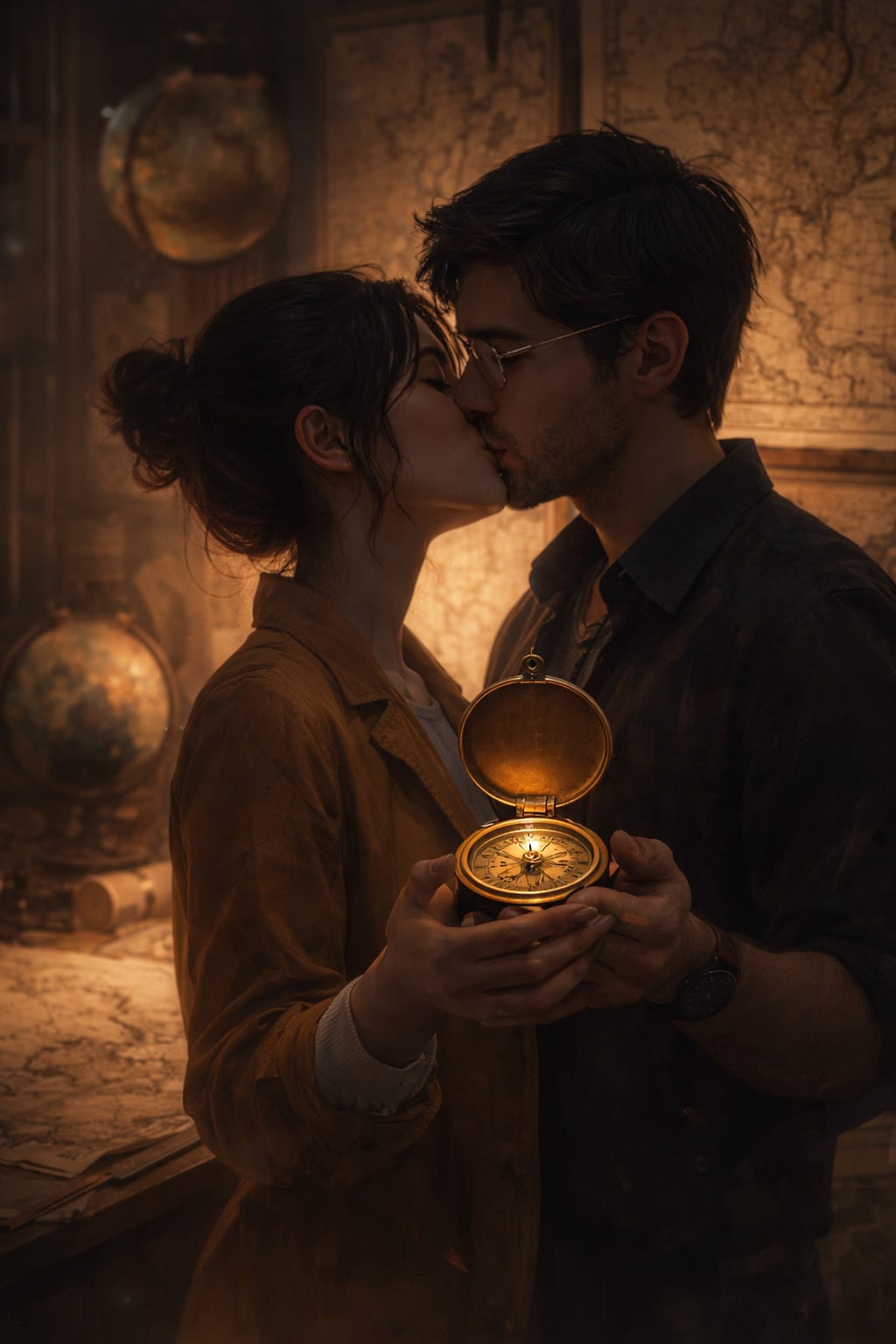
Isla Mercado had inherited three things from her father: his mapmaking business, his stubborn independence, and an antique brass compass that pointed everywhere except north.
She discovered the compass's peculiarity on a Tuesday morning in March 2026, while updating digital surveys of Edinburgh's Old Town. The needle spun wildly whenever she stood still, but locked onto something definite when she walked. Not magnetic north—something else entirely.
"Faulty mechanism," she muttered, though her father had never owned anything faulty in his life.
The compass led her down Advocate's Close, through crowds of tourists, past the shop where she bought her morning coffee. It pulled her toward the Royal Mile, then down a narrow wynd she'd photographed a hundred times but never explored on foot. The needle steadied, pointing at a burgundy door with flaking paint.
Isla knocked. No answer. She tried the handle.
Inside, the shop was a cartographer's fever dream—maps covering every surface, globes suspended from the ceiling, atlases stacked like architectural columns. And in the center of it all, a man roughly her age knelt beside an enormous map of Renaissance Venice, restoring it with hands steadier than a surgeon's.
"We're closed," he said without looking up.
"Your door was unlocked."
"That's not an invitation." He had dark hair that fell across his forehead, silver-rimmed glasses, and the kind of concentration that made the rest of the world disappear.
"I'm Isla Mercado. My father was—"
His head snapped up. "Thomas Mercado's daughter?" His accent was hard to place—Scottish with something else underneath. "I'm Rafe Dalca. Your father was my mentor."
Isla's throat tightened. Her father had died eight months ago, and she still found his handwriting on Post-its, his annotations in margins. She hadn't known he'd taken on apprentices.
"He never mentioned you."
"We had a falling out." Rafe stood, wiping his hands on a cloth. He was tall, angular, with eyes the color of deep water. "About three years ago. I wanted to restore maps. He thought I should create them. Said the future matters more than the past."
"That sounds like him." Isla held out the compass. "This was his. But it's broken—the needle doesn't point north."
Rafe's expression shifted from guarded to astonished. He crossed the room in three strides, taking the compass with a reverence usually reserved for relics. "It's not broken. It points to cartographic anomalies—places that exist but aren't properly documented. Your father and I built it together."
"You built this?"
"We were going to map Edinburgh's forgotten spaces. Every city has them—doorways that lead nowhere, gardens hidden between buildings, rooms that don't appear on blueprints." He turned the compass over, showing her an inscription she'd never noticed: *For the spaces between spaces.* "Then we argued. I accused him of abandoning history. He said I was too afraid to make my own mark on the world."
"Were you?"
Rafe met her eyes. "Yes."
The honesty startled her. Most people performed their grief, their regrets, made them into theater. Rafe simply stood there, holding the compass like an apology he'd never get to deliver.
"The compass led me here," Isla said. "To you."
"Then this shop must be unmapped. I only moved in last month." He smiled, small and sad. "Your father would have appreciated the irony."
Over the following weeks, they became partners in an unlikely project. Isla brought her digital surveying equipment; Rafe contributed his knowledge of Edinburgh's history. The compass led them to a Victorian tearoom sealed behind a false wall, a rooftop garden accessible only through a bookshop's attic, a medieval well in someone's basement.
They documented everything. Isla created precise digital maps while Rafe sketched in watercolor and ink, his illustrations breathing life into her measurements. They worked in companionable silence, then in comfortable conversation, then in something that felt dangerous and inevitable.
One evening in April, while mapping a hidden courtyard, Rafe said, "I was in love with someone when your father and I argued. She wanted me to move to London, take a position at the British Library. Prestigious. Safe."
"You didn't go."
"I chose maps over people. Your father said I'd regret it." He looked at Isla, and she saw everything he wasn't saying. "He was right."
Isla's hands were shaking. "My father also said that maps are just one way of understanding space. That the best cartographers know when to put down their instruments and actually experience a place."
She stepped closer. Rafe removed his glasses, set them carefully aside.
"I'm trying," he said quietly, "to experience this."
Their kiss was soft, tentative—two people learning a new territory without coordinates. When they pulled apart, Isla laughed.
"What?"
"The compass." She pointed. On the worktable, the needle had finally stopped spinning. It pointed directly at them. "I think we're the unmapped space."
Rafe picked up the compass, studied it, then pulled her close again. "Then let's make sure," he whispered against her lips, "we're properly documented."
Outside, Edinburgh hummed with its ancient, endless life. But inside their hidden courtyard, time expanded like parchment unfurling, and two cartographers drew a new world, one kiss at a time.
About the Creator
Alpha Cortex
As Alpha Cortex, I live for the rhythm of language and the magic of story. I chase tales that linger long after the last line, from raw emotion to boundless imagination. Let's get lost in stories worth remembering.
Keep reading
More stories from Alpha Cortex and writers in Fiction and other communities.
The Disappeared Pianist
Detective Sarah Chen stared at the empty concert hall, her neural implant throbbing with phantom pain. The Vienna Philharmonic had performed here last night—she remembered the reviews, the social media buzz, the standing ovation. But when she pulled up the footage, the stage showed only an orchestra minus one crucial element: no pianist.
By Alpha Cortex6 days ago in Fiction
4:37 AM
With a long, exhausted blink, his glued eyes open. A couple more swift blinks followed by a resonating, endless yawn. Then, a sudden twitch, as if a thousand needles pierced his body. “What day is it?! Did I oversleep?!” The world hushed, and all he heard was the pulse of his heart drumming against his eardrums in a manic rhythm. With a still numb hand, he searched in the dark for his phone. Heavy breathing, strong palpitations, His hand picking up the pace. He lifted the blanket, tossed aside pillows, searching. Nothing. The air in the room thickened, and still, he didn’t know. Was it another dawn, or the mids of the night? For too long, his days and nights had blurred into a single, bleak darkness. Finally, he sees a black square resting on the white towel by his bed. His finger tapped the screen manically, and finally, it revealed the time: 4:37 in the morning. The drummer slowed down the beat, and all that fills the room is calming silence.
By George Roasta day ago in Fiction
We Will Bury You
How do you deal with the vast disappointment and anger and rage and grief and rage and RAGE and RAGE and RAGE when a community icon, who did so much to help your gente, is found to be the type of monster that still makes me believe in capital punishment?
By Ariana GonBon6 days ago in Humans



Comments
There are no comments for this story
Be the first to respond and start the conversation.