
The House Remembers
Cinema as Apology in Sentimental Value (2025)

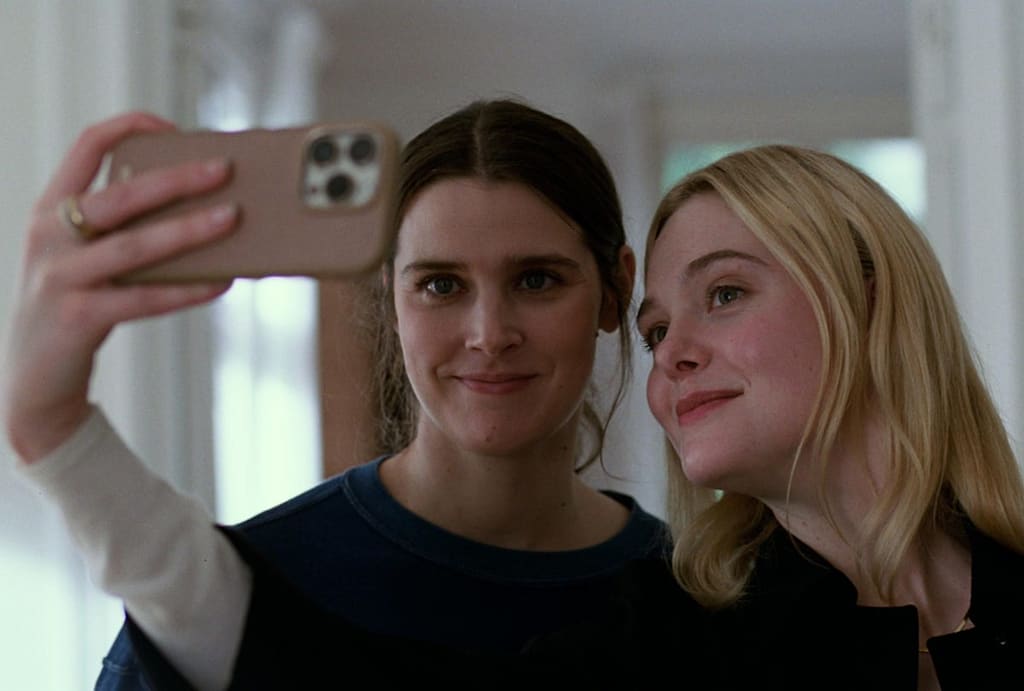
Joachim Trier’s Sentimental Value (2025) is a film that operates with deceptive simplicity. At first glance, it appears to be another entry in the lineage of European family dramas—restrained, introspective, concerned with memory and emotional estrangement. Yet beneath this familiar surface lies a far more intricate structure: a film about the impossibility of direct communication, and the desperate human tendency to replace speech with form, gesture, and performance. What Trier constructs is not merely a story about a broken family, but a meditation on how art becomes the last refuge of those who can no longer speak truthfully to one another.
The title itself functions as both concept and trap. “Sentimental value” usually refers to objects whose emotional significance exceeds their material worth. In Trier’s film, however, this notion is inverted and expanded: it is not objects that carry memory, but spaces, gestures, and artistic reconstructions. The family home becomes the central repository of this value—a silent archive of trauma, absence, and unresolved longing. It is not simply a setting; it is an active participant, a witness that has outlived the emotional coherence of the family it once contained.
At the centre of the narrative stands Gustav, played with remarkable restraint by Stellan Skarsgård. A once-celebrated film director, Gustav returns to his daughters after years of estrangement, prompted by the death of his ex-wife. His reappearance is not framed as a moral reckoning but as a project. He arrives with a script—an autobiographical film about his own mother—and offers his daughter Nora the lead role. The gesture is immediately ambiguous: is this an attempt at reconciliation, or another act of artistic appropriation? The film refuses to resolve this ambiguity, and it is precisely this refusal that gives it its psychological depth.
From Nora’s perspective, the offer is not an invitation but a violation. To act in her father’s film would mean submitting to his interpretation of their shared past, allowing her identity to be rewritten within his narrative. Her refusal is therefore both personal and epistemological: she rejects not only the role but the authority of her father’s version of truth. In this moment, the film establishes its central conflict—not between individuals, but between competing claims over memory, authorship, and meaning.
Gustav’s response to this rejection is telling. Rather than abandoning the project, he replaces Nora with a Hollywood actress, played by Elle Fanning. This substitution introduces one of the film’s most unsettling dynamics: the use of a surrogate to reconstruct personal trauma. The actress becomes a double, a stand-in for both daughter and mother, collapsing generational boundaries and turning private history into staged performance. What emerges is a form of cinematic psychodrama, in which the past is not remembered but reenacted, not understood but directed.
The decision to shoot the film within the actual family home intensifies this dynamic. The house, already burdened with memory, is transformed into a set—a space where reality and fiction are deliberately blurred. Rooms once inhabited by lived experience are now occupied by actors, cameras, and artificial light. This transformation raises a fundamental question: can the truth of a life be recovered through its reenactment, or does the act of staging inevitably distort it? Trier does not offer a definitive answer, but the film’s trajectory suggests that the latter is unavoidable.
Structurally, *Sentimental Value* follows a pattern that aligns closely with Michael Hauge’s model of narrative transformation, particularly the movement from “identity” to “essence.” Gustav begins the film firmly entrenched in his identity as a director—a figure who controls, interprets, and shapes reality. His return to his daughters is mediated entirely through this identity; he does not speak to them as a father, but as an auteur with a project. The script becomes his language, the film his method of communication.
The early stages of the narrative are defined by this attempt to impose structure on emotional chaos. Gustav believes that by transforming his past into a film, he can render it comprehensible, even redeemable. This belief reaches its peak at the midpoint, when production begins and the project appears to gain momentum. The presence of the Hollywood actress, the activation of the set, the reoccupation of the family home—all these elements create the illusion of progress. Art, it seems, is working.
Yet this progress is fundamentally illusory. As the film moves into its second half, the cracks begin to appear. The actress struggles to access the emotional truth of the role, sensing that something essential is missing from the script. Nora and her sister Agnes, observing the production from the margins, experience it not as a healing process but as a further act of alienation. The more Gustav attempts to control the narrative, the more it slips away from him.
The crisis arrives not as a dramatic explosion but as a quiet collapse. The production falters, the performances lose coherence, and Gustav himself suffers a physical breakdown. This moment is crucial, not because it resolves the conflict, but because it strips away the protective layer of his identity. For the first time, he is no longer a director orchestrating events, but a man confronted with his own inability to communicate.
What follows is one of the film’s most striking achievements: a movement towards silence. In contrast to the elaborate construction of the film-within-the-film, the final scenes are marked by an almost radical simplicity. Dialogue recedes, gestures become minimal, and meaning is conveyed through presence rather than speech. The climactic moment—a shared glance between Gustav and Nora—embodies this shift. It is not a reconciliation in the conventional sense; nothing is resolved, nothing is explained. Yet within this silence, there is a recognition that had previously been impossible.
This emphasis on silence is not merely aesthetic; it is thematic. Throughout the film, language is shown to be inadequate, even deceptive. Gustav’s script, for all its complexity, fails to communicate what it intends. The actress’s performance, despite its technical precision, cannot capture the lived reality it seeks to represent. Even the conversations between characters are marked by evasion, misunderstanding, and emotional displacement. In this context, silence emerges not as absence, but as a form of truth—a space where meaning is no longer mediated by narrative or performance.
The film’s engagement with generational trauma further complicates this dynamic. Gustav’s own past—particularly the story of his mother’s suffering—serves as the foundation of his artistic project. Yet this past is never fully accessible, either to him or to others. It exists as a fragment, a source of emotional pressure that cannot be fully articulated. By attempting to reconstruct it through film, Gustav inadvertently perpetuates its distortion, transforming it into something that can be seen but not truly understood.
Nora’s journey, though less overtly structured, mirrors this tension. Her refusal to participate in her father’s film is not a rejection of memory, but a defence of its integrity. She resists the reduction of her experience to a scripted narrative, insisting on the irreducibility of personal truth. Yet her eventual reading of the script introduces a shift: she begins to see it not as an act of exploitation, but as an imperfect attempt at communication. This recognition does not erase the past, but it allows for a different kind of relation to it—one that acknowledges both its weight and its opacity.
In this sense, *Sentimental Value* can be understood as a film about the limits of representation. It explores the tension between life and art, not in order to resolve it, but to expose its persistence. Art, the film suggests, cannot replace life; it cannot heal wounds or restore lost connections. What it can do, however, is map the contours of these wounds, making visible the spaces where communication has broken down.
This idea is reinforced by the film’s visual language. Trier’s use of the house as a “silent witness” is particularly effective. The camera lingers on corridors, doorways, and empty rooms, emphasising the material presence of memory. These spaces are not neutral; they are saturated with past events, even when those events are no longer visible. The act of filming within them becomes a form of excavation, uncovering layers of meaning that resist narrative closure.
At the same time, the film avoids the temptation of aestheticising trauma. Its visual style remains restrained, almost austere, refusing to turn suffering into spectacle. This restraint is crucial, as it preserves the ethical tension at the heart of the story. Gustav’s project is always on the verge of becoming exploitative, and the film never allows the audience to forget this. Instead, it invites a critical distance, encouraging viewers to question the very process of representation.
The performances contribute significantly to this effect. Skarsgård’s portrayal of Gustav is marked by a careful balance between authority and vulnerability. He is neither villain nor victim, but a figure caught in the contradictions of his own methods. Renate Reinsve’s Nora provides a counterpoint, embodying resistance without slipping into caricature. Elle Fanning’s role as the surrogate actress adds another layer, highlighting the disjunction between performance and lived experience.
Ultimately, *Sentimental Value* is less concerned with resolution than with recognition. Its conclusion does not offer closure in the traditional sense; the family remains fractured, the film within the film remains uncertain. Yet something has shifted. The characters have moved, however tentatively, from a reliance on constructed narratives towards an acknowledgment of their limitations. In doing so, they approach a form of connection that is not based on shared stories, but on shared absence.
This is perhaps the film’s most significant achievement. It redefines reconciliation not as the restoration of harmony, but as the acceptance of incompleteness. The “sentimental value” at the heart of the story is not located in objects or even in memories, but in the fragile, often wordless recognition between individuals who can no longer fully understand each other.
In an era saturated with narratives—cinematic, digital, ideological—Trier’s film stands out for its insistence on what cannot be narrated. It reminds us that the most important aspects of human experience often resist articulation, and that attempts to capture them may only deepen their ambiguity. Yet within this ambiguity lies a different kind of truth, one that does not depend on coherence or clarity.
*Sentimental Value* is, in the end, a film about the failure of language and the persistence of meaning. It shows how people continue to seek connection even when their tools for doing so are inadequate, and how art, for all its limitations, remains a vital part of this search. Not because it provides answers, but because it allows us to confront the questions we cannot escape.
About the Creator
Peter Ayolov
Peter Ayolov’s key contribution to media theory is the development of the "Propaganda 2.0" or the "manufacture of dissent" model, which he details in his 2024 book, The Economic Policy of Online Media: Manufacture of Dissent.
Keep reading
More stories from Peter Ayolov and writers in Fiction and other communities.
Pax Imperialis
Every empire tells a story about itself. It claims to be a reluctant hegemon, a civilising force, a guardian of order in a chaotic world. Edward W. Said captured this imperial self-mythology with ruthless clarity when he wrote: ‘Every empire, however, tells itself and the world that it is unlike all other empires, that its mission is not to plunder and control but to educate and liberate.’ The promise is always peace, stability, progress. Yet behind this language of benevolence stands an apparatus of overwhelming violence. Empires do not rule through persuasion alone. They require an ultimate weapon, a technological embodiment of terror that transforms domination into inevitability and resistance into madness. From the atomic bomb to the Death Star, from clone armies to genetically engineered super-soldiers in The Mandalorian, the logic remains unchanged. Universal peace, or Pax, is purchased through the threat of total annihilation.
By Peter Ayolov3 months ago in Fiction
Life in a Sea of Sand
A hundred years ago, the Arab world was vastly different from the glittering cities and towering skyscrapers we see today. Life revolved around endless deserts, date palms, and caravans of camels. It was a world with few conveniences, yet filled with strong hearts and resilient spirits.
By Mariana Farias6 days ago in Fiction



Comments
There are no comments for this story
Be the first to respond and start the conversation.