

Chapter 4: The First Harvest
The District of Rust smelled of wet iron and dying dreams, a sharp contrast to the sterile, pressurized air of the Vane Tower. I sat in the corner of a grease-slicked diner, my hands shaking—not from the cold, but from the low-frequency hum of the Static that had begun to chew at the edges of my vision. I needed a fix. Not the chemical stimulants of the Obsidian Room, but a different kind of grounding. I needed to see Elena Vane.
In the height of my reign as the Glass King, Elena hadn't been a person to me; she had been a structural anomaly. If the city was a grid of my design, she was the rogue frequency that threatened to shatter the glass.
I leaned my head against the cracked plastic of the booth and let the nostalgia wash over me like a fever. It was a dangerous, indulgent nectar. I remembered the gala for the topping-off of the Vane Tower—sixty stories of my own ego, piercing the clouds. The air at that altitude had been thin and expensive.
Elena had been standing on the observation deck, silhouetted against the violet bruise of a city sunset. She was wearing a dress of midnight silk that seemed to drink the light around her, a garment that defied the very laws of tension and gravity I spent my life enforcing. It was backless, a plunging V that traced the delicate, dangerous line of her spine. To any other man, that spine was just bone and skin; to me, it was a load-bearing column of pure, unadulterated chaos.
I remembered walking up behind her, the scent of her perfume—jasmine, cold gin, and something metallic, like a coming storm—cutting through the filtered oxygen of the vents.
"You’re standing too close to the edge, Elena," I had whispered, my voice vibrating with the predatory confidence of a man who owned the horizon.
She hadn't turned around. She’d just tilted her head, letting a stray lock of dark hair fall across the pale expanse of her shoulder. "The edge is the only place where the wind doesn't sound like a blueprint, Silas. Down there, in your streets, everything is a box. Up here, it’s all... breath."
I had reached out then, my fingers grazing the silk at her hip. I didn't want to hold her; I wanted to calibrate her. I wanted to feel the frantic rhythm of her pulse and see if I could tune it to the steady, mechanical throb of the building beneath us. There was a profound, lascivious thrill in the idea of conquering something so inherently entropic. Every time I touched her, it felt like a violation of my own Gospel—a surrender to the curve.
"I could build a cage for the wind if I wanted to," I had told her.
She had finally turned, her eyes reflecting the flickering lights of the city below like twin shipwrecks. She’d smiled, a slow, devastating movement of the lips that made my carefully constructed world feel fragile. "You already have, Silas. You call it architecture. But even your towers have a breaking point. What happens when the frequency changes? What happens when the song is louder than the steel?"
I hadn't understood her then. I had been too busy tracing the hollow of her throat with my eyes, imagining the way she would look if I could strip away the silk and the socialite armor and find the raw, vibrating energy underneath. I wanted to dismantle her, piece by piece, just to see how she worked. It wasn't love; it was an obsession with the only machine I couldn't master.
The Static in the diner intensified, a bruised purple light bleeding out of the neon sign above the counter. It pulsed in time with my heartbeat, and for a terrifying second, I heard it—a faint, ghostly echo of Elena’s voice, caught in a feed.
“What happens when the song is louder than the steel?”
She was out there. Somewhere in the shifting Ghost-Geometry of the city, Elena Vane was being harvested. I could feel it in the molecular ache of my own jaw. Maybe the bastards who had taken my firm and my name—they didn't just want the city’s money. They wanted the "variables." They wanted the chaos that Elena carried in her marrow.
The thought of Marcus laying a hand on her—not with the clinical curiosity I had possessed, but with the cold, utilitarian hunger of the Scythe—sent a jolt of pure, jealous adrenaline through my system. If anyone was going to break Elena Vane, it was going to be the man who built the pedestal she stood on.
I remembered a night in her private suite, weeks before the bridge collapse. The room had been dark, lit only by the glowing grid of the city outside. I had watched her sleep, her body a series of soft, impossible arcs against the sharp, rectangular shadows of the window frames. I had felt a sudden, violent urge to wake her up and demand she justify her existence—to explain why she didn't fit into my math.
I had leaned over her, the heat of her body radiating against my chest, and for a moment, the Glass King had almost cracked. I had wanted to sink into that softness, to let the entropy of her life swallow the rigid perfection of mine. But I had pulled back. I had chosen the steel. I had chosen the Grid.
Now, the Grid had betrayed me, and all I had left was the Static and the memory of that jasmine-scented storm.
The nostalgia was a poison, but it was the only thing keeping the "primary conductor" in my chest from short-circuiting. I stood up from the booth, the movement sending a fresh wave of nausea through me. The waitress, a woman whose face was a map of Shadow-Traces and exhaustion, didn't even look up as I left. I was a ghost in her world, a statistical error in a district of casualties.
But Elena wasn't a casualty yet. She was a prize.
I knew where the Order, the name I came up for the it I identified back at the office basement. It would take her. They needed a grounding point for the "Grand Harvest," a place where the emotional frequency of the city’s elite could be siphoned and concentrated. They would take her to the very heart of the Ghost-Geometry I had helped create.
I stepped out into the rain, the droplets feeling like needles of ice against my scarred face.
"I'm coming for my curve, Elena," I whispered into the biting wind.
It wasn't a rescue mission. It was a reclamation. I was going to find the woman who had haunted my dreams of glass and steel, and I was going to see if she still hummed with that chaotic energy. And if she was broken, if the Order had already begun to tune her to their terrible frequency, then I would be the one to perform the final demolition.
Because if I couldn't own the light that Elena Vane cast on my world, then I would make sure nobody else could.
I began to walk, my gait uneven, my eyes fixed on the distant, flickering lights of the Vane Tower. The Glass King was dead, and the creature crawling through the Rust was something far more dangerous: a man with nothing left to lose but a memory of midnight silk and the scent of a storm.
I was at the Orpheum the night Elena Vane took the stage because I had reached a level of desperation that required the presence of a crowd.
Solitude became a psychological sieve. I had convinced myself of a desperate theory: if I surrounded myself with enough raw, chaotic life—enough screaming fans, pounding percussion, and amplified sound—the Static would be drowned out by sheer volume. I needed a cacophony powerful enough to shake the frequency out of my marrow.
The Orpheum was the perfect venue for such a delusion. It was a gilded cavern of a theater, a relic of an era I had once spent my career trying to replace. Its architecture was baroque, inefficient, and dripping with velvet and gold leaf—the very antithesis of my "cold lines." But that night, the gold leaf was peeling, and the velvet smelled of dust and damp.
Elena Vane was a mirror of my own ruin. She was a Diva whose sequins were losing their luster, singing for a world that had already moved on to younger, louder voices and digitized beats. She was a monument to a fading prestige, clutching the microphone stand as if it were the only thing keeping her upright in the shifting tides of fame.
The concert began as a roar, but for me, the experiment was a failure. The music didn't drown the Static; it weaponized it. Every beat of the drum sent a ripple of gray snow across my vision. Every high note made the hum in my skull sharpen into a needle.
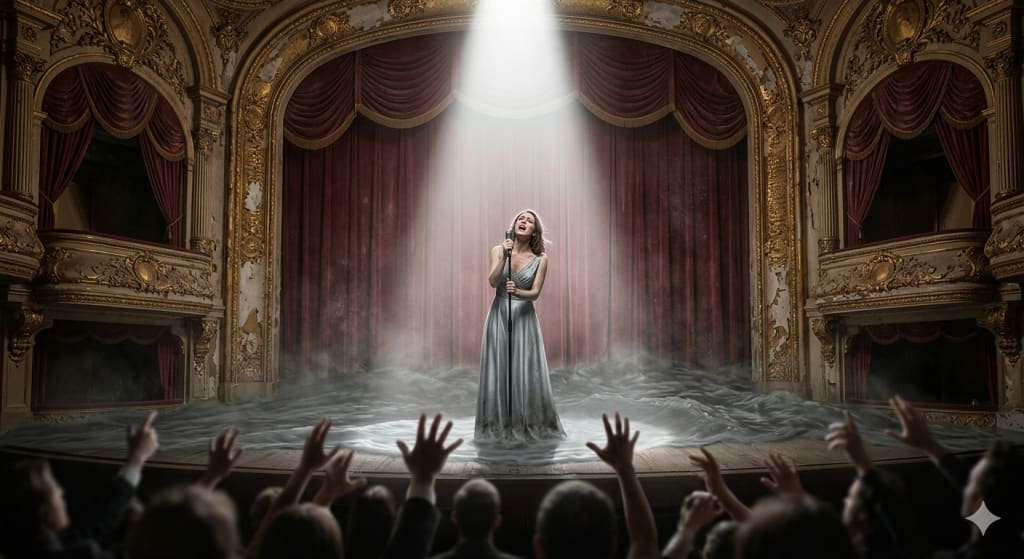
Elena stood in that blinding white spotlight for her final encore.
I didn't see the glamour. I didn't see the aging starlet in her silver gown.
I saw the Water.
It began as a shimmering distortion at the edge of the stage, a phantom tide rising invisibly from the floorboards. It wasn't literal water, yet it possessed a terrifying density. It was thick, gray, and suffocating, pooling around her ankles while she hit an impossible, heartbreaking high C. The crowd erupted, a sea of hands reaching toward her, but to my eyes, they were reaching into a rising flood.
The Water climbed. It reached her knees, then her waist. It moved with a predatory sluggishness, heavy with the weight of "potential" that I had seen around the delivery truck, but amplified a thousandfold. Elena wasn't singing a ballad anymore; she was gasping out a requiem in a room that had already become a tomb. She was fighting for air in a medium only I could see.
I looked around the front row, my heart hammering against my scarred ribs. I was desperate for a witness, some sign that the world wasn't actually drowning. That was when I saw Detective Miller.
He was seated in the VIP box, elevated and shadowed. He wasn't watching the singer. He wasn't even listening to the music. He was watching the clock on the wall with the cold, clinical patience of a farmer awaiting a harvest.
The light from the stage caught his badge, making it glint like a predator’s eye in the dark. While the rest of the audience was lost in the ecstasy of the performance, Miller looked at Elena with a terrifying lack of empathy. He wasn't surprised by the Static churning around her; he invited it. He was a man who knew exactly when the structural integrity of a life was scheduled to fail.
The Water reached Elena’s throat. Her voice cracked—a sound of sheer, unadulterated terror masked as a soul-stirring vibrato.
I couldn't stay silent. The Architect in me—the man who hated failure, who hated to see a structure collapse—overrode the vagrant. I lunged for the stage door, my cane clattering against the floorboards as I pushed through the crowd. I had to scream a warning. I had to tell her the floor was gone, that the current was taking her.
I never made it to the stage.
A hand caught my arm, and the world buckled. Miller was already there, blocking the corridor with a speed that defied his heavy frame. He didn't arrest me. He didn't reach for his cuffs or his radio. He didn't even look surprised to see a scarred, half-mad architect in his path.
"Some structures aren't meant to stand, Silas," he whispered.
His voice was low, devoid of malice but heavy with a terrifying, ancient certainty. His grip on my arm was like a vise, and for a moment, the Static around him changed. It didn't flicker or snow; it turned a deep, bruised purple, so dark it was almost black. It was the color of a storm that never breaks.
"Some are built specifically to fall," he continued, leaning in until I could smell the peppermint on his breath. "'Planned Obsolescence.' It’s the law of the city, Architect. Don't fight the current. You've already drowned once. Don't make us do it again."
I stared into his eyes—flat, gray stones that reflected nothing. He wasn't just a detective; he was a custodian of the inevitable. He let go of my arm, and the force of the release sent me stumbling back against the velvet curtains. By the time I regained my footing, he was gone, and the Orpheum was empty of everything but the echoes of a woman who was already dead.
Two nights later, the inevitable arrived.
Elena Vane was found dead in a luxury bathtub in her penthouse. The world called it a tragic accident—a heart failure, a slip, a sad end for a fading star. The police called it a closed case before the morning editions hit the stands.
But as I sat in my basement, watching the news through the flickering snow of my own vision, I saw a familiar shadow behind the yellow tape. The camera panned briefly past the mantel in Elena’s bathroom, and there was Miller. He wasn't documenting the scene. He was pocketing a small gold record—a trophy, a memento, a piece of her history.
It wasn't evidence. It was a tithe for the Order.
I turned off the television. It was no longer just a symptom of my injury; it was a map.
The Architect was dead. The man who believed in steel and glass had been buried under the Blackwood Bridge. But the Prophet was awake. I saw the city now for what it truly was: a vast, interconnected web of planned collapses, a forest being thinned by unseen hands.
The harvest had only just begun, and for the first time, I realized why I had been tuned to this frequency. I wasn't meant to save the city. I was meant to witness its dismantling.
I picked up my cane and stood, the hum in my head now a steady, driving rhythm. If Miller and his "Order" were the harvesters, I was the one who could see the grain before it fell. And I was no longer afraid of the Water.
The news of Elena Vane’s "accident" didn't just flicker on the screen of my salvaged television; it vibrated through the very floorboards of my basement.
I sat at my scarred oak table, the stolen vellum from the Saint Jude’s project spread out before me. Outside, the rain was a rhythmic drumming on the sidewalk grates—a sound that, to my rewired ears, felt like a slow-motion countdown.
I wasn't looking at the blueprints anymore. I was looking through them.
I pulled a second roll of paper from my coat—the one I’d snatched from the "Unclassified" bin during my raid on the firm. It was the 1954 River-side Viaduct expansion. I remember studying it in university as a triumph of post-war engineering. But now, the triumph looked like a trap.
I reached for my guitar. It was an old jazz box, its finish checked and cracked, but its soul was true. I didn't play a chord. Instead, I took a tuning fork from my drafting kit and struck it against the table.
A-440. The pure, clear tone cut through the gray noise in my head.
I looked over the 1954 blueprints. As the note rang out, the lines on the paper seemed to shiver. I struck the fork again, this time muting the string of the guitar to a flat, dissonant E-flat.
The Static exploded. The gray snow turned into a jagged, electrical storm, hovering precisely over the viaduct’s suspension cables.
"Harmonics," I whispered, the copper taste in my mouth intensifying. "They aren't just breaking things. They’re tuning them."
The city had turned it into a massive, architectural orchestra. The viaduct hadn't collapsed because of "structural fatigue." It had collapsed because the wind that day had hit a specific velocity, creating a frequency that matched the "Scythe" signature hidden in the steel. The bridge had literally sung itself to death.
I looked back at the TV. Elena Vane’s face stared out—the "Icon of the Era." Her death was being broadcast on every channel, a coordinated pulse of public grief.
I began to sketch on the back of the vellum, my "trembling claw" moving with a frantic, rediscovered purpose. If a bridge could be tuned to collapse, then a city’s collective emotion could be tuned to power. The "Architecture of the Scythe" wasn't just about buildings. It was about the energy released when those buildings—and the people inside them—fell.
Public tragedy was the battery. The Static was the current. And I was the only one who could find how to short-circuit the machine.
I picked up the guitar and played a single, dissonant tritone—the diabolus in musica. The air turned crystal clear, the silence so profound it made my ears ache.
I had found the counter-frequency.
I wasn't just a witness anymore. I was a demolitionist learning the weak points of a god. I rolled up the blueprints, grabbed my cane, and stepped out into the rain. I knew where the next "tuning" was going to happen. I could feel the subway lines beneath my feet beginning to hum, I had to find out what Miller's role was in this and I had a feeling about where to start:
About the Creator
Nathan McAllister
I create content in the written form and musically as well. I like topics ranging from philosophy, music, cooking and travel. I hope to incorporate some of my music compositions into my writing compositions in this venue.
Cheers,
Nathan
Keep reading
More stories from Nathan McAllister and writers in Futurism and other communities.
The Frequency of the Doomed
The loss of my career, my name, and my penthouse was a sequence of external tragedies, a series of demolitions I could at least understand through the lens of cause and effect. But they were nothing compared to the loss of my silence.
By Nathan McAllisterabout 24 hours ago in Futurism
AI Orchestration Platform Market to hit USD 48.7 Billion By 2034
The Global AI Orchestration Platform Market is projected to reach approximately USD 48.7 Billion by 2034, rising from USD 5.8 Billion in 2024, and it is expected to grow at a CAGR of 23.7% during the forecast period from 2025 to 2034. The expansion of this market is largely driven by the increasing deployment of artificial intelligence solutions across enterprise environments.
By Roberto Crum6 days ago in Futurism
Top 10 Stablecoin Development Companies in the USA Leading Blockchain Innovation
The world of finance is changing faster than ever. Traditional payment systems that once took days to process transactions are slowly being replaced by faster, blockchain-powered solutions. At the center of this transformation are stablecoins—digital assets designed to maintain a stable value while leveraging the efficiency of blockchain technology.
By Ritu Singh7 days ago in Futurism




Comments
There are no comments for this story
Be the first to respond and start the conversation.