
The Return of History
From the Illusion of Endless Progress to the Harsh Logic of Survival

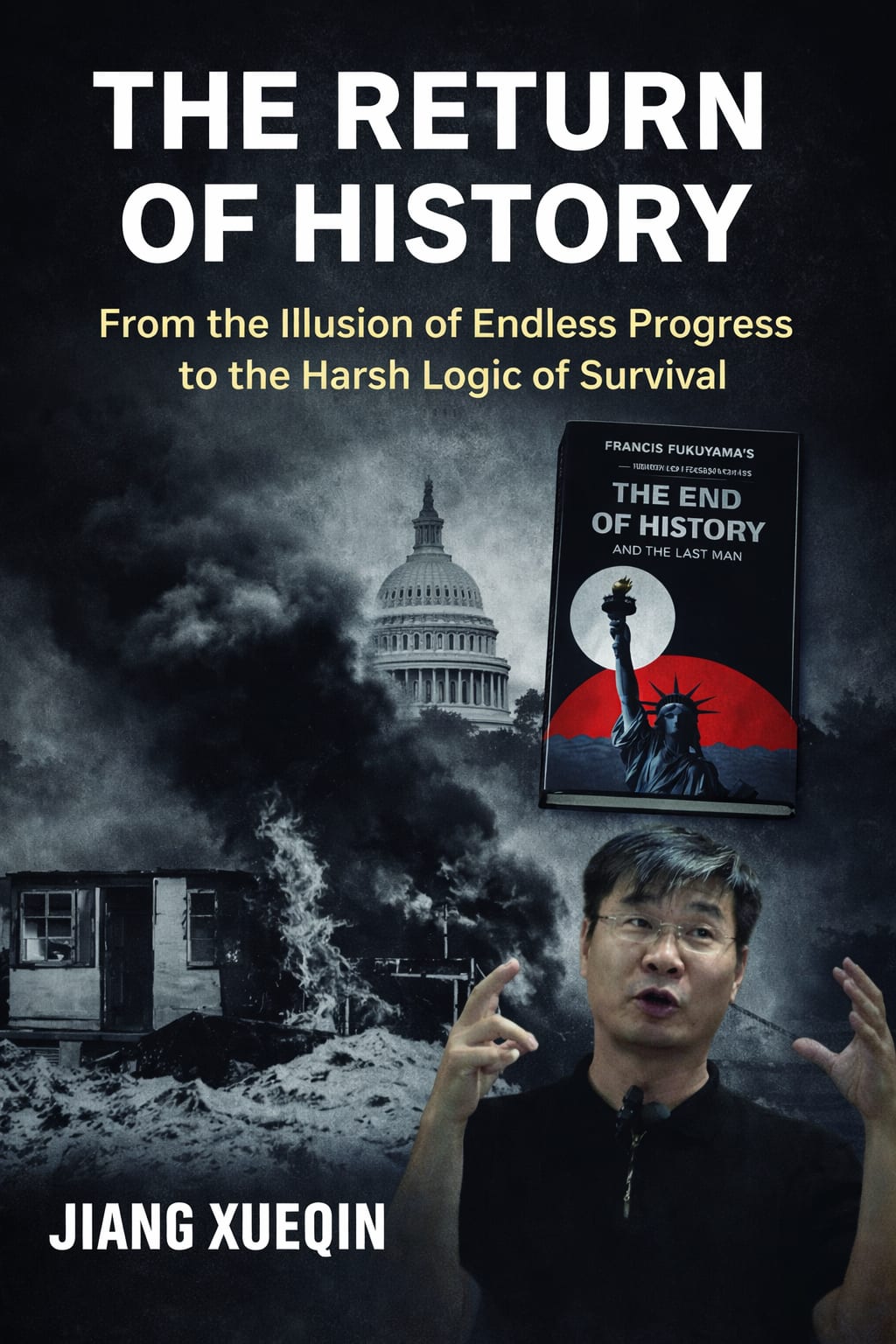
Jiang Xueqin is an educator and thinker known for connecting game theory with broad civilisational and geopolitical analysis. In this argument, he develops a sweeping interpretation of global change, challenging the idea that the post-Cold War order represents a stable endpoint of history. He presents a stark vision of a world entering a new phase defined by instability, scarcity, and the need for resilience.
The Return of History
Jiang Xueqin, Game Theory #15, March 24, 2026
"The new history brings a world in which stability is no longer assumed but constantly contested. It replaces the comfort of global efficiency with the harsh demand for resilience, adaptation, and sacrifice. It returns power to geography, resources, and collective identity, where survival depends less on wealth than on cohesion and endurance. Above all, it forces humanity to confront limits again—of growth, of control, and of the illusion that progress is irreversible."
1. De-industrialisation and de-urbanisation: movement from cities back to countryside and basic survival skills
2. Rise of nationalism and re-militarisation, especially mobilisation of youth
3. Fragmentation into regional trading blocs and decline of globalisation
4. Resource wars over energy, food, and water
5. Increased risk of famine, collapse, and extreme social hierarchies (including forms of servitude)
6. Mass migration from unstable regions (Global South → Europe/North America)
7. Political instability: revolutions, civil unrest, and generational conflict in ageing societies
8. Growing importance of religion and spiritual frameworks for social cohesion
9. Shifting geopolitical alliances and constant global instability (no fixed enemies or blocs)
10. Demographic crisis: ageing populations vs disempowered youth
11. Emergence of AI-driven surveillance states and sharper class divisions
12. Transition to a world defined by resilience, scarcity, and continuous crisis rather than stability
13. American Holy Empire, Rise of Transnational Religion
14. Japan Co-prosperity Sphere
15. Pax Judaica
16. German-Russia Alliance
Francis Fukuyama’s idea in ‘The End of History’ once expressed the great confidence of the post-Cold War age: the belief that liberal capitalism had resolved the central ideological conflict of modernity and that humanity had, in some sense, discovered its final political form. The deeper meaning of the argument examined here, however, is that this confidence was never the end of history at all, but only the temporary illusion produced by a rare and fragile global arrangement. What appeared to be permanent peace, universal progress, rational governance, and endless material expansion was in fact the product of a specific balance of power, a specific energy regime, and a specific cultural mood. Once these foundations begin to weaken, history returns, not as an academic concept but as conflict, scarcity, instability, and the collapse of inherited certainties. The central claim is that the world shaped by American hegemony after 1989 is breaking apart, and that societies must now prepare for an age defined less by efficiency and comfort than by adaptation and survival. The post-Cold War order was built on three interlocking assumptions. The first was military and geopolitical supremacy. A single dominant power, through superior armed force, intelligence capacity, and global reach, could police the world sufficiently to keep trade routes open, suppress major regional conflict, and maintain the conditions for global integration. This was not peace in any ideal sense, but a managed order in which the overwhelming power of one centre limited the ambitions of others. The second assumption was epistemic: science took on the cultural role once occupied by religion. Expertise, institutions, and professional authority became objects of trust, not simply because they produced knowledge, but because they seemed to embody an unquestionable legitimacy. Under such conditions, doubt could easily be recast as ignorance, and technical authority could harden into orthodoxy. The third assumption was monetary and economic universality. The US dollar functioned not merely as a currency but as a kind of secular theology of value, a symbolic measure through which aspirations, production, ambition, and hierarchy were organised across the globe. Together, these three pillars sustained the unipolar world: military dominance, scientific legitimacy, and financial universality. Yet the deeper argument is that every hegemonic order contains within itself the seeds of decay. Power that first presents itself as stabilising gradually becomes arrogant; knowledge that first appears liberating becomes doctrinal; money that first organises exchange becomes detached from reality and feeds speculation, corruption, and inequality. The point is not simply that America declined, or that institutions weakened, but that the very success of the system produced forms of excess that undermined its own legitimacy. When a global order begins to exempt itself from the rules it claims to uphold, when science becomes more concerned with policing acceptable thought than encouraging discovery, and when money circulates more as abstraction than as a measure of real value, the structure starts to hollow out from within. What follows is not a smooth transition but a return of historical pressure: rival powers re-emerge, resource dependencies become visible, and populations begin to experience the limits of a system once presented as boundless. At the heart of this worldview is a powerful contrast between efficiency and resilience. Efficiency belongs to the world of globalisation. It seeks maximum output, lowest cost, greatest speed, and widest scale. It assumes that supply chains will hold, that energy will remain abundant, that markets will stay open, and that political stability will continue. Resilience belongs to a different imagination of the future. It assumes disruption rather than continuity, shock rather than equilibrium, and breakdown rather than seamless coordination. A resilient society is not the one that becomes richest under ideal conditions, but the one that can survive when ideal conditions vanish. This distinction carries enormous philosophical weight because it marks a shift from the mentality of optimisation to the mentality of endurance. A civilisation built for efficiency becomes fragile precisely because it strips away redundancies, local capacities, and communal habits that would help it survive crisis. It becomes highly profitable and highly vulnerable at the same time. This is why modern global life appears, in this interpretation, not as a triumph of rational organisation but as an elaborate structure balanced on hidden dependencies. Cheap oil, secure shipping lanes, fertiliser networks, internet cables, financial clouds, and international confidence all make contemporary life look normal. But what is called normality is in fact a vast technical and geopolitical achievement that can quickly become brittle. Once energy prices rise, transport becomes insecure, or resource flows are interrupted, the apparent solidity of the global order is revealed to be contingent. The lecture’s broader meaning lies in this unveiling of dependency. The modern individual imagines himself free, mobile, informed, and autonomous, yet his entire way of life rests on systems he neither sees nor controls. His food depends on fertiliser and shipping, his communication on undersea cables and server farms, his mobility on aviation networks and oil flows, his comfort on the stability of distant regions he barely understands. What appears as personal freedom is therefore inseparable from imperial order, industrial complexity, and resource extraction. Once these begin to fracture, the freedom they enabled also changes character. Another important dimension of the argument concerns the moral and psychological structure of modern societies. Material abundance encouraged people to think of politics primarily in terms of consumption, lifestyle, and private aspiration. Governments could justify themselves by promising growth, convenience, and rising standards of living. In such a world, meaning became increasingly individualised. The good life was imagined as personal choice, personal satisfaction, and personal accumulation. But this model is portrayed as unsustainable in conditions of decline. When there is less to distribute, less energy to consume, less wealth to promise, and less stability to protect, the state can no longer rely on material gratification alone. It must appeal instead to sacrifice, duty, shared identity, and spiritual significance. This is why the shift from materialism to spirituality appears so central. The point is not only religious in a narrow sense. It is civilisational. A society that expects comfort above all else cannot easily endure scarcity. A society that has forgotten transcendence cannot easily justify sacrifice. A population trained to think in terms of rights and desires may prove weak when confronted with collective danger. Under those conditions, religion or some form of higher moral narrative reappears not as a relic of the past but as a resource of endurance. The same logic applies to the shift from individualism to community. Hyper-individual societies can be innovative and dynamic under favourable conditions, but they can also become atomised, lonely, and incapable of coordinated sacrifice. Community here is not sentimental. It is functional and existential. In an age of disorder, a person survives not as an isolated consumer but as part of a household, a family, a neighbourhood, or a nation that still possesses loyalty and mutual obligation. In this sense, the argument is profoundly anti-liberal, not necessarily because it rejects freedom as such, but because it rejects the image of freedom as detached self-assertion. The future belongs, in this view, to collectivities that can demand discipline, inspire loyalty, and preserve coherence under pressure. Demography becomes crucial within this framework. Ageing societies are presented as decadent not simply because they have many elderly people, but because wealth, power, and decision-making become concentrated in generations whose interests are defensive, self-protective, and resistant to transformation. Youth, by contrast, represents risk, action, fertility, renewal, and the willingness to build under harsh conditions. The deeper claim is that a civilisation cannot survive if its young are economically blocked, culturally demoralised, and politically marginalised while its old retain disproportionate control over institutions and resources. This turns demographic structure into a philosophical issue. It becomes a question of whether a society still believes in the future strongly enough to empower those who must inhabit it. In that respect, gerontocracy is not merely a sociological problem but a symbol of civilisational exhaustion. The old order clings to itself even as it loses the capacity to regenerate. The argument about migration extends this diagnosis to the global level. If large regions experience food scarcity, water stress, war, and ecological instability, people will move. If wealthy northern societies are ageing and require labour, they will import migrants even while fearing the social effects of doing so. This creates a tragic contradiction. Liberal economies need workers, but ageing populations fear replacement; southern populations need survival, but northern societies interpret their arrival as cultural threat. Thus migration becomes not simply a humanitarian issue but a pressure point where demography, economics, identity, and sovereignty collide. The result is likely to be deep social conflict within the states that once imagined themselves stable and secure. One of the strongest aspects of this argument is its insistence that globalisation concealed geography rather than abolishing it. Energy, water, arable land, trade routes, chokepoints, and regional balances of power still matter. The world did not transcend geography after the Cold War; it merely grew accustomed to ignoring it because one hegemonic power temporarily guaranteed the flows on which global life depended. Once that guarantee weakens, physical reality returns with force. Nations with food security, energy resources, geographical protection, and cultural cohesion gain strategic weight. Nations dependent on imports, fragile supply chains, or unstable neighbours become exposed. The return of history therefore also means the return of geography, logistics, and hard limits. The world ceases to be a frictionless market and becomes once again a field of contested survival. The darker side of this vision is its expectation that the decline of cheap energy and open global trade could produce more coercive and brutal forms of political order. If industrial abundance retreats, human labour itself may become cheap again. In older civilisations, when energy was scarce and mechanical substitutes were limited, human beings were often treated as expendable fuel. The suggestion that new forms of servitude, surveillance, or quasi-feudal hierarchy may return is therefore not a historical fantasy but an extrapolation from the relation between energy and social organisation. A society with less surplus and more insecurity tends to harden its class divisions. Freedom becomes stratified. Those at the top retain mobility, options, and autonomy, while those below are subjected to control in the name of order, necessity, and efficiency. This is where the argument about technological surveillance becomes especially significant. A future of scarcity need not resemble the past outwardly. It may combine advanced digital monitoring with archaic social relations. The result would be a highly administered world in which technology does not liberate but disciplines populations under conditions of declining abundance. The essay’s most unsettling implication is that many people still imagine crisis as temporary interruption rather than epochal change. There remains a strong desire to believe that wars end, markets recover, trade resumes, and life returns to what it was before. But the deeper claim here is that historical thresholds do not work like that. Once an order loses legitimacy, once energy regimes shift, once demographic imbalances sharpen, and once global trust fractures, there is no simple return. A new age begins before people are psychologically ready to admit it. This is why the phrase ‘the return of history’ matters. History returns when the future ceases to look like more of the same. It returns when politics is no longer about managing abundance but about distributing pain, when identity is no longer ornamental but existential, when belief is no longer private but strategic, and when power is no longer hidden behind neutral systems but openly contests the shape of survival. The argument can certainly be criticised for its sweeping generalisations and apocalyptic tone, yet its force lies in the way it links geopolitics, economics, demography, culture, and psychology into one civilisational picture. Its real subject is not only international order but the end of an entire way of imagining the world. The age that treated consumption as freedom, globalisation as destiny, science as unquestionable authority, and money as universal meaning is entering a phase of decomposition. In its place emerges a harsher question: what kind of people, communities, and nations can endure when growth slows, certainty dissolves, and comfort can no longer hold society together? That is the true meaning of the return of history. It means that civilisation is once again exposed to tragedy, to necessity, and to the old law that societies survive not because they are rich or sophisticated, but because they possess discipline, cohesion, memory, and the strength to adapt when the world they took for granted disappears.
About the Creator
Peter Ayolov
Peter Ayolov’s key contribution to media theory is the development of the "Propaganda 2.0" or the "manufacture of dissent" model, which he details in his 2024 book, The Economic Policy of Online Media: Manufacture of Dissent.
Keep reading
More stories from Peter Ayolov and writers in Futurism and other communities.
Electrifying the Existing Fleet
Electrifying the Existing Fleet: National Retrofitting as an Industrial and Climate Strategy Abstract The large-scale electrification of used internal combustion engine vehicles through retrofitting has emerged as a contested but increasingly plausible strategy within circular economy and climate policy frameworks. Rather than relying exclusively on the production of new electric vehicles, national-scale conversion programmes propose extending the life of existing vehicle fleets, particularly for government and commercial use. This article analyses the environmental rationale, economic viability, industrial constraints, policy landscape, and consumer adoption challenges associated with used-car electrification. Drawing on European case studies, cost comparisons, and current incentives, it argues that retrofitting is not a universal substitute for new electric vehicles but represents a strategically efficient solution for specific use cases, especially urban fleets operating on predictable routes.
By Peter Ayolov2 months ago in Futurism
How machines can learn from human behaviour
In order to understand where we are and where we are going, we need to understand where we were first. - Susan Fourtane Could a human behaviour simulator be embedded into a robot or online avatar to the point that it’s hard to distinguish between a real person or artificial intelligence? Scientists have been upping the stakes in this “Turing test” for years, to the point that human-mimicking programmes are ready to answer tricky questions, assist people with online shopping or be companions.
By Susan Fourtané 8 days ago in Futurism
Adhesives and Sealants Market Outlook: Sustainable Formulations & Emerging Applications
According to IMARC Group's latest research, the global adhesives and sealants market size reached USD 72.4 Billion in 2025. Looking forward, IMARC Group expects the market to reach USD 105.1 Billion by 2034, exhibiting a growth rate (CAGR) of 4.10% during 2026–2034.
By sujeet. imarcgroupabout 6 hours ago in Futurism




Comments
There are no comments for this story
Be the first to respond and start the conversation.