
Animal Farm
A Timeless Allegory of Power and Corruption


Animal Farm, written by George Orwell in 1945, is widely regarded as one of the most influential allegorical novels of the 20th century. Though it tells the story of a group of farm animals overthrowing their human owner, the novel is far more than a tale about animals—it is a profound commentary on political power, corruption, and the cyclical nature of oppression.
Plot Summary
The story is set on Manor Farm, where the animals, led by the pigs, rise against Mr. Jones, the negligent and often cruel farmer. Inspired by the visionary pig Old Major, the animals dream of a society free from human exploitation. After the rebellion, they rename the farm Animal Farm and establish a set of principles known as Animalism, advocating equality and collective ownership.
Initially, the farm flourishes, and the animals experience hope and a sense of freedom. However, as time passes, the pigs—particularly Napoleon—begin to consolidate power. Through manipulation, propaganda, and fear, the pigs slowly betray the principles of the rebellion, ultimately becoming indistinguishable from the oppressive humans they once overthrew.
1. Power and Corruption
One of the novel’s central messages is the corrupting influence of power. Napoleon’s rise mirrors historical figures who exploited revolutionary ideals for personal gain. Orwell demonstrates that those in authority often prioritize self-interest over communal well-being, warning readers that unchecked power leads to tyranny.
2. The Dangers of Propaganda
The character of Squealer, a pig who serves as Napoleon’s mouthpiece, exemplifies the role of propaganda in controlling the masses. By constantly altering facts and rewriting history, Squealer manipulates the other animals, keeping them obedient despite worsening conditions. This mirrors real-world regimes that rely on misinformation to maintain dominance.
3. Inequality and Class Struggle
Despite the rebellion’s promise of equality, Animal Farm illustrates how societal hierarchies can reemerge even after revolutions. The pigs assume privileges and luxuries denied to other animals, demonstrating that revolutions can replace one form of oppression with another. This reflects Orwell’s critique of the Soviet Union after the Russian Revolution.
4. Idealism vs. Reality
The animals’ initial dreams represent idealism—hope for a fair, just society. Yet, the harsh reality of governance and human nature reveals that achieving utopia is fraught with challenges. Orwell’s work emphasizes the tension between noble intentions and the corrupting influence of power and greed.

Symbolism
Animal Farm is rich in symbolism. Each character and event parallels real historical figures and occurrences:
- Napoleon symbolizes Joseph Stalin, while Snowball, another pig, represents Leon Trotsky.
- Old Major embodies Karl Marx and Vladimir Lenin, whose ideas inspired revolutionary movements.
- The farm itself serves as a microcosm for human society, illustrating the mechanisms of political control and societal hierarchy.
- The windmill represents both industrial progress and the exploitation of the working class for leaders’ ambitions.
Relevance Today
Although written in the aftermath of World War II, Animal Farm remains relevant. Its lessons about propaganda, authoritarianism, and the fragility of freedom are timeless. Across the world, readers continue to find parallels between Orwell’s allegory and modern political events, emphasizing the novel’s enduring social and political resonance.
The novel also serves as a cautionary tale for future generations, illustrating that complacency and blind obedience enable tyranny, regardless of how noble a movement’s origins may appear.
Literary Style
Orwell’s writing in Animal Farm is deceptively simple, with clear prose that makes the allegorical story accessible to readers of all ages. The narrative style, combined with sharp satire, allows readers to grasp complex political ideas through a compelling story. The use of animals rather than humans universalizes the message, highlighting how corruption, greed, and ambition are human flaws, regardless of context.
Conclusion
Animal Farm is more than a story about farm animals; it is a masterful allegory about the nature of power, revolution, and human behavior. Orwell’s incisive critique of corruption and propaganda, coupled with the novel’s rich symbolism and enduring themes, ensures that it remains a cornerstone of political literature. Its warnings about the dangers of authoritarianism, the manipulative power of propaganda, and the cyclical nature of oppression remain as relevant today as they were in 1945.
About the Creator
Zain writes
I am a writer, and I write these words for all of you, my readers, who appreciate meaningful and thought-provoking content.
Keep reading
More stories from Zain writes and writers in Geeks and other communities.
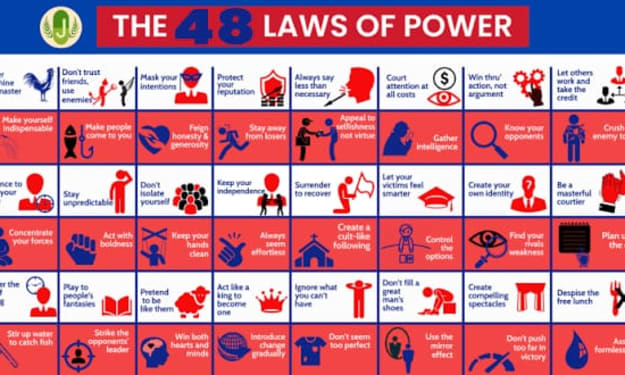
The 48 Laws of Power
In a world where influence shapes outcomes, few books have captured the nuances of power as profoundly as The 48 Laws of Power by Robert Greene. First published in 1998, this bestselling book has become a cornerstone for anyone seeking to understand human behavior, strategy, and the delicate dynamics of authority. Its appeal spans leaders, entrepreneurs, politicians, and even artists, offering a pragmatic—if sometimes controversial—approach to achieving and maintaining influence.
By Zain writes2 days ago in Geeks
Simpsons Review: "So It's Come to This: A Simpsons Clip Show"
Happy April Fools' Day, all! It's been a while since I've written a review of a Simpsons episode, and with today being the aforementioned holiday, I just have to talk about this episode. It's a landmark episode, in more ways than one, so let's get to it.
By Clyde E. Dawkins7 days ago in Geeks
Rambo's Legacy
John Rambo is as iconic an action hero as Sarah Connor, John McClane, or nearly any of Schwarzenegger's roles at the height of his career. Yet for all the explosions, archery, horse-riding, and feathered hair that the cinematic guerrilla fighter is remembered for, most people today don't acknowledge the humbler, more tragic origins of the character in his onscreen debut "First Blood" (1982).
By Andrei Babanin6 days ago in Geeks


Comments
There are no comments for this story
Be the first to respond and start the conversation.