
Beneath the Führer’s Shadow
Exploring the underground world of the Wolf’s Lair and the mysteries buried beneath one of Nazi Germany’s most secretive headquarters

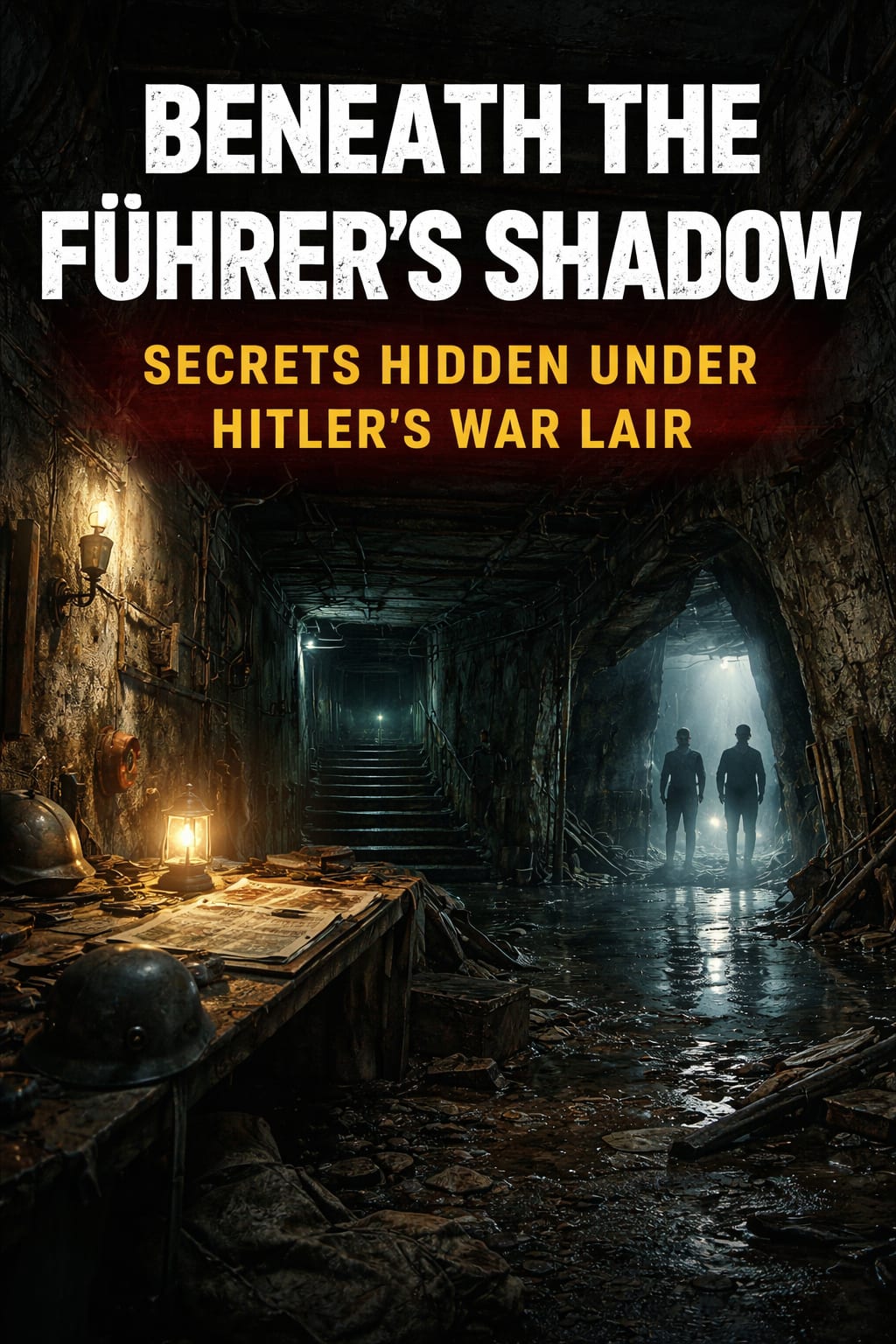
Deep within the dense forests of northeastern Poland once stood one of the most heavily guarded and secretive military complexes of the Third Reich: the Wolf’s Lair. Known in German as Wolfsschanze, this sprawling wartime headquarters served as the primary command center for Adolf Hitler during much of World War II. While the ruins above ground still draw visitors today, it is what lies beneath the surface that continues to intrigue historians, archaeologists, and conspiracy theorists alike.
Constructed in 1940 as part of Germany’s preparations for the invasion of the Soviet Union, the Wolf’s Lair was far more than a collection of bunkers. It was a fortified city hidden in the woods, complete with railways, airstrips, and layers of security. Yet, the visible structures tell only part of the story. Beneath the concrete and steel lay a network of underground passages, shelters, and possibly even deeper, more secretive chambers.
The underground infrastructure of the Wolf’s Lair was designed with both practicality and paranoia in mind. Hitler and his inner circle feared assassination attempts and aerial bombardment, so engineers created reinforced subterranean spaces capable of withstanding massive explosions. Thick concrete roofs, some up to eight meters deep, covered bunkers that extended below ground level. These spaces housed communication rooms, war planning areas, and personal quarters, all connected by hidden corridors.
One of the most famous events linked to the Wolf’s Lair is the failed assassination attempt on Hitler during the July 20 Plot. Led by German officer Claus von Stauffenberg, the plot involved a bomb placed inside a conference room within the complex. Although the explosion killed several individuals, Hitler survived—partly due to the structure of the building and perhaps also because key meetings were sometimes held above ground rather than in the deeper bunkers. This incident reinforced the regime’s obsession with underground security.
Despite extensive documentation, much of what lies beneath the Wolf’s Lair remains uncertain. As Nazi forces retreated in 1945, they attempted to destroy the complex to prevent it from falling into enemy hands. Massive explosives were used to demolish buildings, collapsing many entrances to underground areas. However, the destruction was incomplete. Today, large sections of the underground network are either inaccessible or unexplored, buried under rubble and forest growth.
This has led to decades of speculation. Some believe that deeper tunnels may connect the Wolf’s Lair to other hidden ռազմական installations across the region. Others suggest that secret archives, treasures, or classified documents might still lie buried beneath the ruins. While no definitive evidence supports the existence of hidden Nazi gold or secret weapons laboratories here, the idea persists, fueled by the secrecy that surrounded the site during the war.
Modern archaeological efforts have begun to shed light on these mysteries. Using ground-penetrating radar and other technologies, researchers have identified anomalies beneath the surface that could indicate undiscovered chambers. Excavations, however, are slow and cautious. The area is still littered with unexploded ordnance, making exploration dangerous even decades after the war’s end.
Beyond speculation, what is certain is that the underground structures of the Wolf’s Lair played a crucial role in the Nazi war machine. From these hidden rooms, Hitler directed military campaigns that would shape the course of the war, including the disastrous invasion of the Soviet Union. The subterranean design reflects not only military necessity but also the mindset of a regime driven by secrecy, control, and fear.
Today, the ruins of the Wolf’s Lair stand as a haunting reminder of that era. Moss-covered bunkers and shattered concrete blocks mark the visible remains, but beneath them lies a darker, less understood world. Visitors walking through the forest paths may not realize that just below their feet are layers of history—sealed corridors, collapsed chambers, and perhaps secrets that will never be fully uncovered.
In the end, what lies beneath Hitler’s war lair is a mixture of documented engineering and enduring mystery. It is a buried network that symbolizes both the technological ambition and the moral darkness of Nazi Germany. As research continues, some answers may eventually emerge. Yet, like many relics of World War II, the deepest secrets of the Wolf’s Lair may remain hidden underground, locked away by time, destruction, and the silence of history.
About the Creator
Irshad Abbasi
Ali ibn Abi Talib (RA) said 📚
“Knowledge is better than wealth, because knowledge protects you, while you have to protect wealth.
Keep reading
More stories from Irshad Abbasi and writers in History and other communities.
The Enigmatic Death of Jane Austen
The death of Jane Austen, one of the most cherished authors in English literature, continues to puzzle historians and medical experts more than two hundred years later. Best known for her timeless works such as Pride and Prejudice and Sense and Sensibility, Austen left behind not only a literary legacy but also a lingering mystery surrounding her untimely death at the age of 41.
By Irshad Abbasi about 11 hours ago in History
The Crusades
On July 15, 1099, after five weeks of siege, Christian Crusaders breached the walls of Jerusalem and embarked on a massacre so extreme that eyewitnesses reported riding horses through streets where blood reached the stirrups, slaughtering every Muslim and Jewish resident they could find regardless of age or gender, and one chronicler recorded that the killers then washed the blood from their hands and walked barefoot to the Church of the Holy Sepulchre to pray and give thanks to God for their victory, seeing no contradiction between worship and genocide.
By The Curious Writerabout 13 hours ago in History



Comments
There are no comments for this story
Be the first to respond and start the conversation.