
Cannabis in Ancient Worship?
A critical exploration of claims that ancient Israelites used cannabis in religious ceremonies—and what archaeology actually reveals

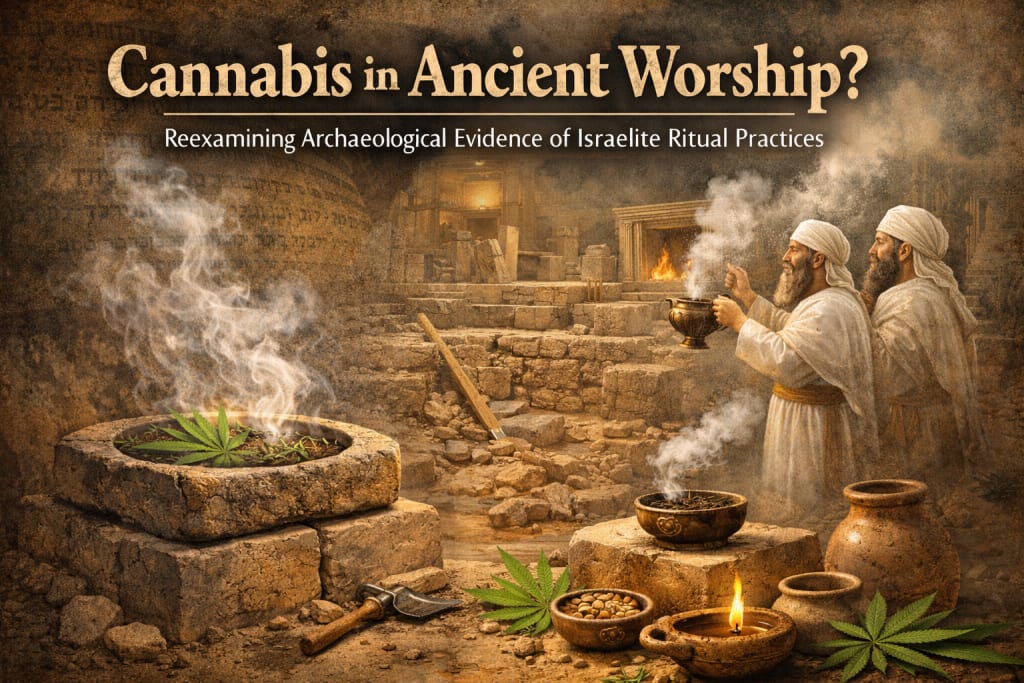
The idea that cannabis played a role in ancient religious rituals has attracted growing attention in recent years, particularly in discussions about the spiritual practices of the ancient Israelites. Some researchers and popular media sources have suggested that members of the Israelite community may have burned cannabis during worship, raising intriguing questions about the intersection of religion, culture, and psychoactive substances in antiquity. But how strong is the evidence behind this claim, and what does archaeology truly tell us?
The debate largely stems from a notable archaeological discovery at Tel Arad, a site in present-day Israel. In the remains of a small shrine dated to around the 8th century BCE—during the Kingdom of Judah—researchers found traces of organic materials on two limestone altars. Scientific analysis revealed that one of these altars contained residues consistent with cannabis, while the other showed evidence of frankincense, a well-known aromatic resin widely used in ancient religious rituals.
This finding sparked considerable interest because it appeared to provide direct material evidence of cannabis being used in a formal religious context. According to the researchers involved, the cannabis may have been burned intentionally to produce a psychoactive effect, potentially enhancing spiritual experiences or inducing altered states of consciousness during worship.
However, interpreting this evidence requires caution. Archaeology can tell us what substances were present, but understanding how and why they were used often involves speculation. While the presence of cannabis residue is scientifically supported, its function within the ritual is not definitively known. It is possible that the substance was used for its aroma, symbolic significance, or medicinal properties rather than for intoxication.
Moreover, it is important to consider the broader historical and cultural context. The religious practices of ancient Israel were not uniform and evolved over time. They were also influenced by neighboring cultures in the ancient Near East, many of which incorporated various plants and resins into their rituals. For instance, incense burning was a common feature in temples across the region, often associated with purification, prayer, and divine communication.
Another point of discussion revolves around biblical texts. Some scholars have attempted to link cannabis to the Hebrew term “kaneh-bosm,” which appears in the Old Testament as an ingredient in sacred anointing oil. While a few researchers argue that this term could refer to cannabis, the majority of linguistic and historical analyses identify it as calamus, a different aromatic plant. This debate remains unresolved but highlights the challenges of translating and interpreting ancient languages.
Critics of the cannabis-in-worship theory also emphasize that a single archaeological site does not necessarily represent widespread religious practice. The shrine at Tel Arad may reflect a localized or even heterodox tradition rather than mainstream Israelite worship. In fact, historical records suggest that religious reforms during the reigns of certain Judean kings sought to centralize worship in Jerusalem and eliminate alternative or unauthorized practices.
Additionally, the preservation of organic residues over thousands of years is rare, making such discoveries both valuable and difficult to contextualize. Environmental factors, contamination, and limitations in analytical techniques can all affect the interpretation of results. Therefore, while the Tel Arad findings are compelling, they should be viewed as part of a broader and still-developing body of evidence.
Beyond the specifics of cannabis use, this discussion touches on a larger theme: the role of sensory experience in ancient religion. Rituals often engaged multiple senses—sight, sound, smell, and sometimes taste—to create a powerful atmosphere of sacredness. The burning of incense, the chanting of prayers, and the use of symbolic objects all contributed to a deeply immersive spiritual environment. Whether or not cannabis was part of this experience, the importance of sensory elements in worship is well established.
In conclusion, the claim that ancient Israelites burned cannabis during worship is based on intriguing but limited archaeological evidence. The discovery at Tel Arad opens the door to new interpretations of ancient religious practices, but it does not provide definitive proof of widespread or intentional psychoactive use in Israelite rituals. As research continues and new discoveries emerge, our understanding of the ancient world—and its complex spiritual traditions—will undoubtedly continue to evolve.
About the Creator
Irshad Abbasi
Ali ibn Abi Talib (RA) said 📚
“Knowledge is better than wealth, because knowledge protects you, while you have to protect wealth.
Keep reading
More stories from Irshad Abbasi and writers in History and other communities.
Ancient Neanderthal Remains Unearthed in Italian Cave Shed Light on Prehistoric Life
Archaeologists in Italy have uncovered remarkable remains of Neanderthals in a coastal cave, offering fresh insights into the lives of these ancient human relatives. The discovery, made in the well-known Grotta Guattari, has been described by researchers as one of the most significant Neanderthal findings in recent decades.
By Irshad Abbasi 5 days ago in History
Antarctica's Blood Falls Mystery
In 1911, explorers discovered a glacier in Antarctica bleeding bright red water, and when scientists finally analyzed what was coming out, they found an ecosystem that has been sealed away from Earth's surface for millions of years.
By The Curious Writer7 days ago in History
Why Iran Is Impossible to Conquer
In 1986, the United States launched an attack on Libya. In 2003, it invaded Iraq. And in 2014, it carried out operations in Syria. Time and again, America has tried to reshape the destiny of the Middle East. But there is one country that has remained beyond its control for decades — Iran.
By Imran Ali Shah3 days ago in History


Comments
There are no comments for this story
Be the first to respond and start the conversation.