
Inside the Hunt for the Other Humans
In a world reshaped by silence, one question drives the journey: who else is still out there?

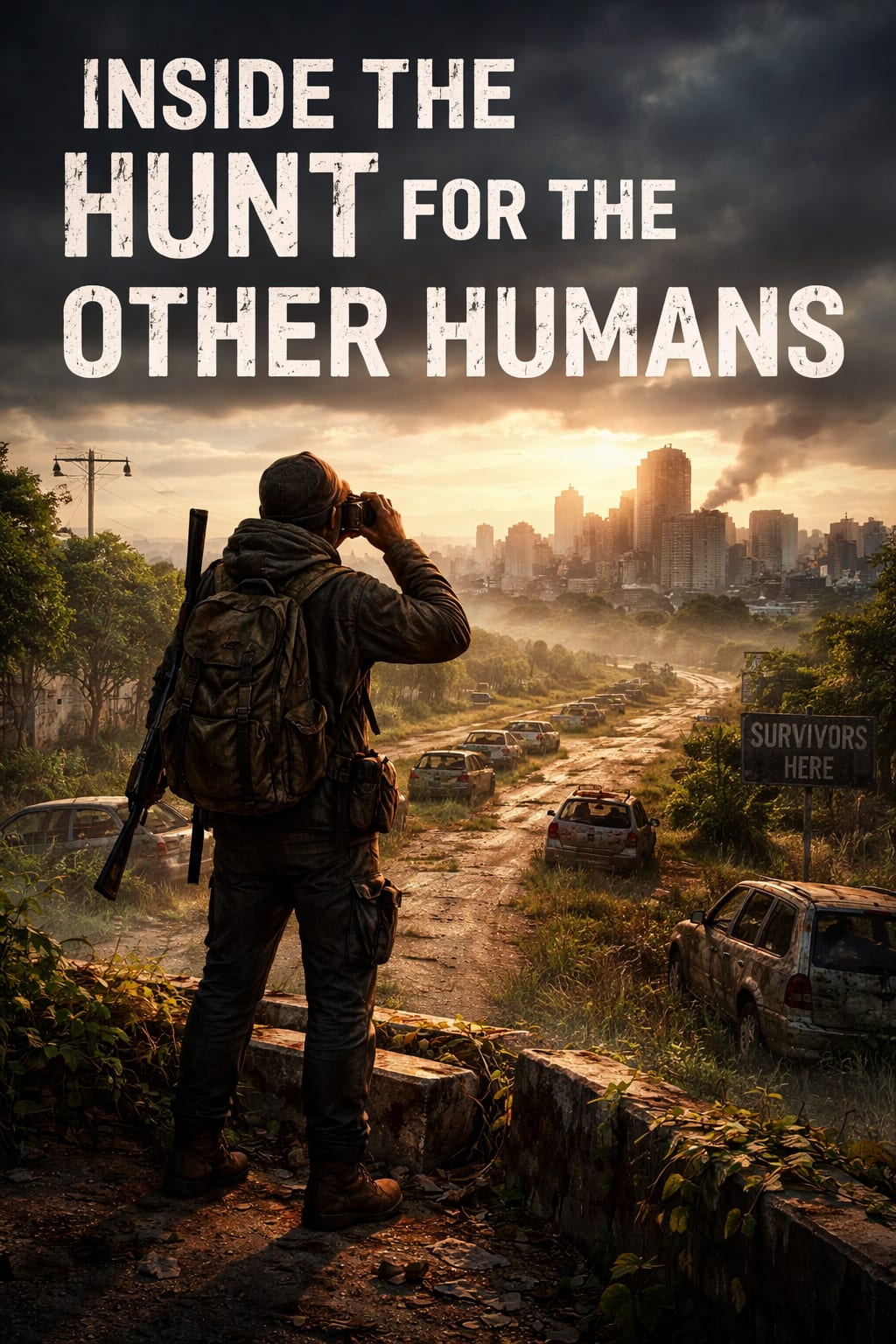
The first sign that something was wrong wasn’t the silence—it was the absence of interruption. No distant engines, no chatter bleeding through thin walls, no sudden bursts of laughter from unseen neighbors. Just a stillness so complete it felt intentional, as if the world had paused mid-breath and forgotten how to continue.
For those who remain, the search for other humans has become more than survival. It is purpose, obsession, and sometimes the only reason to keep moving forward. Because solitude, when stretched long enough, begins to erode the edges of identity. Without others, who are we?
The hunt is not like the old searches of history—no maps with marked cities, no reliable signals, no institutions coordinating efforts. The systems that once connected humanity—satellites, networks, infrastructure—have either collapsed or become unreliable ghosts, flickering in and out of usefulness. What remains is instinct, improvisation, and hope.
Hunters, as they’ve come to be called, travel light. They carry what they can, abandon what they must, and learn quickly that attachment is dangerous. Not just to objects, but to places. Any location that feels safe for too long becomes a trap—resources dwindle, structures decay, and isolation deepens. Movement is survival.
But movement is also risk.
The world itself has changed in subtle, disorienting ways. Roads are no longer pathways but puzzles, choked with debris and overgrowth. Cities stand like hollow monuments, echoing with the past but offering little in the present. Nature has begun its quiet reclamation, blurring the lines between what was built and what was always there.
And yet, signs of life do exist.
A door reinforced from the inside. A fire pit still warm beneath ash. A message scrawled in chalk on a crumbling wall: “We were here. Head north.” These fragments become lifelines, clues in a vast and uncertain game. Hunters learn to read them like language—deciphering intention, urgency, even personality from the smallest details.
But not every sign leads to reunion.
Sometimes the trail goes cold. Sometimes it leads to places abandoned in haste, where the story ends abruptly and without explanation. And sometimes—though few speak of it openly—it leads to danger. Because not everyone who survived remained unchanged.
Isolation reshapes people. It strips away the layers built by society and leaves something raw underneath. For some, that rawness becomes resilience, empathy, a fierce determination to reconnect. For others, it becomes something darker—a mistrust so deep that any stranger is seen as a threat, not a possibility.
This is the paradox of the hunt: the very thing you seek may also be what you fear.
Still, the search continues.
Groups have formed in scattered regions—small, fragile communities built on cooperation and necessity. They create signals meant to be found: reflective markers, coded broadcasts, patterns of light visible from a distance. These are invitations, declarations that say, “You are not alone. Come find us.”
But reaching them is never simple.
Distance is no longer measured in miles but in uncertainty. A journey that once took hours can now take weeks, diverted by obstacles, scarcity, or the need to avoid unknown threats. Each step forward is a calculation, a balance between risk and reward.
And yet, people keep walking.
Because every hunter carries a memory of what connection felt like. A conversation that lingered longer than it needed to. A shared silence that didn’t feel empty. The simple, profound comfort of knowing someone else was there.
That memory becomes a compass.
It points not to a specific place, but to a possibility—the idea that somewhere, someone else is also searching. That two paths, drawn across a fractured world, might one day intersect.
When that happens, the moment is often quiet.
No grand reunions, no dramatic declarations. Just a cautious approach, a pause at a distance, the careful study of another human face. And then, slowly, the realization: this is real. This is someone.
In that instant, the hunt changes.
It is no longer about finding others. It is about building something again, however small, however fragile. A shared fire. A conversation. A plan for tomorrow.
Because the true discovery was never just other humans.
It was the understanding that even at the edge of everything, connection is still possible—and that possibility is enough to keep the world, in some small way, alive.
About the Creator
Irshad Abbasi
Ali ibn Abi Talib (RA) said 📚
“Knowledge is better than wealth, because knowledge protects you, while you have to protect wealth.
Keep reading
More stories from Irshad Abbasi and writers in History and other communities.
The Rise and Fall of the Neanderthals
Neanderthals, scientifically known as Homo neanderthalensis, were a group of archaic humans who lived across Europe and parts of western Asia for hundreds of thousands of years. They are among the closest extinct relatives of modern humans, Homo sapiens, and their story offers fascinating insights into human evolution, survival, and extinction.
By Irshad Abbasi a day ago in History
The Gramercy Park Hotel
The Gramercy Park Hotel is located in a quiet, tree-lined neighborhood alive with legend and history. Astors, Morgans, Rockefellers, and Roosevelts all lived here, and their elegant townhouses are still part of the neighborhood’s unique charm.
By Rasma Raisters7 days ago in History


Comments
There are no comments for this story
Be the first to respond and start the conversation.