
San Francisco
The fog rolled in like a living thing, soft and silent over San Francisco.
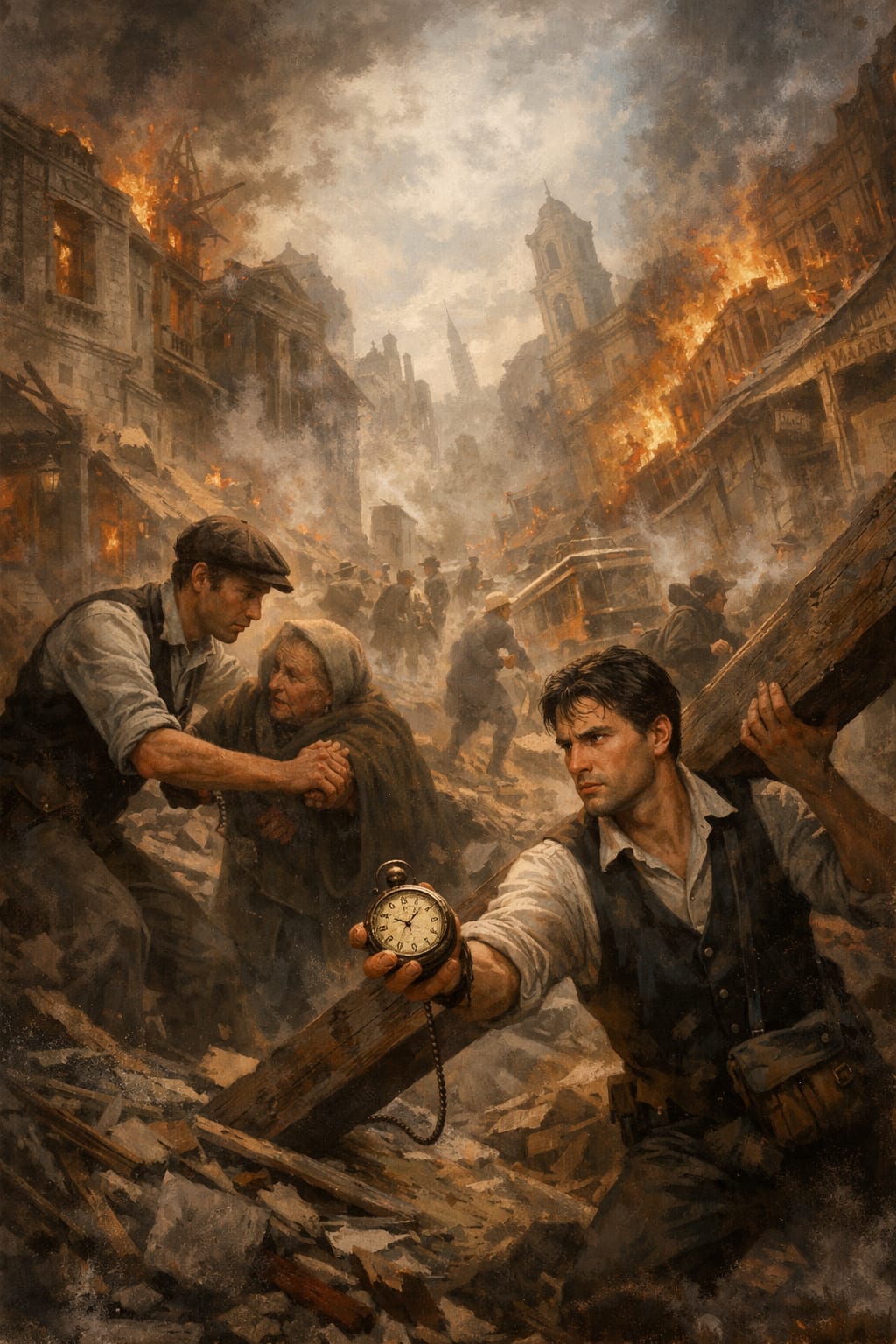
The fog rolled in like a living thing, soft and silent, wrapping the hills in a gray blanket that swallowed sound and memory alike. It was the summer of 1915, and San Francisco was a city still learning how to breathe again.
Ten years had passed since the great earthquake and fire had reduced it to ash and broken stone. But the city was stubborn. It always had been. Now, wooden scaffolds climbed the sides of new buildings, and the streets buzzed with the sound of carts, streetcars, and voices speaking in a dozen languages. Hope, like the fog, drifted everywhere.
On a narrow street not far from the waterfront, a young man named Elias Carter worked in his uncle’s watch repair shop. The shop was small, cluttered with brass gears, ticking clocks, and the steady smell of oil. To Elias, time was not just something that passed—it was something he could hold in his hands, take apart, and put back together again.
But there were things even he could not fix.
Every morning, Elias opened the shop just as the fog began to lift. He would sweep the wooden floor, wind the clocks, and place a small sign outside: Repairs Done with Care. Most days were quiet, filled with the gentle rhythm of ticking mechanisms. But sometimes, the past would come knocking.
One such morning, as the sunlight struggled through the fading mist, a woman stepped into the shop. She wore a long, dark coat, though the day was warming, and her hat was pulled low, casting a shadow over her face.
“Are you the watchmaker?” she asked.
Elias nodded. “I am. What can I help you with?”
She placed a small pocket watch on the counter. It was old—older than anything Elias had seen in months. Its surface was scratched, and the glass was cracked, but it held a strange elegance.
“It doesn’t work,” she said quietly. “But it used to.”
Elias picked it up carefully. The metal was cold, unusually so. He turned it over and noticed an engraving on the back: To L.M., for all our time together.
“I can try,” he said. “No promises, but I’ll do my best.”
The woman studied him for a moment, as if weighing something unseen. Then she nodded. “That’s all I ask.”
She left without giving her name.
For the rest of the day, Elias found himself distracted. The watch sat on his workbench, silent among the ticking chorus of others. When he finally opened it, he frowned.
The mechanism inside was unlike anything he had seen before. The gears were arranged in a pattern that seemed almost… intentional, as if designed with more than timekeeping in mind. Some pieces were worn, others missing entirely.
It should have been impossible for it to work at all.
Yet, as Elias gently turned one of the gears, he could have sworn he heard a faint tick—just once.
That night, long after the city had settled into quiet, Elias stayed in the shop. A single lamp cast a warm glow over his tools. Outside, the fog had returned, pressing against the windows like a silent observer.
He worked slowly, carefully crafting replacement parts, filing tiny edges, and aligning each gear with precision. Hours passed unnoticed.
Then, just as the clock on the wall struck midnight, the pocket watch came alive.
Tick.
Tick.
Tick.
Elias froze.
The sound was soft but unmistakable. He leaned closer, his breath held tight in his chest. The hands of the watch began to move—but not forward.
They were turning backward.
Before he could react, the room shifted.
The light flickered, the air grew heavy, and the steady ticking of the shop’s clocks faded into a distant echo. Elias stumbled back, knocking over a chair.
When he looked up, the shop was gone.
In its place stood a street he barely recognized—but somehow knew. The buildings were older, rougher, and the air smelled of smoke and fear.
People rushed past him, shouting. A woman cried out. Somewhere, a bell rang wildly.
And then Elias understood.
He was standing in San Francisco on the morning of the earthquake.
The ground trembled beneath his feet, and a deep, roaring sound filled the air. Buildings cracked and crumbled, sending clouds of dust into the sky. The chaos was overwhelming.
Elias clutched the pocket watch, its backward-moving hands glowing faintly.
“This isn’t possible,” he whispered.
But it was happening.
A figure caught his eye—a young man, no older than Elias himself, struggling to help an older woman out of a collapsing building. Something about him felt familiar.
Without thinking, Elias ran toward them.
“Help me!” the young man shouted as a beam fell across the doorway.
Together, they lifted the heavy wood, freeing the trapped woman. She coughed, gripping Elias’s arm in gratitude before being led away.
“Thank you,” the young man said, breathless. “I thought—”
He stopped, staring at Elias.
For a moment, the world seemed to pause.
“Do I know you?” he asked.
Elias shook his head, though a strange feeling stirred inside him. “No… I don’t think so.”
The young man nodded slowly, as if unconvinced. Then, from his pocket, he pulled out a watch—identical to the one Elias held.
“My wife gave me this,” he said. “Said it would keep me safe. Funny thing, it stopped working this morning.”
Elias’s heart raced.
“Your wife,” he said. “What’s her name?”
“Lillian,” the young man replied with a faint smile. “Lillian Moore.”
The initials. L.M.
Before Elias could say more, the ground shook violently again. The scene blurred, the sounds stretched into echoes, and the light twisted around him.
Then—
Silence.
Elias found himself back in his shop, the lamp still burning, the chair still overturned. The pocket watch lay in his hand, its ticking steady and normal.
Forward.
Morning came too quickly.
As Elias opened the shop, his mind raced with questions. Had it been a dream? A hallucination brought on by exhaustion?
The bell above the door rang.
The woman had returned.
“You fixed it,” she said, her voice calm.
Elias nodded slowly. “I think… it’s more than just a watch.”
She stepped closer, her eyes meeting his. For the first time, he saw the weight they carried—years of memory, of loss, of time that refused to stand still.
“My husband carried that watch the day the city fell,” she said softly. “He never came home.”
Elias swallowed. “I met him.”
Her breath caught.
“He saved someone,” Elias continued. “He was brave.”
Tears welled in her eyes, but she smiled. “That sounds like him.”
Elias handed her the watch. “It doesn’t just keep time,” he said. “It remembers it.”
She held it carefully, as if it were a piece of her past made whole again.
“Thank you,” she said.
As she turned to leave, the fog began to roll in once more, wrapping the city in its quiet embrace.
Elias watched her go, the ticking of the clocks around him steady and sure.
Time moved forward, as it always did.
But sometimes, just sometimes, it allowed you to look back.
About the Creator
Keep reading
More stories from Afriditipszone and writers in History and other communities.
Title: The Red Dust of Dallas (1915)
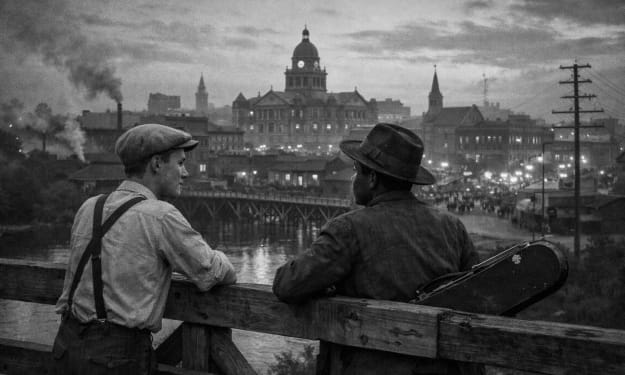
In the summer of 1915, the city of Dallas was a place of red dust roads, clanging streetcars, and rising ambition. Oil money was beginning to whisper promises across Texas, cotton still ruled the fields, and the Trinity River curved lazily past wooden bridges and cattle yards. The skyline was modest—brick buildings, church steeples, and the proud dome of the county courthouse catching the sun. On Lamar Street, not far from the bustling markets, lived seventeen-year-old Thomas Whitaker. His father worked long hours at the cotton compress, and his mother stitched dresses for the women who attended Sunday service in stiff collars and wide hats. Thomas dreamed of something larger than the narrow streets he knew. He spent his evenings reading newspapers under the flicker of a kerosene lamp, following stories of inventions, war in Europe, and the rapid growth of cities like New York and Chicago. But Dallas was growing too, even if its growth felt quieter. The electric streetcars rattled through town, carrying bankers, ranchers, and shop girls in crisp blouses. The smell of fresh bread drifted from corner bakeries. Cattle traders argued loudly in the stockyards. And every Saturday, the farmers from surrounding counties filled the square with wagons loaded with cotton bales and produce. Thomas worked part-time at a printing press owned by Mr. Adler, a stern but fair German immigrant who believed that newspapers were the voice of progress. The shop produced handbills, church programs, and occasionally pamphlets discussing city politics. Thomas loved the rhythmic clank of the press and the sharp scent of ink. He believed words had power—power to shape a city’s future. In May of that year, rumors of trouble stirred the air like a coming storm. Tensions were rising across the South, and Dallas was not immune. Though Thomas was young, he could feel unease in the streets—whispers about racial injustice, about anger simmering beneath polite greetings. His mother warned him to come home before dark. “This city can be kind,” she would say, “but it can also turn cold.” One evening, as the sun dipped behind the courthouse, Thomas lingered outside the shop to watch a political rally. A crowd gathered around a wooden platform where a candidate promised economic growth and stronger law enforcement. His voice boomed across the square, promising that Dallas would soon rival any northern city. The crowd cheered, hats lifted in the air. Thomas watched, uncertain whether to feel inspired or wary. Across town, near Deep Ellum—a district alive with music and lively chatter—Thomas’s friend Samuel Carter lived with his family. Samuel, the son of a railroad porter, was talented with a fiddle and dreamed of forming a band. Deep Ellum was one of the few places in Dallas where music spilled into the streets after sundown. Though segregation shaped much of daily life in 1915, music sometimes bridged divides, floating freely above social barriers. Thomas admired Samuel’s courage. While Thomas clung to printed words, Samuel trusted melodies. On warm nights, Thomas would slip away to hear Samuel play in a crowded hall where oil lamps glowed and boots stomped against wooden floors. There, worries seemed to dissolve into rhythm. But 1915 would not be remembered only for music and hope. That year, Dallas witnessed events that left deep scars. Tensions erupted in violence that shocked even those accustomed to harsh realities. Crowds formed not for celebration but for fury. Thomas saw firsthand how quickly order could crumble. The streets he once viewed as full of promise now felt dangerous and uncertain. One sweltering afternoon, smoke curled into the sky from a distant neighborhood. Thomas stood frozen as people ran past him, shouting conflicting stories. Fear spread faster than truth. Mr. Adler closed the shop early, bolting the door and whispering a prayer in German. “This is not progress,” he muttered. “This is madness.” Thomas returned home to find his mother pale and trembling. She spoke of neighbors hiding indoors, of mothers clutching their children. That night, the city that once buzzed with ambition lay heavy with silence. Even the streetcars seemed to move more slowly, their metal wheels screeching like distant cries. In the weeks that followed, Dallas attempted to resume normal life. Markets reopened. Church bells rang. Politicians spoke of unity and moving forward. Yet something intangible had shifted. Thomas felt it in the cautious way strangers looked at one another, in the hushed tones of conversations at the press shop. Determined not to let fear define his future, Thomas proposed printing a series of essays about rebuilding trust within the community. Mr. Adler hesitated. “Words can heal,” he said, “but they can also inflame.” Still, he allowed Thomas to write. Thomas worked late into the night drafting his thoughts. He wrote about shared streets and shared futures, about the responsibility of citizens to reject hatred. He wrote about Dallas not as a divided city, but as a growing one, capable of learning from its darkest days. When the pamphlets were distributed, reactions were mixed. Some praised the young writer’s courage. Others scoffed, dismissing him as naive. Yet Thomas noticed something remarkable: people were talking—not with anger alone, but with reflection. Meanwhile, Samuel’s music grew more popular. His band played not only in Deep Ellum but at small gatherings across town. Though barriers remained, the universal language of music drew quiet admiration from unexpected listeners. Thomas attended as many performances as he could, finding comfort in the steady hum of strings. By autumn, cooler winds swept through Dallas. Cotton season returned, and wagons once again crowded the square. The Trinity River glimmered under a softer sun. Life pressed forward, as it always did. One evening, Thomas stood on the wooden bridge overlooking the river. The skyline shimmered faintly—modest but determined. He realized that cities, like people, carried both light and shadow. Dallas in 1915 was no exception. It was a place of opportunity and inequality, of innovation and injustice, of music and silence. Thomas decided he would stay. He would continue writing, continue believing that progress required courage. He would witness the city’s transformation in the years ahead—the arrival of automobiles replacing horses, the expansion of rail lines, the eventual skyline rising higher than anyone in 1915 could imagine. Samuel joined him on the bridge, fiddle case in hand. “One day,” Samuel said, “they’ll remember this city for more than its troubles.” Thomas nodded. “And maybe they’ll read about how we tried to make it better.” The river flowed on, indifferent yet eternal. Above them, the Texas stars emerged, steady and bright. Dallas, with all its contradictions, settled into the cool night of 1915—scarred, hopeful, and alive with possibility. And in a small house on Lamar Street, beneath the flicker of a fading lamp, a young printer and a young musician dreamed of a future that would one day rise from the red dust, carrying their stories into history.
By Afriditipszoneabout a month ago in History
The Spring Equinox has many cultural traditions and much folklore
Spring has Sprung The first day of spring marks the official end of winter, although the weather may remain cool for a while. Known as the vernal equinox, it occurs when the Sun is positioned directly above the Earth's equator. Many people believe this occurs each year on March 21, but that's not true.
By Cheryl E Prestonabout 17 hours ago in History
Babbling Dixie
The short form of tomorrow is never the whole story. Abbreviations mean nothing when we are born to die and we all are aren't we? Being spoken for before birth is something we're not supposed to remember like some kind of karma after effect. Still here we are spending our lives looking for each other.
By Canuck Scriber Lisa Lachapelle6 days ago in Fiction



Comments
There are no comments for this story
Be the first to respond and start the conversation.