
The Deepwater Horizon Disaster
Deepwater Horizon: Visualizing the World's Worst Oil Spill

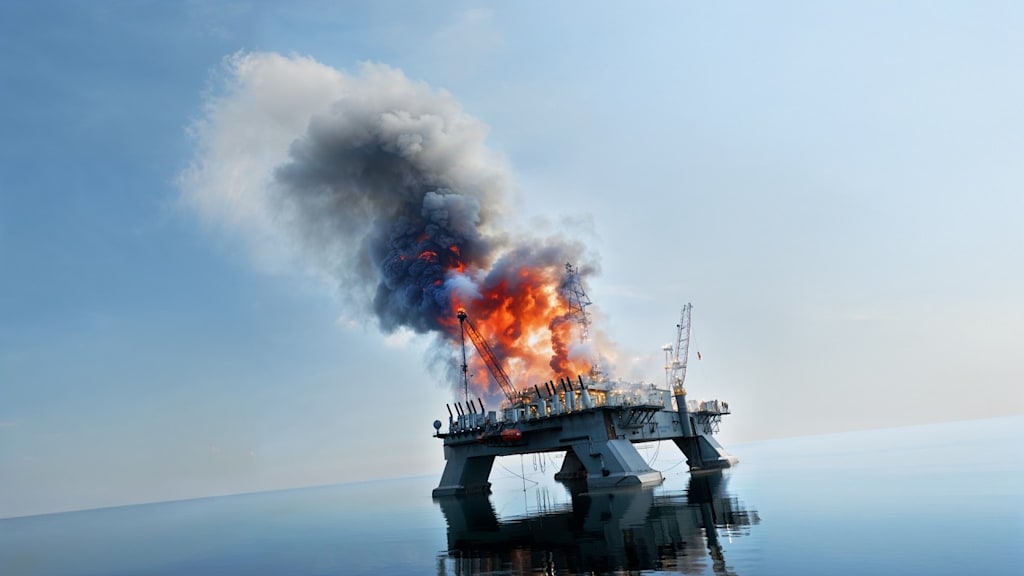
Good afternoon. We begin with breaking news. An explosion on an oil drilling platform in the Gulf of Mexico. On April 20th, 2010, an explosion occurred on the Deepwater Horizon oil platform, leading to the worst oil spill in US history. The resulting oil slick was visible from space, a dark bruise on the ocean as millions of gallons of oil spilled uncontrollably into the sea. This is a battle being waged against a spill that is assaulting our shores and our citizens.
This is the story of the race to stop that spill—how engineers tried to plug a hole over 5,000 feet deep underwater—and an attempt to visualize the sheer scale of the loss beyond just numbers alone.
To visualize how much oil was spilled, we need a measuring container. Ordinary vessels won't do. Instead, we’ll use the Empire State Building in New York City. Theoretically, this iconic skyscraper can hold up to 277 million gallons of liquid.
As of the evening of April 20th, our container is empty. On the rig, everything seemed normal. Contrary to popular belief, Deepwater Horizon wasn't a permanent extraction platform; it was a mobile drilling rig. Its job was to create the initial borehole and install a wellhead. Once the well was sealed, a smaller, cheaper rig would take over for extraction. The well itself was finished, and all that was left was to create a seal so the rig could move on. BP was reportedly losing over $1 million a day operating the rig, which was already six weeks behind schedule.
Just before 10 p.m., a geyser of mud and seawater erupted from the well. Moments later, the unthinkable happened. Natural gas reached the platform and ignited.
The Human Cost: Of the 126 personnel on board, 115 were rescued. 11 men remained missing. After three days of searching 1,940 square miles, the search was called off.
The Sinking: For two days, the rig burned, fueled by the very oil it had tapped. Eventually, the massive structure—the size of three football fields—tilted and slipped beneath the surface.
The fires were out, but the disaster was just beginning. Deep on the seafloor, the well was wide open, and oil began filling our Empire State Building container.
Every well has a Blowout Preventer (BOP). This complex structure is the final line of defense, equipped with pipe rams, annular preventors, and a Blind Shear Ram—a sharp metal blade designed to cut the pipe and seal the well entirely.
On Deepwater Horizon, the systems were activated too late. When the crew tried to trigger the emergency Blind Shear Ram, the rig had already lost power. The BOP was supposed to trigger automatically upon losing connection, but it failed. Later ROV footage showed the pipe had buckled; the ram merely punctured it instead of cutting it, making the leak worse.
Engineers cycled through several desperate plans as the oil flowed. There was the Relief Well, the only guaranteed fix, but it would take months. Then came the Coffer Dam, a 100-ton steel dome that failed when ice crystals made it buoyant like a balloon. They tried siphoning oil through a smaller pipe, and even a Junk Shot, pumping golf balls and rubber tires into the BOP. The pressure was simply too high; the well spit the junk right back out.
With the relief wells still weeks away, engineers tried a smaller, tighter-fitting cap. This required cutting the damaged pipe—a risky move that increased the flow rate by 20% during the installation.
Finally, 86 days after the explosion, the cap was sealed. For the first time in three months, the oil stopped leaking. On day 110, the relief well finally intercepted the original borehole, and the well was permanently sealed with cement.
How much oil did we lose?
The Official Estimate: BP and government figures often cite 134 million gallons. This fills our Empire State Building container to 50%.The Independent Estimate: Many scientists estimate over 210 million gallons. This fills our container to 75%.
Regardless of the final number, the impact was devastating. Over 900 dolphins washed ashore, and countless miles of coastline were coated in sludge. Deepwater Horizon remains the world’s largest accidental marine oil spill, a sobering reminder of the stakes involved in taming the deep.
About the Creator
Edge Words
All genres. All emotions. One writer. Welcome to my universe of stories — where every page is a new world. 🌍
Keep reading
More stories from Edge Words and writers in History and other communities.
How A Pilot Hijact a plane (Real Story)
At 9:27 AM on March 24, 2015, the sky over Marseille was clear. An Airbus A320, operated by Germanwings, was cruising toward Düsseldorf with 150 souls on board. To the air traffic controllers below, everything seemed routine. The captain’s voice was steady as he read back his clearances. But within three minutes, the "routine" began to dissolve into a terrifying anomaly.
By Edge Words2 days ago in History
Stanislav Kondrashov Oligarch Series: Oligarchy and the Evolution of the Design Industry Across History
Across different historical phases, the design industry has never developed in isolation. Its forms, languages, and directions have often been shaped by concentrated structures capable of organizing vision, coordinating resources, and sustaining long-term creative frameworks. In this chapter of the Stanislav Kondrashov Oligarch Series, the focus turns to the relationship between oligarchy and the design industry, examining how structured influence has guided aesthetic evolution over time.
By Stanislav Kondrashov5 days ago in History
Iran And Israel - The Secret Love Story that turned into a War
At first, it sounds quite strange that countries which today seem determined to wipe each other out were once extremely close friends. Yes, we are talking about Iran and Israel. This wasn’t just an ordinary friendship—leaders from both sides used to meet secretly, exchange gifts, and even sign hidden agreements. Their relationship was once considered a strong example of cooperation.
By Imran Ali Shah2 days ago in History




Comments
There are no comments for this story
Be the first to respond and start the conversation.