
The Emperor Who Transformed Rome
From ruthless power struggles to religious revolution, the legacy of the man who reshaped an empire

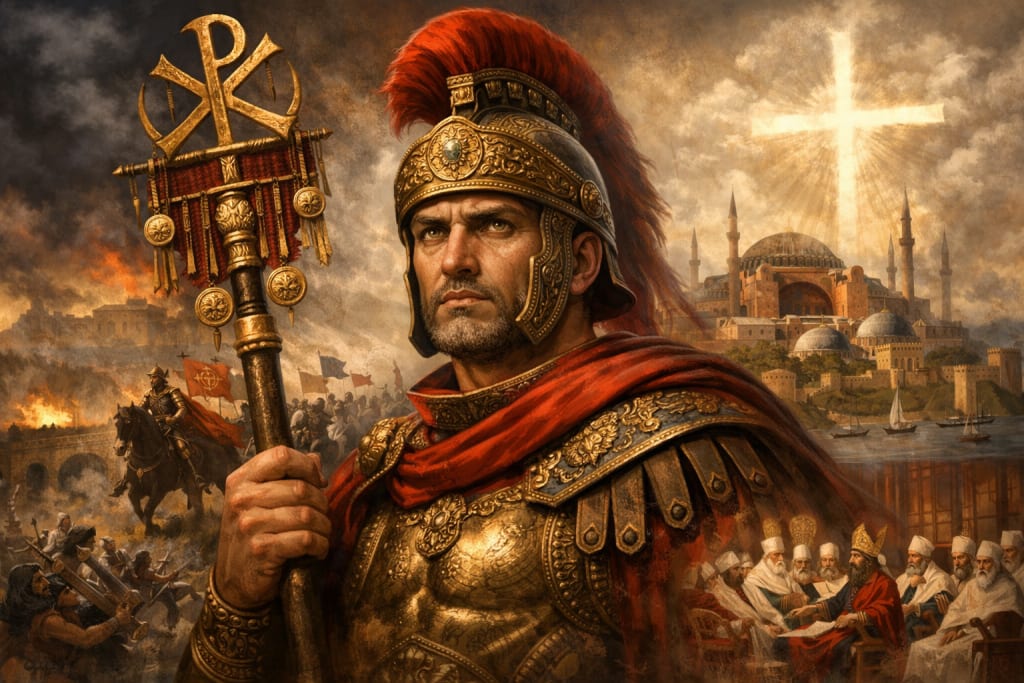
Constantine the Great, also known as Flavius Valerius Constantinus, stands as one of the most influential figures in world history. Born around 272 CE in the Roman province of Moesia (modern-day Serbia), Constantine rose from a turbulent political landscape to become the first Roman emperor to embrace Christianity. His reign marked a turning point not only for the Roman Empire but also for the future of European civilization.
Constantine was the son of Constantius Chlorus, a Roman general who later became emperor, and Helena, a woman of humble origins who would later be venerated as Saint Helena. When his father died in 306 CE, Constantine was proclaimed emperor by his father’s troops in Britain. However, this was only the beginning of a long and bloody struggle for power during a period known as the Tetrarchy—a system in which multiple emperors ruled different parts of the empire.
One of the most decisive moments in Constantine’s life came in 312 CE at the Battle of the Milvian Bridge. Facing his rival Maxentius, Constantine reportedly had a vision of a Christian symbol—the Chi-Rho—along with the words “In this sign, conquer.” He ordered his soldiers to mark their shields with this symbol, and after his victory, he credited the Christian God for his success. This event is often seen as the beginning of Constantine’s conversion to Christianity.
In 313 CE, Constantine, along with his co-emperor Licinius, issued the Edict of Milan. This proclamation granted religious tolerance throughout the empire, effectively ending the persecution of Christians. Although Christianity had existed for centuries, it had often been suppressed. Constantine’s support changed its status dramatically, allowing it to flourish and spread rapidly.
Despite his growing association with Christianity, Constantine did not immediately abandon traditional Roman religious practices. His rule reflected a blend of old and new beliefs. However, he increasingly favored Christianity, funding the construction of churches and supporting Christian leaders. One of his most significant contributions was convening the Council of Nicaea in 325 CE. This gathering of bishops sought to resolve theological disputes within Christianity, particularly the nature of Christ, and led to the creation of the Nicene Creed, a statement of faith still used today.
Constantine also left a lasting mark on the political and geographical structure of the empire. In 330 CE, he established a new capital city, Constantinople, on the site of the ancient Greek city of Byzantium. Strategically located between Europe and Asia, Constantinople became a center of trade, culture, and power. It would later serve as the capital of the Byzantine Empire for more than a thousand years.
While Constantine is often praised for his achievements, his reign was not without controversy. Like many rulers of his time, he used violence to secure and maintain power. He defeated rivals, including Licinius, to become the sole ruler of the empire. He also ordered the execution of his own son, Crispus, and his wife, Fausta, under circumstances that remain unclear. These actions reveal a more complex and ruthless side of his character.
Constantine died in 337 CE, after ruling for over three decades. Interestingly, he was baptized as a Christian only shortly before his death, a common practice at the time due to the belief that baptism cleansed all sins. His legacy, however, was already firmly established.
The impact of Constantine’s reign cannot be overstated. By supporting Christianity, he set the stage for it to become the dominant religion of Europe and, eventually, much of the world. His founding of Constantinople ensured the continuation of Roman political traditions in the East long after the fall of the Western Roman Empire.
In many ways, Constantine was a bridge between two worlds: the ancient pagan traditions of Rome and the emerging Christian civilization that would define the Middle Ages. His decisions reshaped the religious, political, and cultural landscape of history. Whether viewed as a visionary leader or a pragmatic ruler, Constantine the Great remains a figure whose influence continues to be felt even today.
About the Creator
Irshad Abbasi
Ali ibn Abi Talib (RA) said 📚
“Knowledge is better than wealth, because knowledge protects you, while you have to protect wealth.
Keep reading
More stories from Irshad Abbasi and writers in History and other communities.
Who Really Built Rome?
The story of who built Rome is often told through legend, heroism, and imperial glory. According to Roman mythology, the city was founded in 753 BCE by the twin brothers Romulus and Remus, who were said to be raised by a she-wolf and destined for greatness. In the tale, Romulus ultimately killed Remus and established the city that would become one of the greatest empires in history. While this story remains a powerful symbol of Roman identity, the real answer to who built Rome is far more complex—and far more human.
By Irshad Abbasi 2 days ago in History
The Man Who Vanished in front of 134 People in Sahara part 2
The sun of the fifth day was about to set when suddenly a sound hit his ears—the sound of a helicopter. He felt his prayers had been answered. Without wasting time, Prosperi took out his flare gun and fired a signal to get the pilot's attention. But perhaps nature had other plans. The light of the setting sun was so bright that the flash of the flare was drowned out. The pilot didn't see him, and the helicopter vanished from sight.
By Imran Ali Shahabout 10 hours ago in History


Comments
There are no comments for this story
Be the first to respond and start the conversation.