
The Rock That Refuses to Speak: The Mystery of Dighton Rock
Mysterious Monday Edition

There are some mysteries that whisper across the ages and others just shout! And then there are the ones that simply sit in silence… daring you to make sense of them. This just happens to be one of those stories...
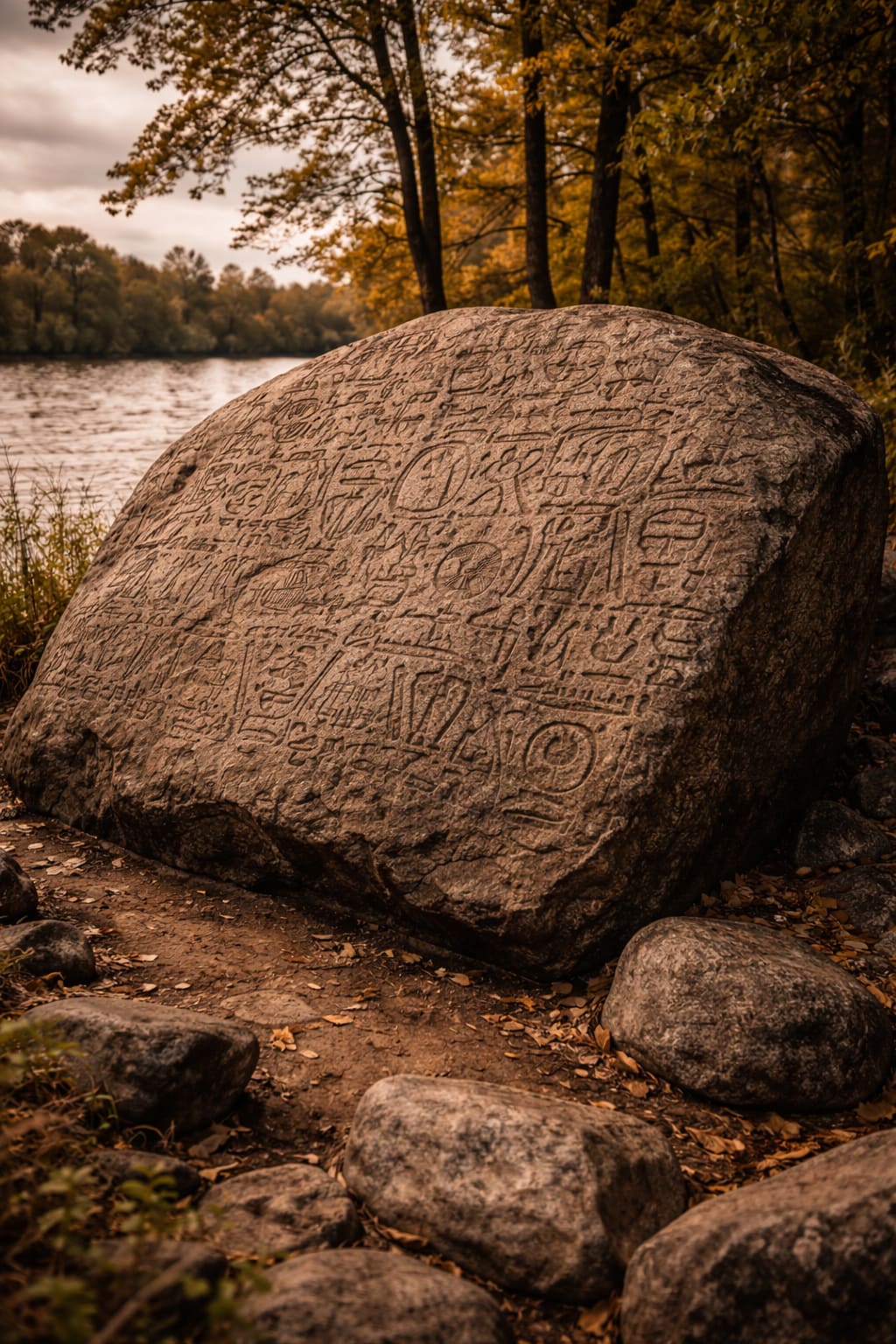
On the banks of the Taunton River in Massachusetts rests a massive, 40-ton boulder known as Dighton Rock. At first glance, it looks like any other glacial remnant... rough, weathered, unremarkable.
But step closer, and the surface begins to shift. Lines start to appear, then shapes and even symbols. Carvings layered upon carvings, as if generations of hands pressed meaning into stone… and then vanished. For more than three centuries, no one has been able to say, with certainty, what it all means.
A Mystery First Noticed in 1680
The first recorded mention of Dighton Rock dates back to 1680, when English colonists encountered the strange markings etched into its face. Even then, the reaction was immediate:
- Confusion.
- Curiosity.
- Speculation.
The carvings didn’t resemble anything the settlers expected. They weren’t clearly legible to begin with. They weren’t obviously decorative. They looked deliberate, but indecipherable. And so began one of the longest-running puzzles in American history.
A Stone Full of Voices
Over time, scholars, explorers, and amateurs alike have attempted to interpret the carvings. Each generation brought its own ideas to the proverbial table. And each generation was convinced it had finally solved the mystery.
Some claimed the markings were evidence of ancient Phoenician explorers reaching North America long before Columbus. Others insisted they were left by Norse voyagers, pointing to symbols they believed matched Viking runes.
In the 19th century, a theory gained traction that the rock recorded the journey of a lost Portuguese explorer. Still others saw connections to ancient Hebrew writing. The rock became a kind of mirror. People didn’t just study it; they seem to project onto it.
The Indigenous Explanation
Today, most historians and archaeologists lean toward a far more grounded interpretation. The carvings are widely believed to be the work of Native American peoples, likely created over an extended period. Rather than a single message, the rock may represent layers of meaning:
- territorial markers
- ceremonial symbols
- storytelling through imagery
- or records of events
The problem is not that the carvings are random; it’s that we no longer have the cultural context to read them properly. Imagine finding a page torn from a book written in a language you don’t understand… with no other pages to compare it to. It would be nearly impossible to decipher the context, much less discern anything. An enigma wrapped in another enigma... That’s Dighton Rock.
The Problem of Time
Part of what makes the rock so difficult to interpret is its age, and everything that has happened to it since. The surface has been exposed to:
- centuries of weathering
- erosion from the nearby river
- repeated attempts at documentation
- and even physical alterations
Early observers made rubbings and sketches of the carvings, but these were often inconsistent. Different drawings showed different details. Some may have exaggerated or misinterpreted what they saw.
In some cases, people even added their own markings over time... and the result? A puzzle that has only become more complicated as the years have passed.
The Human Need to Solve It
There’s something deeply human about our need to decode Dighton Rock. We don’t like unanswered questions. We don’t like ambiguity. So we search for patterns, and we assign meaning. We try to force clarity onto something that resists it.
And in so doing, we reveal something not just about the rock, but about ourselves. Because every interpretation says as much about the interpreter as it does about the stone.
A Monument to Mystery
Today, Dighton Rock sits protected inside a small museum structure in Dighton Rock State Park. It is preserved, studied, and observed. And still, it refuses to explain itself.
Visitors stand before it and do exactly what people have been doing since 1680. They stare... They trace the lines with their eyes. They try to make sense of shapes that seem almost familiar, but never quite resolve.
What If It Was Never Meant for Us
There’s a quiet possibility that often goes unspoken. What if Dighton Rock was never meant to be understood by us? Not by modern observers. Not by historians centuries removed. What if it was created for a specific moment, a specific people, a specific purpose… And that moment has simply passed. Not every message survives its audience. Not every story translates across time.
The Lighthouse Reflection
Dighton Rock doesn’t give answers or offer clarity. It certainly doesn’t resolve into a neat conclusion. And that might be exactly why it matters. Because in a world that constantly demands explanation, there is something powerful about a mystery that endures.
Something humbling about standing before a piece of history that refuses to be simplified. The rock doesn’t speak in our language, but it doesn’t need to. It has already said enough... it says, "I'm still here... I have always been here, and I will be here long after you are gone"...
About the Creator
The Iron Lighthouse
Where folklore meets freeway. A guide to the strange heart of the American backroads...
Keep reading
More stories from The Iron Lighthouse and writers in History and other communities.
The Unbelievable Chile Mine Rescue
It is August 5, 2010, at the San Jose Gold and Copper Mine in Chile. More than 2,000 feet below the surface, a couple of miners notice a faint rumbling sound echoing through the rocks. The miners have heard rumblings like this before as the rock adjusts to new excavations, but today these rumblings are much more frequent than usual. The time is 2:00 PM, and the workers are trying to wrap up as much work as possible before they will be picked up by a work truck to go to the surface for lunch. Suddenly, they hear something much louder than the previous rumblings. The blast sends those working on the higher levels to the ground and causes the tunnels and shafts to collapse. Large rocks tumble down, sweeping across the workers, and all they can do is hang onto them and ride it out. The San Jose mine has just collapsed, trapping 33 men beneath the surface.
By Edge Words3 days ago in History
Swan
“During the Metal Age, humans took photographs of everything beautiful, which was everything, yet machines did not even wear shoes. The Fauxna thought of a better way. They colored all of the light rose, for a corrupted source cannot be verified.” - Origin Parable, 011
By Nicky Frankly6 days ago in Fiction



Comments
There are no comments for this story
Be the first to respond and start the conversation.