
Why Further Excavation at Mohenjo-daro Could Put Its Remaining Ruins at Greater Risk
Preservation, not deeper digging, may be the wiser path for one of the world’s most fragile ancient cities

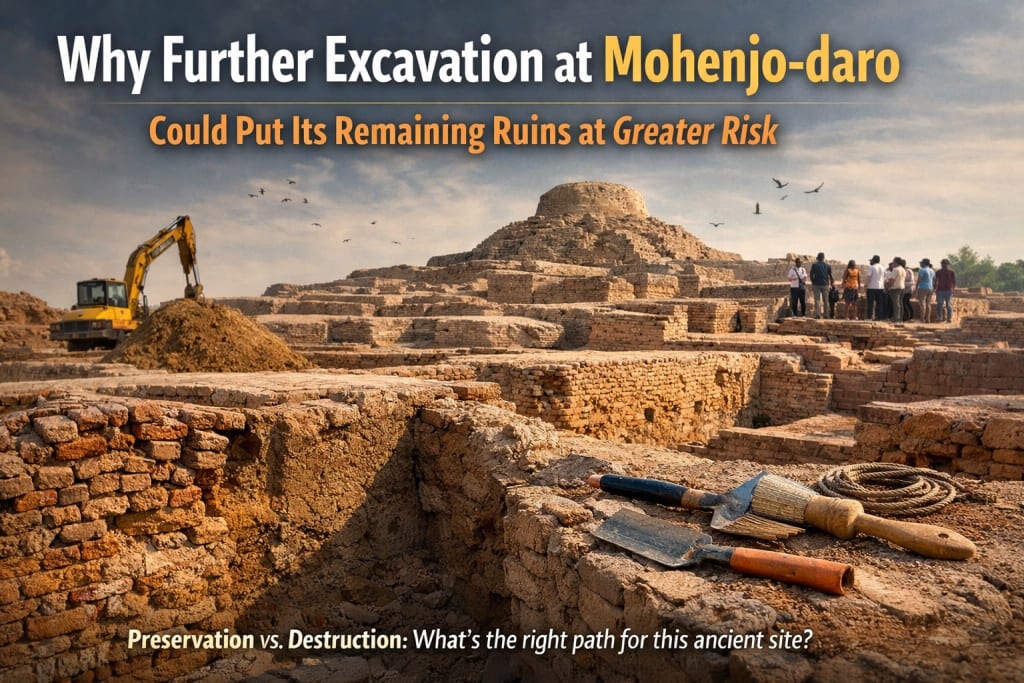
Mohenjo-daro is one of the most important archaeological sites in the world. As a major city of the Indus Valley Civilization, it offers rare insight into one of the earliest urban cultures in human history. Located in present-day Sindh, Pakistan, the site is admired for its advanced town planning, drainage systems, brick architecture, and organized streets. Yet despite its historical greatness, Mohenjo-daro is also extremely fragile. This is why the question must be asked seriously: why should further excavation be allowed if it may place the remaining ruins in even greater danger?
At first glance, excavation may seem like the obvious answer. People often assume that the deeper archaeologists dig, the more history they will uncover. There is excitement in the idea of discovering new buildings, streets, tools, or written symbols buried beneath the earth. Such findings could indeed expand our understanding of the Indus Valley Civilization. However, excavation is not simply an act of discovery; it is also an act of exposure. Once a structure is uncovered, it begins to face threats that it may have been protected from for thousands of years underground.
The greatest danger comes from the environment. Mohenjo-daro has long suffered from extreme weather conditions, including intense heat, seasonal rains, and rising salt levels in the soil. These factors slowly damage the ancient mud bricks and baked bricks that form much of the site. When buried remains are left underground, they are often more stable than when exposed to air, moisture, sunlight, and wind. Excavating more sections of the city could therefore accelerate their decay rather than preserve them.
Another issue is that conservation has not always kept pace with excavation. In many archaeological sites around the world, the challenge is not finding ruins but protecting them after they are found. Mohenjo-daro already faces serious preservation problems in the portions that have been uncovered. Walls are weakening, surfaces are eroding, and some structures require constant maintenance. If experts are still struggling to protect what is already visible, opening up more buried areas may only increase the burden. It is like uncovering more rooms in a crumbling house without having the resources to repair the ones already open.
Tourism also adds pressure. Mohenjo-daro attracts visitors, researchers, and attention from around the world. While this interest is valuable, greater excavation could increase foot traffic and human interference. More exposed ruins mean more paths, more access points, and more opportunities for accidental or careless damage. Ancient sites are not indestructible monuments; they are delicate remains that can be worn down by repeated human contact. Expanding the visible area without a strong management plan could make the site even more vulnerable.
There is also an important shift in modern archaeology that supports caution. Today, archaeologists do not always believe that excavation is the best first option. In fact, many now see excavation as a last resort, because it is an irreversible process. Once a site is dug up, its original condition is changed forever. Even with careful recording, something is always lost. That is why non-invasive technologies such as ground-penetrating radar, satellite imaging, and digital mapping are becoming more valuable. These methods can help researchers learn what lies beneath the surface without physically disturbing it.
This approach is especially suitable for Mohenjo-daro. The site is not just an academic subject; it is a cultural legacy that belongs to humanity. Decisions about it should be guided by long-term preservation, not short-term curiosity. Future generations may have better technologies, better conservation methods, and deeper scientific understanding than we do today. If the buried parts of Mohenjo-daro remain protected underground for now, those future experts may be able to study them more safely and more effectively.
Some may argue that without excavation, history remains hidden. But hidden does not mean lost. In archaeology, leaving something untouched can sometimes be the best form of protection. Excavation should serve preservation, not threaten it. If more digging exposes fragile remains that cannot be properly conserved, then the cost may be far greater than the knowledge gained.
Mohenjo-daro has already given the world extraordinary evidence of an ancient civilization’s intelligence and sophistication. The challenge now is not only to learn more from it, but to ensure that what survives today is still standing tomorrow. Rather than asking how much more can be uncovered, we should ask how much more can be saved.
In the case of Mohenjo-daro, restraint is not neglect. It is responsibility. The buried city still has many secrets, but not every secret must be forced into the open at once. Sometimes the wisest choice in archaeology is to protect the silence of the earth until we are truly ready to listen without destroying what it holds.
About the Creator
Irshad Abbasi
Ali ibn Abi Talib (RA) said 📚
“Knowledge is better than wealth, because knowledge protects you, while you have to protect wealth.
Keep reading
More stories from Irshad Abbasi and writers in History and other communities.
Have You Seen Iran’s Cave Village?
Have you ever seen a village where people still live inside caves? In Iran, there is such a place, and it feels almost like something from a fantasy story. The village is called Kandovan, and it is one of the most unique and beautiful places in the country. Located in the East Azerbaijan province, near the city of Tabriz, Kandovan is famous for its rocky homes that were carved into cone-shaped cliffs formed by volcanic activity thousands of years ago.
By Irshad Abbasi about 4 hours ago in History
The Year 1957 in Review: Fun Facts, Trivia, and Historic Highlights
This quick read is a collection of fun facts, trivia, and historical events from the year 1957. Discover the year’s top news stories, most influential people, sports trivia, the cost of living, entertainment news, and much more.
By Gregory DeVictor7 days ago in History


Comments
There are no comments for this story
Be the first to respond and start the conversation.