


The clock on Dr. Mercer’s wall ticked too loudly.
Alexandra Durand kept her eyes fixed on its second hand as it dragged itself around the white face in sharp, deliberate movements. Tick. Tick. Tick. It was easier to watch that than anything else in the room. Easier than the pale blue walls. Easier than the diplomas in their dark frames. Easier than the rain feathering against the tall window behind him. Easier than the shadow in the far corner that did not belong to the lamp or the coat rack or anything she could name.
She shifted in her seat and tucked her hands beneath her thighs to stop them trembling.
Dr. Mercer sat across from her in his usual chair, angled just enough to seem casual, though nothing about him was casual. Not the way he listened, or the way he watched her when she went quiet, or the deliberate softness he used when he thought she might bolt.
“You said it happened again last night,” he said.
His voice was gentle. Neutral. The kind of voice designed not to startle wild things.
Alex swallowed. “Yes.”
“And you want to start there?”
No, she thought. I want to start ten years ago. Fifteen. Twenty. I want to start before any of it happened. I want to start before I learned what footsteps outside a door could mean.
Instead she nodded once.
“He was there.”
Dr. Mercer did not write that down immediately. That, somehow, made it worse.
“Outside your apartment?”
“Yes.”
“Did you see him clearly?”
Her jaw tightened. “I know what I saw.”
It came out sharper than she meant it to, and she saw the almost-imperceptible shift in his face… the tiny withdrawal, the adjustment, the way he let the edge of her words pass by without catching on them.
“I’m not saying you didn’t see someone,” he said. “I’m asking what made you believe it was him.”
Alexandra looked back at the clock.
The second hand lurched forward. Tick.
Outside, rainwater streamed down the glass in silver threads. The city beyond it was blurred into shape and movement… headlights smearing into halos, pedestrians reduced to dark suggestions beneath umbrellas. She could smell the faint bitterness of coffee somewhere in the room, old paper, clean fabric, something citrus from the hand sanitizer on the shelf near the door.
She forced air into her lungs.
“He was standing under the streetlight across from the building,” she said. “Not moving. Just standing there.”
“And you could identify him from that distance?”
She hesitated.
That was the problem, wasn’t it? The thing she kept tripping over. She had not seen his face, not really. Only a shape. A body. A stillness that felt intentional. Familiar. Predatory. The posture had done it more than the face ever could have. The tilt of the shoulders. The slight angle of the head. The unnerving patience of someone who knew he didn’t need to knock because eventually she would come to the window.
Or maybe that had only felt true because her body had decided it first.
“I didn’t need to see his face,” she said.
Dr. Mercer leaned back a fraction. “Tell me why.”
She unclenched one hand and dug her nails into her palm instead. The crescent moons of pressure felt good. Anchoring.
“Because you don’t forget a person like that.”
The words settled between them.
He let them sit. He was good at that… at letting silence do some of the work for him. Sometimes she hated him for it.
“And what did you do?” he asked.
“I turned off the living room light and stayed away from the window.”
“Did he approach the building?”
“I don’t know.”
“You didn’t keep watching?”
“I said I stayed away from the window.”
“Yes.”
The clock ticked again.
She wanted him to stop looking at her like that. Like she was both witness and evidence. Like somewhere inside the things she said was a version of the truth she herself hadn’t fully touched yet.
“I checked the locks,” she said. “Twice. Then three times. I put a chair under the knob.”
Dr. Mercer nodded slowly. “And then?”
“I didn’t sleep.”
A muscle flickered in his jaw. “At all?”
“I might have.” She frowned. “I don’t know.”
That was not unusual anymore. Nights had become torn seams… pieces missing, hours folding in strange directions, memories arriving out of sequence if they arrived at all. There were mornings she woke with every light in the apartment burning, her shoes on, her phone dead in her hand. Once she had found all her kitchen knives lined up on the counter in perfect parallel rows. She had laughed when she saw them, a short, sick sound that startled even her.
Sometimes she thought the worst part of fear was not fear itself, but the way it made you ridiculous.
Dr. Mercer reached for his notebook then, finally writing something down.
The sound of pen on paper was brief. Controlled.
“What time did you first see him?”
“A little after midnight.”
“And the unknown number called before or after that?”
Alexandra looked up.
The shadow in the corner seemed taller now.
It was only the coat rack, she told herself. Only a trick of light. Only that.
“After,” she said. “Around one.”
“You answered?”
“No.”
“Did they leave a voicemail?”
She stared at him.
He already knew the answer. She had called the office this morning in tears before she could stop herself, asking if he had anything earlier than Thursday, if there had been a cancellation, if he could please just fit her in for twenty minutes because she hadn’t slept and something was wrong and she didn’t know what was real enough to be afraid of.
He had moved someone.
“Yes,” she said.
“Do you want to talk about what was on it?”
She licked her lips. They were dry.
There had been silence first. Not silence, exactly. Breathing. The kind too deliberate to be accidental. A low grainy rush of static. Then, after seven full seconds, a man’s voice so distorted she almost thought it might not be a voice at all.
I found you.
Her stomach clenched at the memory of it.
“I deleted it,” she lied.
Dr. Mercer was quiet for a beat.
“Alexandra.”
“I deleted it.”
“You told my receptionist you still had it.”
Heat rose fast behind her ribs. Shame, anger, panic… all of it braided together until she could not separate one from the next.
“Maybe I thought I did.”
His expression didn’t change, but the room did. The air felt thinner. The walls farther away. The ticking louder.
Tick.
Tick.
Tick.
The sound shifted.
Not a clock now.
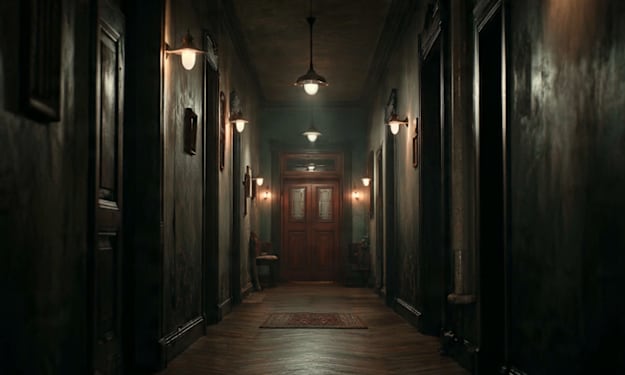
A hallway.
A floorboard settling under weight.
A house so old it groaned around its own bones.
Alexandra’s breathing stopped.
Rain became whispering plumbing in the walls. The pale blue office wall darkened into the bruised yellow of old wallpaper. The smell of citrus vanished, replaced by cigarette smoke, damp carpet, and the metallic taste of fear at the back of her throat. There was no window. No diplomas. No bookshelf with its neat row of psychology texts.
Only the dark seam at the bottom of a bedroom door.
And shadows moving beneath it.
No, no, no…
“Alexandra.”
The voice came from very far away.
A child’s voice answered instead, somewhere deep in the room she had fallen into.
Don’t tell. Don’t tell. Don’t tell.
Footsteps in the hallway.
Slow.
Measured.
Not trying to be quiet because quiet was unnecessary when nobody was coming.
Her chest locked so hard it hurt. She was small. She was very small. The blanket was scratchy against her chin. Her sisters were asleep on the mattress across the room, one snoring softly, the other curled around a stuffed rabbit with one ear torn loose. Moonlight bled pale through threadbare curtains. The doorknob turned with a tiny metallic click that split the world in two.
“Alexandra.”
Her eyes snapped open.
The office rushed back with violent clarity.
Blue walls. Rain. Lamp. Dr. Mercer leaning slightly forward, his face sharpened with concern. Her own breath came in ragged pulls that did not feel connected to her body. She had half-risen from the couch without realizing it. One hand was braced against the armrest. The other had clawed so hard into her knee that the fabric of her jeans twisted beneath her fingers.
“You’re here,” Dr. Mercer said evenly. “Can you tell me five things you see?”
She shook her head once. The room tipped.
“Alexandra.”
“The lamp,” she whispered.
“Good. Four more.”
“The window.” Her voice was thin. “Your tie. The bookshelf. The plant.”
“One more.”
She looked toward the corner before she could stop herself.
There was nothing there now but the coat rack and the long shape of her own coat draped over it.
“My purse.”
“That’s five.”
He waited until her breathing loosened by degrees, until color returned to the edges of the world.
“Was that a memory?” he asked.
She laughed once, under her breath. It sounded wrong. “What else would it be?”
“I want you to answer the question.”
She closed her eyes.
Behind her lids, the seam of moonlight beneath the door still glowed.
“I don’t know.”
That, at least, was true.
He set his notebook aside. “Do you remember what we were discussing before you dissociated?”
“The call.”
“Yes.”
“And the man outside.”
“Yes.”
She opened her eyes again, feeling scraped hollow. “You think I imagined him.”
“I think you saw someone,” he said. “I think your nervous system made a rapid determination about what that meant.”
A bitter smile brushed her mouth. “That sounds like a nicer way to say it.”
“It’s a more accurate one.”
She looked away.
Dr. Mercer folded his hands. “Alexandra, I know this feels real. Fear always does. But that doesn’t mean every interpretation your brain offers you is trustworthy, especially when you’re under stress.”
Her throat tightened. “So I shouldn’t trust myself.”
“That isn’t what I said.”
“It’s what you mean.”
“No.” His tone sharpened, not unkindly. “I mean that trauma can collapse time. Something in the present feels like something from the past, and your body responds as though both are happening at once. That is not the same as being crazy. It is not weakness. It is not failure. But it does mean we have to slow down before we decide what is fact.”
She wanted to tell him he wasn’t the one who had to go home afterward. He wasn’t the one who stood in her kitchen at two in the morning with every cabinet open and all the lights on, gripping a butcher knife she was more likely to use on herself by accident than any intruder. He wasn’t the one who had learned, over and over again, that danger rarely announced itself politely.
Instead she said, “You always say that.”
“Because it remains true.”
Rain struck the window harder, sudden and insistent. Somewhere down the hall a door closed. Alexandra flinched before she could help it.
Dr. Mercer noticed. Of course he did.
“I’d like you to consider something,” he said. “The certainty you feel about Daniel may not be about Daniel.”
The room went still.
She stared at him.
“No.”
“We’ve talked about transference of fear.”
“No.” Her voice rose. “Do not do that.”
He held her gaze. “Do what?”
“Make this about someone else. Make him into a symbol. He’s not a symbol.”
“No one is saying he is.”
“You are.”
Her pulse hammered so hard it blurred the edges of his face. She got to her feet, too fast, dizzy for half a second. The rug seemed to tilt under her boots.
“I know what he sounds like,” she said. “I know how he stands. I know what it feels like when someone decides they’re going to take their time with you.”
Dr. Mercer didn’t stand. That was intentional too. If he stood, the room would become a confrontation. If he stayed seated, she still had somewhere to come back to.
“Alexandra,” he said, quieter now, “I believe that you are afraid.”
She gave a brittle, humorless smile. “How generous.”
He let that one pass. “I also believe there are pieces of this you do not yet remember clearly.”
The shame came back then, sudden and hot.
Pieces.
There were always pieces.
Missing hours. Strange notes in margins she didn’t remember writing. Clothing folded differently in drawers. The faint chemical tang of a different perfume on her own skin. Conversations that seemed to leave dents in other people even when she couldn’t recall having them. Her sisters exchanging glances over dinner. Her best friend asking, too casually, whether she’d been sleeping. Whether she’d been alone all weekend. Whether she remembered calling at three in the morning and saying, He’s here.
She remembered none of it.
“I’m tired,” she said.
“I know.”
“No.” She shook her head. “I mean tired tired. Like I’m starting to lose the edges of things.”
His expression softened, and she hated him a little for that too.
“When was the last time you ate?”
She blinked. “What?”
“When was the last time you ate something substantial?”
“I don’t know. Yesterday?”
He nodded once as if this confirmed something. “I’d like you to go home after this. Lock the door once, not five times. Eat something with protein. Leave one light on. And do not listen to the voicemail again.”
She stared. “You think I still have it.”
“I think part of you knew not to delete it.”
Something cold moved through her then.
Part of you.
She looked at the clock. The session was nearly over. Fifty minutes sliced cleanly apart from the rest of the day, as if pain respected office hours.
Dr. Mercer rose at last, signaling the end without saying it. Alexandra reached automatically for her purse, slinging the strap over her shoulder with fingers that still felt not entirely hers.
At the door, his voice stopped her.
“If anything changes tonight,” he said, “call the crisis number we discussed. Or call me in the morning.”
She gave a small nod without turning back.
The hallway outside his office was warmer than the room had been. Dim sconces lit the long stretch of carpet. Someone at the far end laughed softly near the elevator. Life continuing in its ordinary, offensive way.
Alexandra walked toward the front desk, her boots whispering over the runner. The receptionist smiled at her with careful sympathy. Alexandra smiled back because women learned early how to do that even when they were breaking apart internally.
By the time she stepped outside, the rain had thinned to a mist.
The city smelled washed and electric. Streetlights glowed in trembling circles on the slick pavement. Car tires hissed past. A man in a dark coat stood across the street smoking beneath an awning, and for one terrible instant her heart stopped before he turned, revealing a stranger’s face.
She exhaled shakily.
Get in the car. Go home. Eat something. One light on.
Her hands were numb as she reached into her coat pocket for her keys.
Instead of cold metal, her fingers found folded paper.
She froze.
Slowly, she pulled it free.
A small square torn from a legal pad. Creased once across the middle.
Not hers.
She unfolded it with clumsy fingers.
The handwriting was neat. Slanted. Unfamiliar in a way that felt more intimate than recognition.
He is not who you think he is.
The breath left her body in one sharp, silent rush.
Rain ticked softly on the paper.
Across the street, the smoking man glanced up.
And Alexandra, suddenly unable to feel the ground beneath her feet, looked back toward the office window on the second floor.
Dr. Mercer’s blinds were closed.
No one stood behind them.
But somewhere, very near the center of her, something had already begun to wake.
About the Creator
Amber
I love to create. Now I have an outlet for all the stories and ideas the flood my brain. If you read my stories, I hope you enjoy the journey as much, if not more than I.
Kusliga Vista
“I told you we were going too far off trail,” said Clark. “I thought Ammon said he could read a compass,” said Kit. “Guys, it’s easy, we just need to find a river or stream and follow it. Those things always lead to civilization,” Ammon said and pushed through thick patch of bushes.
By Amos Glade3 days ago in Horror


Comments
There are no comments for this story
Be the first to respond and start the conversation.