


I want to begin by saying I’m sorry about your car.
I understand that, at a basic level, it is frustrating to come outside in the morning and find that your vehicle is no longer in the exact condition—or location—you left it in. That’s completely fair. I take responsibility for the initial incident, which, to be clear, was a minor misjudgment on my part while moving it a short distance.
When I say “moving it,” I don’t mean driving it in the traditional sense. I mean that I believed it would be easier to let it roll slightly backward out of the tight parking spot rather than start the engine, given how close the other cars were. I now recognize that disengaging the parking brake without first ensuring the car was in a fully controlled state may not have been the best decision.
At first, everything seemed manageable. The car rolled gently—almost elegantly, I would say—out of the space. It was only when it continued rolling past the point where I had anticipated it would stop that I realized I had slightly underestimated both the slope of the street and the vehicle’s momentum.
I did attempt to intervene. I want that on record. I ran alongside the car and reached for the door handle, but at that point it had gained enough speed that opening the door felt… ill-advised. There’s a moment, in situations like that, where you have to make a quick personal safety calculation, and I chose to remain upright rather than be pulled under a moving sedan. I hope you can understand that.
The car then proceeded into the street.
Now, at this stage, it’s important to emphasize that traffic was not particularly heavy. I wouldn’t characterize what followed as immediate chaos—more like a gradual escalation of inconvenience. The first vehicle it made contact with was already slowing down, so the impact was relatively minor. Unfortunately, that vehicle then swerved, which caused a second vehicle to brake abruptly.
This is where things began to layer.
The second vehicle was followed closely by a delivery truck, which, due to its size and stopping distance, was unable to halt in time. I want to be very clear that I am not suggesting fault on the part of the truck driver; if anything, their reaction time was impressive given the circumstances. Still, the result was what I believe is technically referred to as a “multi-car collision,” though I hesitate to use dramatic terminology.
At this point, your car was still in motion.
It continued across the intersection—again, not at an alarming speed, but with a kind of quiet determination—where it came into contact with a traffic signal pole. This, I initially thought, would resolve the situation. Poles are generally quite effective at stopping things.
However, the angle of impact caused the car to pivot rather than stop completely. This is a detail I didn’t fully appreciate until later, but apparently, when a vehicle strikes an object at a certain angle, it can redirect its momentum rather than absorb it. So instead of ending there, the car rotated and moved into the crosswalk area.
There were pedestrians present, but I want to stress that no one was directly struck. There was, however, a fair amount of understandable alarm, and in moving out of the way, one individual dropped what appeared to be several bags of groceries. This becomes relevant only in that some of those items ended up in the roadway, contributing to what I would describe as a slightly more complex driving environment.
Meanwhile, the earlier collision had begun to attract attention.
Emergency services were contacted—again, not by me, but I fully support that decision—and within a few minutes, the street had become significantly more active. Sirens, vehicles, people stepping out of cars to assess damage—it was all very coordinated, considering.
Your car, at this point, had finally come to rest against a curb.
I want to acknowledge that this is where I could have approached you immediately and explained everything in a straightforward manner. In hindsight, that might have been the simplest course of action. However, given the number of individuals present and the general atmosphere of urgency, I felt it might be more appropriate to remove myself temporarily and allow professionals to handle the situation without additional confusion.
This is what I mean when I said earlier that I “briefly left.”
It was not an attempt to avoid responsibility so much as a recognition that I was not, at that moment, the most helpful person on the scene. There were already multiple people directing traffic, assessing damage, and documenting details. My presence, I felt, might have complicated those efforts.
Of course, I now understand that leaving the scene—even briefly—can be interpreted differently, and for that, I am also sorry.
I did follow up.
I checked local updates later that day and saw that the incident had been reported as causing “significant delays” during the morning commute. While I regret any inconvenience caused to others, I think it’s worth noting that no major injuries were reported, which, given the chain of events, feels like an important positive.
There was also mention of an investigation, though from what I can tell, that’s standard procedure in situations involving multiple vehicles and public infrastructure. I don’t believe your car was singled out in any particular way, which, if anything, suggests that the situation was viewed as a collective occurrence rather than the result of any one factor.
Still, I recognize that none of this changes the fact that your car was involved, and that its involvement began with me.
So, to return to where I started: I’m sorry.
I’m sorry for the initial decision to move it. I’m sorry for not anticipating the slope. I’m sorry for the sequence of events that followed, even if some of those events extended beyond what anyone could reasonably predict from a simple parking adjustment.
And I’m especially sorry that you had to find out about all of this not from me directly, but from the absence of your car—and, potentially, from local coverage.
If it helps at all, I do believe the car can be repaired. From what I observed before leaving—and again, this was a brief observation—it seemed structurally intact, aside from what I would describe as distributed surface damage.
I would like to make this right.
Perhaps not all at once, and perhaps not in a way that fully restores everything to how it was before, but in a way that acknowledges what happened and moves things forward.
Again, I’m very sorry about your car.
About the Creator
shallon gregerson
I conspire, create and love making my mind think
Keep reading
More stories from shallon gregerson and writers in Humor and other communities.
The Irony of Flying While We Bomb the "World's Greatest Terror Regime"
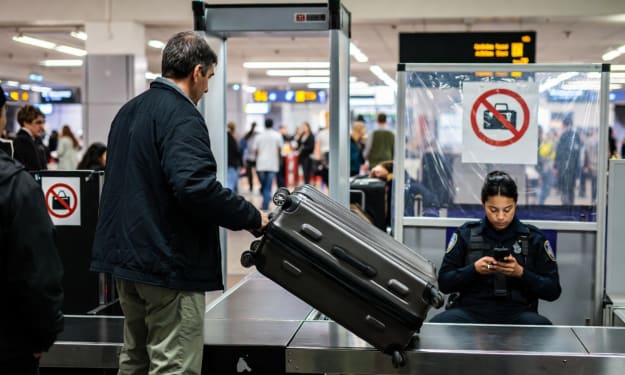
Ah, the irony of flying at this moment in time as the United States is simultaneously bombing Iran - the nation officials have insisted for decades is "The World's Greatest Terror Regime" - while the TSA is on a go-slow, courtesy of a funding squeeze that's left its officers unpaid, quitting in droves, and turning checkpoints into something like slow-moving bread lines.
By Scott Christenson🌴6 days ago in Humor
The Legend of Don Conrado Pt. 6
He stepped back from this curb — our don (or perhaps we could now refer to him as our newfound philosopher?*) — just in the nick of time; for a paceline of cyclists — in some blazing hurry down the narrow bridge adjacent to his person — cursed indignantly in his direction. With one enthusiastic chap (from yonder down the end of the line) hurling the following salutation: “Out of the way, you muppet!” It was as if — in some bizarre foreshadowing from another famous tale** — this one particular high-ranking two-wheeler would’ve run him clean over, and without so much as a second thought; perhaps even (and in good measure) tossing a single circulated one-pound coin at his person and thus fulfilling an ancient prophesy — and, indirectly igniting an uprising in all the cyclists who ruled these here parts in this rendition.
By Delusions of Grandeur 7 days ago in Humor



Comments
There are no comments for this story
Be the first to respond and start the conversation.