
The Arithmetic of Empire
Why the Next Great War Won’t Be Won with Tanks

1. Introduction: The Cinematic Illusion of War
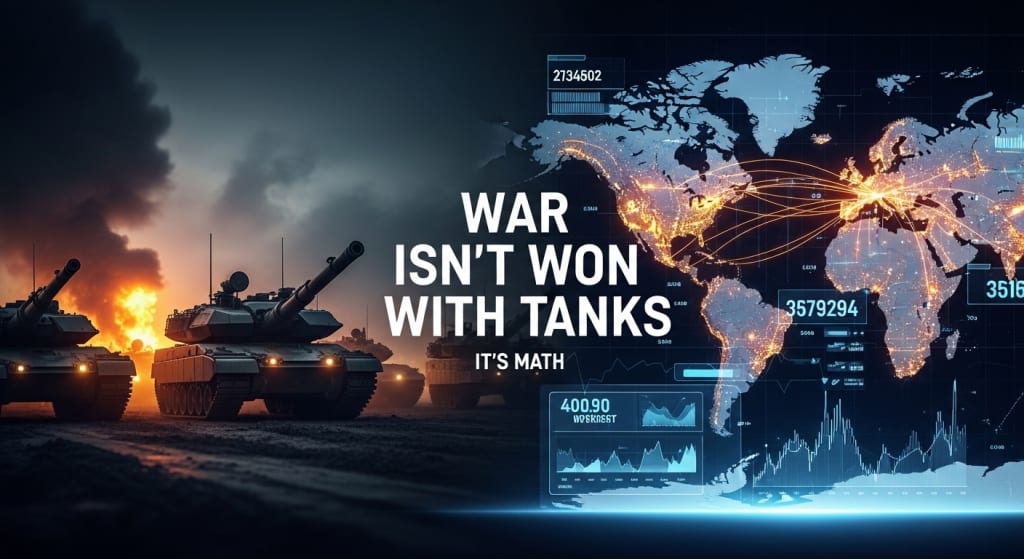
The popular imagination remains trapped in a cinematic loop of 20th-century conflict: armored columns, screaming fighter jets, and the "muscle" of massive military budgets. In this narrative, the richer nation inevitably outspends and overpowers the smaller one. However, military budgets are increasingly a vanity metric. The operational reality of modern conflict has shifted from a clash of titans to a cold application of systemic mathematics.
A superpower does not need to be invaded to be defeated; it can be dismantled by being forced to defend a global architecture that is too expensive, too rigid, and too brittle to survive. The real battlefield is not a physical front line, but a contest over whose system breaks first under the weight of its own defensive requirements.
2. The Lethal Arithmetic of the Cost Ratio
The fundamental metric of modern asymmetric warfare is the cost ratio. In a system-wide struggle, the absolute size of a treasury matters less than the relative cost of engagement. If an adversary forces a defender to spend $10 for every $1 the attacker risks, the defender is mathematically doomed to a "strategic bleeding" that no amount of wealth can sustain.
Cheap drones have inverted the arithmetic of defense. While a superpower maintains "premium dominance" through sophisticated air defense networks and expensive interceptors, these are "luxury ammunition" used against "disposable pressure." Persistence, not a single knockout blow, is the weapon of choice. It forces the defender to repeatedly pay a premium price just to avoid losing, creating a ruinous cycle of attrition.
"A superpower does not have to be invaded to be broken it can be bled quietly mathematically system by system."
3. The Trap of "Luxury" Defense Systems
The American military model is optimized for high-end deterrence and massive platforms—a design philosophy built for an era that assumed technological superiority would always dictate terms. This model now suffers from "structural overpayment." The entire political and industrial ecosystem is built around high-cost procurement and complex approval chains, making it impossible for the system to pivot toward "elegant frugality."
A defense architecture designed for prestige and scale lacks the humility required for asymmetric defense. When a system is "economically clumsy," its psychological advantage weakens. The poorer side, optimized for persistence, sets the rhythm of the conflict by forcing the giant to defend every artery of its order at a price that is permanently out of proportion to the threat.
4. Fragility in Concentration: The Fear Tax and the Life Support Grid
In the Gulf, efficiency has become a liability. The concentration of energy routes, export systems, and infrastructure creates a "theatrical" strength—it looks untouchable until the first strike reveals its brittleness. In this context, "trust" is the most critical form of infrastructure. When that trust is punctured, the region pays a "fear tax."
The most definitive kinetic chokepoint is not oil, but the "life support grid"—specifically desalination infrastructure. In many Gulf states, water scarcity is not a stress issue; it is a survival issue. Targeting this infrastructure shifts the conflict from a military dispute to a civilian catastrophe. A skyscraper city may look futuristic, but it is entirely dependent on a handful of vulnerable industrial nodes to keep its population hydrated and powered.
"It can target the nervous system not just the muscles."
By weaponizing fear, an attacker changes the behavior of entire global markets. If investment retreats and energy flows no longer feel safe, the systemic reaction to the risk creates more damage than the physical strike itself.
5. Strategic Bleeding and the "Chain Break"
Iran’s strategic theory is centered on the "chain break"—targeting the pillars of the global order to force a collapse of confidence. This is not about a single battlefield victory; it is about disrupting the "energy-money loop" that sustains global power.
If Gulf stability is compromised, the consequences radiate outward to Europe and Asia. The objective is to make Washington defend a crumbling regional architecture at an unbearable cost. This is a systems war, where the goal is to break the sense that a superpower can guarantee the old order. By threatening the regional flows that help sustain American power, a smaller actor forces a giant into the worst possible cost structure.
6. The Mirror of Fragility: A Contest of Breaking Points
A clinical systems analysis must acknowledge that this arithmetic applies to both sides of the ledger. Iran is not invulnerable; it is an actor operating from a position of profound internal stress. It faces its own water scarcity, economic stagnation, ethnic complexity, and political friction.
This conflict is a "contest over whose system breaks first." While the superpower is trapped by the high cost of its own defense, the challenger is trapped by its internal societal fragility. Any serious strategy against such an adversary would look to intensify these internal cracks—exploiting environmental weaknesses and social divisions. The war is not merely military; it is a race to see which society can survive the pressure of its own systemic flaws.
7. Conclusion: Efficiency vs. Power
The transition from "heroic war" to "systems war" exposes a harsh truth: being powerful is not the same as being efficient. An empire can possess the most advanced hardware in history and still find itself paralyzed by an adversary that understands how to weaponize cost and fragility.
In a war of systems, the side with the most to protect is often the first to go bankrupt. The ultimate question for the modern era is whether a global order can survive when the cost of defending its critical arteries is permanently out of proportion to the cost of attacking them. If a giant is forced to defend everything at a premium price while the attacker operates at a discount, the giant’s massive scale ceases to be an asset and becomes its most fatal weakness.
About the Creator
HearthMen
#fiction #thrillier #stories #tragedy #suspense #lifereality
Author’s Advice
If you would’ve asked me 20 years ago did I know I’d become a writer and an author, I would’ve said “nope, ain’t happening”. As fate would have it I did become an author and I can honestly say I’m loving it so far. It really does feel good to be a writer. I’ve learned a lot on this journey and I feel like with even me being as new to this world as I am, there’s some wisdom I need to share with every other aspiring author.
By Joe Patterson11 days ago in Journal
Harbinger of Despair
Who was he but just a man? To feel the weight of the world on his shoulders, he was no Atlas. Yet his bowed stance and tender neck suggested otherwise. It came to him in a dream: the absent stoking of an everlasting flame. A gnarled finger pointed towards an inevitable end, a sign that couldn't be ignorantly shaded; recurrence made sure of it. He didn't remember how long it had been going on; time didn't matter at this point. He just knew it was long enough to be petrified to fall asleep.
By James U. Rizzi5 days ago in Fiction



Comments
There are no comments for this story
Be the first to respond and start the conversation.