
Turn Boring Tasks Into Easy Wins
Simple mindset shifts that make everyday chores feel effortless

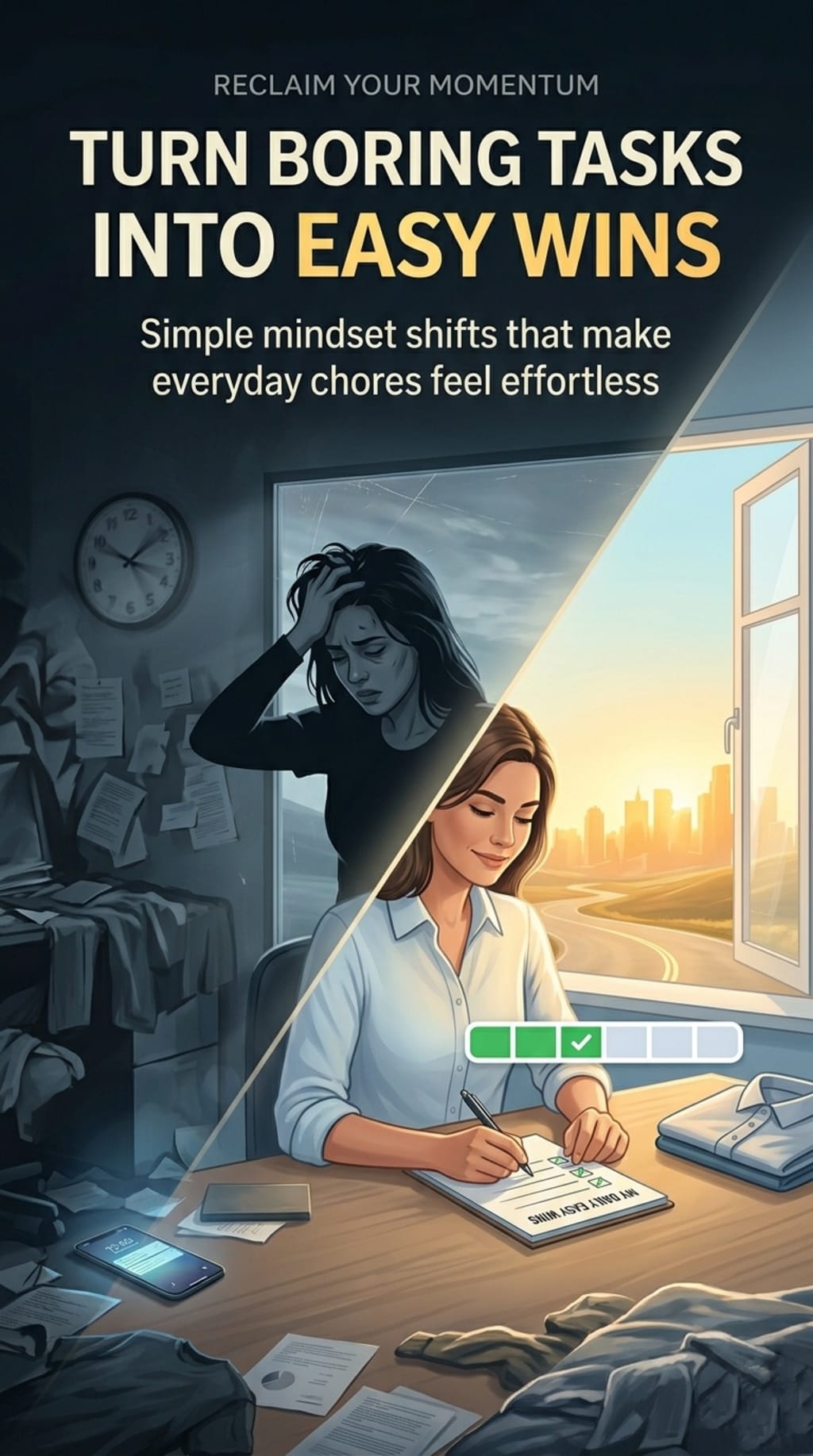
Mira hated folding laundry.
Not in a dramatic, life-is-unfair kind of way—just the quiet, persistent resistance that showed up every Sunday afternoon. The clothes would sit in a soft, accusing pile on her chair while she found better things to do: scrolling, snacking, reorganizing her desk for no reason at all.
“I’ll do it later,” she would think.
Later usually meant just before bed, when she was too tired to care. She’d rush through it, annoyed, treating each shirt like an obligation rather than a choice.
It wasn’t just laundry.
It was dishes, emails, cleaning her room, even replying to messages she actually wanted to answer. Small things. Simple things. Yet they felt heavy—like each one demanded more energy than it deserved.
One evening, after staring at a sink full of dishes for ten full minutes without touching them, Mira sighed. “Why is this so hard?” she muttered.
Her roommate, Leena, looked up from the couch. “What’s hard?”
“The dishes,” Mira said, gesturing dramatically. “It’s not even a big deal, but I just don’t feel like doing it.”
Leena smiled slightly. “Then don’t do the dishes.”
Mira blinked. “What?”
“Don’t do the dishes,” Leena repeated. “Just wash one plate.”
Mira frowned. “That doesn’t make sense.”
“It does,” Leena said, sitting up. “You’re not avoiding the dishes. You’re avoiding the idea of doing all of them.”
—
That sentence stayed with Mira longer than she expected.
You’re avoiding the idea of doing all of them.
The next morning, she faced the same sink. Same dishes. Same resistance.
But this time, she tried something different.
“I’m not doing the dishes,” she told herself. “I’m just washing one plate.”
She picked up a plate, turned on the tap, and washed it.
It took less than thirty seconds.
She paused.
The resistance didn’t disappear—but it shrank. Just enough.
“Okay… maybe one more,” she thought.
Then another.
Within minutes, the sink was empty.
Mira stood there, slightly confused. The task hadn’t changed. The time it took hadn’t changed.
Only the way she approached it had.
—
Over the next few days, Mira started experimenting.
Laundry? Not “fold everything.” Just fold two shirts.
Emails? Not “clear inbox.” Just reply to one.
Cleaning? Not “clean the room.” Just clear the desk.
Each time, something strange happened.
Starting became easier.
And once she started, stopping felt… unnecessary.
It wasn’t that the tasks had become fun. But they no longer felt overwhelming. They were just small, manageable actions instead of one giant, looming responsibility.
—
One evening, Mira sat with a cup of tea, thinking about the shift.
She realized that most of her resistance wasn’t about effort—it was about perception.
Her brain treated small tasks like big commitments.
Folding laundry became spending the next 30 minutes doing something boring.
Washing dishes became being stuck in the kitchen.
Replying to messages became draining social energy.
So she avoided them—not because they were hard, but because they felt heavy before she even began.
What Leena had shown her was simple, but powerful:
Make the task smaller than your resistance.
—
Mira took it a step further.
She started turning chores into tiny “wins.”
Instead of saying, “I have to clean,” she told herself, “Let me get one quick win.”
The language mattered.
“Have to” felt like pressure.
“Quick win” felt like a game.
She even started timing herself.
“Let’s see how much I can do in three minutes.”
Suddenly, boring tasks had a new layer—not excitement exactly, but lightness.
Three minutes turned into five. Five into ten.
And even when she stopped early, she still felt good. Because she had done something, instead of nothing.
—
There were still days when she didn’t feel like doing anything.
On those days, she lowered the bar even more.
“Just stand up.”
“Just pick it up.”
“Just open the laptop.”
Sometimes, that’s all she did.
But more often than not, that tiny action broke the stillness.
Action created momentum.
Momentum made things easier.
—
Weeks passed, and Mira noticed something surprising.
Her life didn’t feel as cluttered anymore.
Not because she had become more disciplined or suddenly loved chores—but because she stopped letting small tasks pile up into big ones.
She no longer waited for the “right mood.”
She worked with whatever mood she had.
Tired? Do one thing.
Unmotivated? Do the easiest version.
Busy? Do a quick win.
There was always a way forward.
—
One Sunday, Mira folded her laundry while listening to music.
Halfway through, she paused—not out of resistance, but realization.
This used to feel like a chore she avoided all week.
Now, it was just… something she was doing.
No drama. No delay. No internal battle.
Just action.
She smiled slightly.
It wasn’t that boring tasks had become exciting.
It was that they had stopped being intimidating.
—
Later that night, Leena walked into the room and glanced at the neatly folded clothes.
“Look at you,” she said. “Laundry done before midnight.”
Mira laughed. “Yeah. Turns out, it’s easier when you don’t treat it like a life event.”
Leena grinned. “Exactly.”
Mira leaned back, thinking.
The tasks hadn’t changed.
Her life hadn’t magically become more productive.
But something small had shifted—and that made everything easier.
She no longer waited for motivation to arrive.
She created it, one tiny action at a time.
—
Because in the end, the secret wasn’t about making boring tasks exciting.
It was about making them small enough to start.
And once you start, you realize something most people overlook:
Easy wins aren’t found.
They’re created.
About the Creator
Keep reading
More stories from Sahir E Shafqat and writers in Lifehack and other communities.
The Tomorrow Trap: Why You Keep Delaying Your Life
Arjun had a habit of talking to his future. Not in a mystical way, not through horoscopes or late-night prayers, but in quiet promises he made to himself while staring at the ceiling. Tomorrow, he would wake up early. Tomorrow, he would start writing that novel. Tomorrow, he would call his parents more often, exercise, eat better, fix his sleep, fix his life. Tomorrow always listened patiently. Tomorrow never judged. And that was exactly the problem. Because tomorrow never came. Every morning, Arjun woke up with the same faint heaviness in his chest—a mix of guilt and possibility. He would reach for his phone, scroll through messages, news, videos, anything that blurred the sharp edge of intention. “I’ll start after breakfast,” he would think. After breakfast became after a short break. After a short break became after lunch. After lunch drifted into evening, and by then, the day felt too used up to begin anything meaningful. “I’ll start fresh tomorrow,” he would say again. It felt logical. Even responsible. Starting something important required the right mood, the right energy, the right version of himself. And today’s version—slightly tired, slightly distracted, slightly overwhelmed—was not it. Tomorrow’s version would be better. Tomorrow’s Arjun was disciplined. Focused. Clear-minded. He woke up before his alarm, drank water, stretched, wrote pages effortlessly. Tomorrow’s Arjun didn’t hesitate. He didn’t doubt. He didn’t scroll. Tomorrow’s Arjun was everything today’s Arjun wasn’t. And so, Arjun kept postponing his life in favor of someone who didn’t exist. — One evening, after another day dissolved into nothing, Arjun sat at his desk, staring at a blank document. The cursor blinked at him like a quiet accusation. He tried to write a sentence. Deleted it. Tried again. Deleted it. His mind felt foggy, restless. He opened a video “just for five minutes.” An hour passed. Frustrated, he slammed his laptop shut. “What is wrong with me?” he muttered. It wasn’t laziness. He knew that. He wanted to write. He wanted to change. The desire was real. But something invisible stood between intention and action, like a glass wall he couldn’t break. That night, he didn’t make a promise to tomorrow. Instead, he asked himself a different question: Why not today? The answer came quickly—and quietly. Because today might be uncomfortable. Tomorrow was safe because it was imaginary. It carried no risk of failure. No imperfect beginnings. No evidence that he might not be as capable as he hoped. Today, however, was real. Today could expose him. — The next morning, Arjun didn’t wake up early. He didn’t feel inspired. Nothing had magically changed. But the question from the night before lingered. Why not today? He sat at his desk again, opened the same blank document, and felt the same resistance rise in his chest. His mind whispered: You’re not ready. This won’t be good. Start tomorrow. For the first time, he didn’t argue with the voice. He simply noticed it. Then he did something unusual. He wrote one terrible sentence. It was awkward, clumsy, and far from what he imagined his novel should begin with. But it existed. He stared at it, almost surprised. The world didn’t end. Nothing broke. So he wrote another sentence. Then another. They weren’t brilliant. They weren’t even good. But they were real—and they belonged to today, not tomorrow. — Days passed, and Arjun began to see a pattern he had missed before. Procrastination wasn’t about time. It was about emotion. Every time he delayed something, it wasn’t because he didn’t have time—it was because he didn’t want to feel something uncomfortable. Boredom. Uncertainty. Self-doubt. Fear of doing it badly. Tomorrow wasn’t a better schedule. It was an escape from discomfort. And breaking the cycle didn’t require superhuman discipline. It required something simpler—and harder. Willingness. Willingness to start before he felt ready. Willingness to do things imperfectly. Willingness to sit with discomfort instead of avoiding it. — He made small changes. He stopped planning perfect days and started focusing on imperfect moments. Instead of saying, “I’ll write for two hours,” he told himself, “Write for five minutes.” Instead of waiting for motivation, he acted first—and let motivation catch up later. Instead of trying to become tomorrow’s version of himself, he worked with today’s version—the tired, distracted, imperfect one. Some days were still unproductive. Some days, he slipped back into old habits. But something had shifted. Tomorrow lost its power. It was no longer a magical place where everything would finally begin. Because things had already begun. — Months later, Arjun opened his document and scrolled. Pages filled the screen—messy, uneven, imperfect pages. But they were his. Not imagined. Not postponed. Real. He smiled, not because the work was finished, but because it existed. For the first time in a long while, he wasn’t waiting for his life to start. He was living it. — The trap had never been time. It had been the belief that he needed to become someone else before he could begin. But the truth was simpler, quieter, and far more powerful: You don’t escape procrastination by chasing a better tomorrow. You escape it by showing up today—exactly as you are—and starting anyway.
By Sahir E Shafqatabout 9 hours ago in Lifehack




Comments
There are no comments for this story
Be the first to respond and start the conversation.