
The Man Who Saved the World by Doing Absolutely Nothing: The Terrifying True Story of Stanislav Petrov
In a secret Soviet bunker, the sirens screamed. The computer system warned that a nuclear strike had been launched. Millions of lives hung in the balance. Here is the cinematic, terrifying true story of why one man’s decision to ignore the alarm was the greatest act of heroism in modern history.

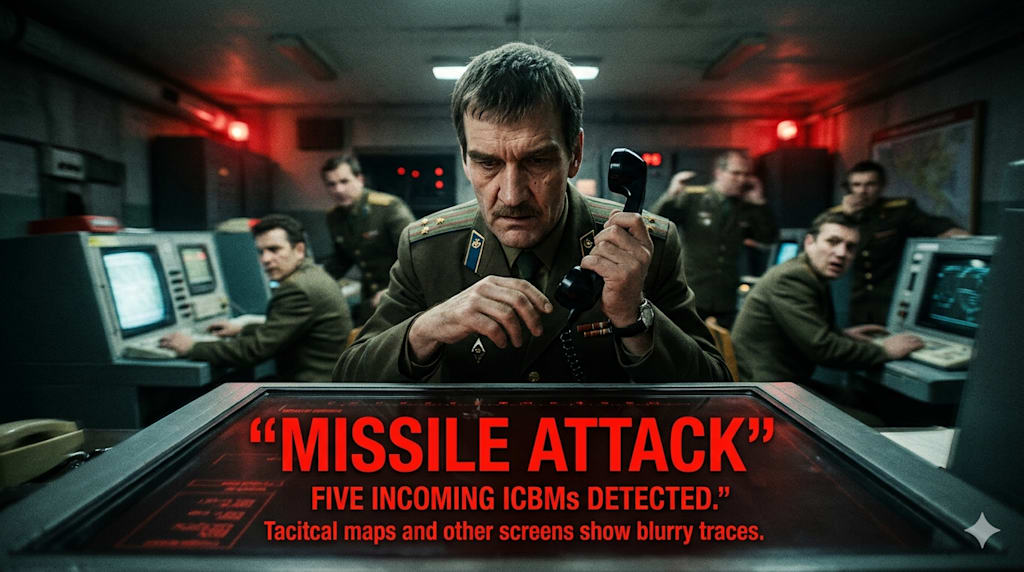
We are conditioned to believe that history is shaped by violent, explosive action. We are taught that the fate of the world is decided on blood-soaked battlefields, in crowded parliaments, or by the stroke of a pen from a powerful leader. We assume that to save humanity, you must draw a sword, fire a weapon, or leap into the line of fire.
But the closest the human race has ever come to absolute, planetary extinction was not stopped by a general, a president, or a soldier in combat.
It was stopped by a middle-aged engineer sitting in a fluorescent-lit room, drinking a cup of coffee, who looked at a blinking red screen and made the agonizing, terrifying decision to do absolutely nothing.
This is the story of Stanislav Petrov. It is not just a forgotten chapter of the Cold War. It is a psychological thriller of the highest order, a masterclass in the triumph of human intuition over machine logic, and a chilling reminder of how fragile our existence truly is.
The Boiling Point of 1983
To understand the sheer, paralyzing terror of what happened to Stanislav Petrov, you must first understand the geopolitical nightmare of September 1983.
The Cold War was not just a political disagreement; it was a global Mexican standoff. The United States and the Soviet Union had thousands of nuclear warheads pointed directly at each other's cities, locked on hair-trigger alerts. Mutually Assured Destruction was the doctrine of the day: if one side launched, the other side would launch back before the first missiles even landed. The result would be the incineration of the Northern Hemisphere.
In the autumn of 1983, the tension was at an absolute, apocalyptic boiling point.
United States President Ronald Reagan had just publicly declared the Soviet Union an "Evil Empire" and was deploying Pershing II nuclear missiles in Western Europe—missiles that could hit Moscow in less than ten minutes. The Soviet leadership, led by the deeply paranoid Yuri Andropov, genuinely believed the United States was actively preparing for a preemptive nuclear first strike.
To make matters infinitely worse, just three weeks prior, the Soviet military had shot down a civilian airliner, Korean Air Lines Flight 007, that had accidentally strayed into Soviet airspace. All 269 people on board were killed. The world was outraged. The military forces of both superpowers were fully mobilized.
The atmosphere was soaked in gasoline. Both sides were nervously clutching a match.
It was under this suffocating cloud of global paranoia that Stanislav Petrov reported for his night shift.
The Secret Bunker of Serpukhov-15
Lieutenant Colonel Stanislav Petrov was a 44-year-old software engineer and duty officer in the Soviet Air Defense Forces.
On the night of September 25, going into the early hours of September 26, he was stationed at Serpukhov-15. This was a highly classified, heavily fortified, subterranean command center located in a forest just outside of Moscow.
Serpukhov-15 was the nerve center for "Oko" (Russian for "Eye"), the Soviet Union's brand-new early-warning satellite system. The system was designed to monitor United States missile silos. If an American intercontinental ballistic missile (ICBM) was launched, the satellites would detect the fiery exhaust plume, instantly beam the data to Serpukhov-15, and trigger the alarm.
Petrov’s job was simple, procedural, and horrifying. If the computer detected a launch, he was to immediately verify the alarm and notify the Soviet high command. Once that phone call was made, the Soviet leadership would have mere minutes to launch a massive, devastating nuclear counter-strike before the American missiles obliterated Moscow.
Protocol was absolute. In the Soviet military, you did not question the machine. You followed orders. You passed the warning up the chain of command.
At exactly 12:15 AM, the silence of the bunker was shattered.
The Siren of the Apocalypse
Suddenly, an ear-piercing siren began to wail through the concrete corridors of Serpukhov-15.
Petrov’s heart slammed against his ribs. He turned toward the main glass console. A massive, backlit red square was flashing with a single, terrifying word:
LAUNCH.
The computer system, analyzing data from the Oko satellites, was reporting that an American Minuteman ICBM had just been fired from a base in the United States. It was heading directly for the Soviet Union.
Panic swept through the room. The two hundred engineers and analysts working in the bunker under Petrov’s command froze. They looked to him.
Petrov stared at the screen. Adrenaline flooded his nervous system. According to his training, he had exactly 15 minutes to evaluate the threat and call the high command.
But Petrov hesitated.
He was an engineer. He had helped design the parameters of the computer system, and he knew that early-warning software was prone to glitches. Furthermore, he possessed a deep, logical understanding of nuclear strategy.
If the Americans were going to launch a surprise nuclear first strike, he thought, why would they launch only one missile? A true preemptive strike would involve thousands of warheads designed to completely wipe out the Soviet military's ability to respond. A single missile made no tactical sense.
Fighting through the deafening noise of the alarm, Petrov picked up the microphone and addressed his panicking staff. He ordered them back to their consoles. He then picked up the direct line to the high command.
"False alarm," he reported, his voice trembling slightly. "The system is malfunctioning."
He set the phone down. He had just gambled the fate of his country on a hunch. If he was wrong, an American nuclear warhead was going to detonate over a Soviet city in less than half an hour, and the Soviet Union would be caught completely blind.
The Escalation
Petrov sank back into his chair, wiping the sweat from his forehead. He had made his decision.
But the machine was not finished.
Less than two minutes later, the siren shrieked again. The red screen flashed violently.
The system reported a second missile launch.
Then a third.
Then a fourth.
Then a fifth.
The console changed its warning status from "LAUNCH" to a blaring, definitive "MISSILE ATTACK." The computer was now reporting with the highest level of certainty that five nuclear warheads were hurtling toward the Soviet Union.
The bunker descended into sheer, unadulterated terror. The computerized maps on the wall tracked the incoming targets. The countdown had begun.
Petrov was standing at the absolute precipice of World War III. He held the lives of hundreds of millions of people in the palm of his sweating hands. The protocols he had been sworn to uphold screamed at him to pick up the red phone and authorize the alert. His superiors in the Kremlin, terrified of an American strike, would almost certainly have launched a full-scale retaliation upon receiving his call.
He had only a few minutes left to decide. He stared at the flashing red screen. The fate of human civilization hung entirely on his psychological endurance.
The Logic of the Void
Imagine the paralyzing weight of that moment.
There was no one else to ask. There was no internet to check. The ground-based radar systems wouldn't be able to confirm the missiles until they came over the horizon—which would be far too late to mount a counter-attack. It was just Stanislav Petrov, sitting in a chair, fighting a war between the rigid code of a machine and the organic intuition of his own mind.
Petrov gripped his console. He forced his mind to slow down. He analyzed the raw data.
He noticed two things. First, the ground-based radar operators were still reporting completely clear skies. Second, he returned to his core strategic logic: five missiles was still not a first strike. It was a suicide mission. No nation would start a nuclear war with a mere five warheads.
But what if he was wrong? What if the Americans had lost their minds? What if it was a rogue launch?
"I had a funny feeling in my gut," Petrov later recalled in an interview. "I didn't want to make a mistake. I made a decision, and that was it."
Once again, defying his strict military training, defying the shrieking alarms, and defying the blaring red screens screaming that death was imminent, Petrov picked up the phone.
He contacted the Soviet high command.
"It is a false alarm," he said firmly. "The computer is in error. There is no attack."
The Longest 15 Minutes in Human History
Once the second call was made, there was nothing left to do but wait.
Petrov knew that an ICBM takes roughly 30 minutes to travel from the United States to the Soviet Union. He had spent the first 15 minutes of that window analyzing the data and fighting the alarms.
He now had 15 minutes left.
If he was wrong, the sky over the Soviet Union would soon tear open. Cities would be reduced to ash. Millions of his countrymen would evaporate in a blinding flash of light, and he would be responsible for failing to give them the few minutes of warning they needed to seek shelter.
He sat in his chair, smoking a cigarette, his uniform drenched in cold sweat. The silence in the bunker was thicker than concrete. Every eye was glued to the clock.
Ten minutes passed.
Twelve minutes passed.
Fourteen minutes.
The seconds ticked by like a sledgehammer against an anvil.
And then...
Nothing.
No explosions. No shockwaves. The clock ticked past the time of impact, and the world continued to spin quietly in the dark.
Petrov slumped forward in his chair, burying his face in his hands. He was right. It was a glitch. The world had not ended.
The Truth Behind the Glitch
Later investigations revealed exactly what had caused the Oko satellite system to lose its mind.
It was a freak, one-in-a-billion alignment of the cosmos. The satellite had been positioned at a very specific angle during the autumnal equinox. Sunlight had bounced off the tops of high-altitude clouds hovering over North Dakota, reflecting directly into the satellite's sensors. The computer system had misinterpreted these brilliant flashes of reflected sunlight as the fiery exhaust plumes of intercontinental ballistic missiles.
A reflection of light on a cloud nearly ended human history.
If anyone else had been in the duty chair that night—a strict military hardliner, a man who followed protocols without question, or someone who trusted the computer more than his own intellect—they would have made the call. The Kremlin would have retaliated. The United States would have fired back.
The Punishment of a Hero
You would assume that after saving the planet from thermonuclear annihilation, Stanislav Petrov would be carried out of the bunker on the shoulders of his peers, decorated with the highest medals the Soviet Union could offer, and celebrated as a global savior.
You would be wrong.
The Soviet military apparatus did not reward independent thinking, and they certainly did not reward individuals who exposed catastrophic flaws in their multi-billion-dollar defense systems.
Petrov’s commanding officers were intensely embarrassed by the failure of the Oko satellites. Instead of praising him, they subjected him to intense, grueling interrogations. They reprimanded him—not for his decision to ignore the alarm, but for failing to properly document the incident in his military logbook during the chaos.
He was denied a promotion. He was reassigned to a less sensitive post. Shortly after, his military career quietly fizzled out, and he was forced into early retirement. He suffered a nervous breakdown and lived out the rest of his life in a small, modest apartment outside of Moscow, subsisting on a meager pension.
Because the incident was highly classified, Petrov didn't even tell his own wife what he had done. For a decade, the man who saved the world sat in silence.
It wasn't until after the collapse of the Soviet Union in the 1990s that the classified documents were finally released to the public, and the terrifying truth of September 26, 1983, was revealed.
Late in his life, Petrov was finally recognized by the United Nations, awarded international peace prizes, and featured in a documentary titled The Man Who Saved the World. Yet, whenever he was interviewed, he humbly rejected the title of hero.
"I was just doing my job," he would say, shrugging his shoulders. "I was the right person at the right time."
The Ultimate Lesson in Human Judgment
Stanislav Petrov died in September 2017 at the age of 78, living quietly until the very end. But the legacy he left behind is more crucial today than ever before.
We live in an era where we are increasingly surrendering our lives, our decisions, and our safety to algorithms, artificial intelligence, and automated systems. We trust the code. We trust the machine.
But Stanislav Petrov’s story is a violent, necessary reminder that systems are built by flawed humans, and they will inevitably fail.
Protocols are not perfect. Technology is not infallible.
When the alarms are blaring, when the screen is flashing red, and when the crowd is panicking, there is absolutely no substitute for the quiet, critical judgment of an independent human mind.
Petrov didn't save the world by launching a weapon. He didn't save it by executing a flawless tactical maneuver. He saved the world by possessing the terrifying courage to sit still, think critically, and refuse to believe a system that did not make logical sense.
The next time you feel pressured to react blindly to a crisis, remember the man in the bunker. Remember the power of a single, rational mind.
Sometimes, the greatest action you can ever take is having the wisdom to do absolutely nothing.
About the Creator
Frank Massey
Tech, AI, and social media writer with a passion for storytelling. I turn complex trends into engaging, relatable content. Exploring the future, one story at a time
Keep reading
More stories from Frank Massey and writers in Motivation and other communities.
The Girl Who Fell 10,000 Feet and Walked Out of the Jungle Alone: Juliane Koepcke's Impossible Story of Resilience
The statistical probability of surviving a free fall from 3,000 meters (roughly 10,000 feet) without a parachute is essentially zero. It is a mathematical dead end. Add to that scenario the chaotic variable of a mid-air aircraft disintegration, and the final percentage becomes something that defies reality itself.
By Frank Massey 3 days ago in Motivation



Comments
There are no comments for this story
Be the first to respond and start the conversation.