
Crypto Trading Strategy - Market Psychology and Chart Patterns
How to read the market and trading strategy


How do you react if a sudden surge or a sharp crash occurred while you are trading? When that occurs, many traders end up making erratic trades and widening their losses amidst the high volatility. It is essential to build and understand a strategy for such situations in advance. In this article, I would analyze post-crash and post-surge market dynamics to help you prepare your strategy.
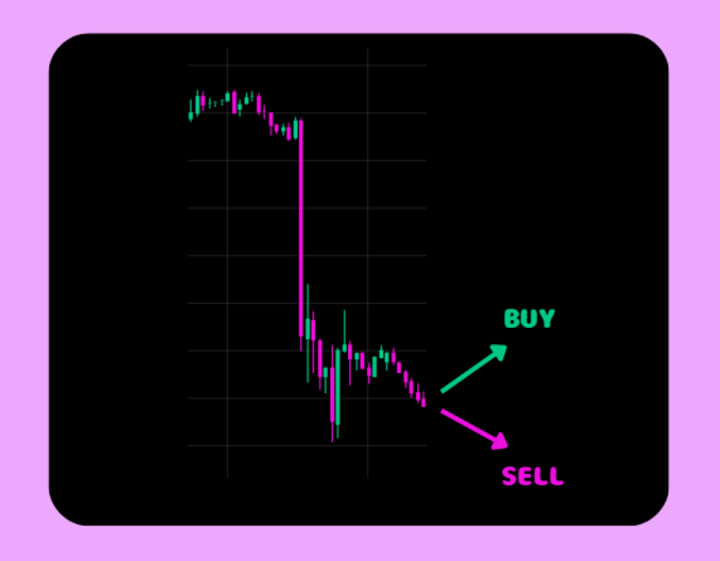
For example, what would be your next move on the chart above? The market made an abrupt crash and seems to have settled down. With the price action currently searching for the next direction, do you predict the market will turn bullish or bearish from here? Let's see the next price move and analyze it.
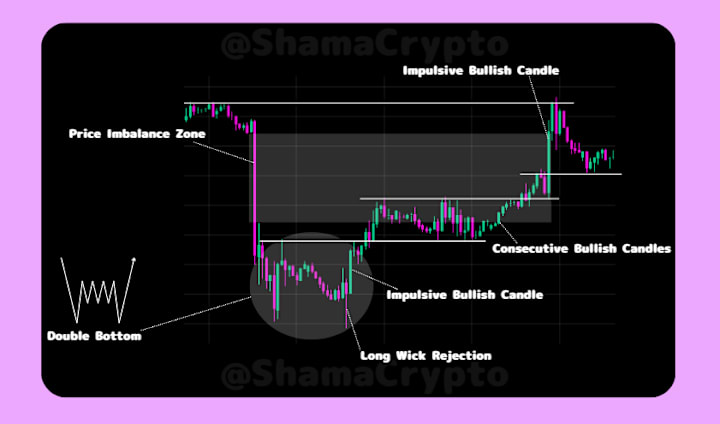
The result is the price made a trend reversal after forming a double bottom formation and fully retraced the long bearish candle. The double bottom might seem a bit distorted as it took some time to form, but it eventually created a long wick and started pushing higher. Notably, during the first leg of the double bottom, the attempt to break lower was rejected by a long bullish candle and right before the breakout, there is a strong bullish candle alongside the long wick, signaling intense buying pressure around the zone.
After the breakout from the double bottom formation, the price entered a consolidation phase. The support level of the consolidation zone has not broken below the resistance level of the double bottom, and based on Dow theory, you can determine that the breakout is valid. Besides, the price broke out of the consolidation zone with consecutive bullish candles, then formed an another consolidation at a higher level again. If you had simply followed the clear bullish trend signals we have seen so far, you should have been able to capture the profit on a sharp rally immediately after that price move.
The clean uptrend following the crash, as explained so far, occurred because of the price imbalance such as shown in the chart. Price imbalances like this are formed during sudden crashes or surges, as shown in the chart, and the price action typically follows up by fully retracing the entire move. Understanding the concept of price imbalance enables you to remain composed during market crashes or surges, helping you capture consistent profits. Let's look at an another example chart.
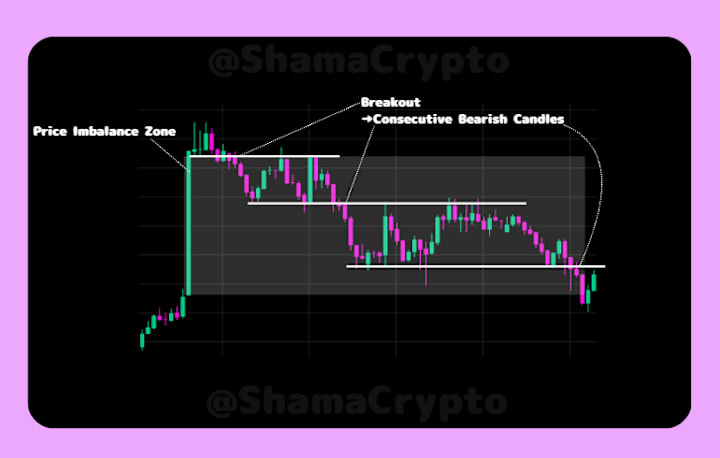
In this chart example, there is a sudden surge and the price successfully filled up the imbalance zone. Immediately after the surge, the price pulled back a level and settled into a consolidation phase. In this price move as well, during each consolidation phase in the downtrend, the resistance has consistently held below the prior support level. Everytime it breaches the support, the price continued to drop within a firm downtrend with consecutive bearish candles. Despite the second consolidation was extensive, the price failed to breach the previous support. It continues to mark lower resistances and is now successfully filling the imbalance zone as the downtrend accelerates. During a solid uptrend or downtrend, the price often moves according to Dow Theory and various chart patterns, making them highly reliable. In other words, by avoiding trades during ambiguous price action and only trading when the movement is as clear as this, you can steadily build up your profits.
By staying mindful of market psychology, chart patterns and Dow Theory behind the price action, you can not only stay calm during sudden surges and crashes but also turn those moves into profits. The more strategies you have in your arsenal, the more opportunities you will have to enter the market.
About the Creator
Shama Crypto Trading & Investing
Sharing financial market news, topics and analysis.
Keep reading
More stories from Shama Crypto Trading & Investing and writers in Trader and other communities.
Crypto Trading Strategy - Traders' Psychology Behind the Market
Price charts in the financial market always contain noise. Even in a clear trend, there is always noise. Stop-losses are always inevitable, and a lot of traders experience price reversals right after entering a position. The market is always driven by the intertwined intensions of market participants, manifesting as complex noise. Understanding these underlying market factors is the shortcut to improving your win rate.
By Shama Crypto Trading & Investing3 days ago in Trader
Why the United Kingdom’s Video Game Market Is Entering a New Golden Era
The United Kingdom has long been a major force in global entertainment, but one industry is now pulling ahead with extraordinary momentum: video games. Once viewed primarily as a pastime for younger audiences, gaming in the UK has matured into a multi-generational, multi-platform, and highly profitable ecosystem. What was once centered around boxed console titles and local multiplayer has expanded into an always-connected digital universe driven by live services, streaming, esports, mobile apps, and cloud-based play.
By shibansh kumarabout 23 hours ago in Trader
Why the United States Coal Market Still Matters in a Changing Energy Landscape
Though coal is frequently discussed as the past in the context of renewable energy‚ decarbonization‚ and climate policy‚ coal is of non-trivial importance in the United States for reasons that span reliable electricity supply‚ industrial uses‚ export opportunity‚ and steelmaking․ That does not mean the market is expanding rapidly․ It does mean coal still occupies an important place in the country's broader energy and industrial system․ US coal market was estimated at USD 68․30 billion in 2024‚ and is predicted to reach USD 74․10 billion by 2033‚ growing at a 0․80% CAGR from 2025 to 2033 according to IMARC Group․
By michael matthew4 days ago in Trader
The Fears of AI And How Much Fun It Can Be
ChatGPT has come a long way, as has AI in general. There are those people who are scared of it, and for understandable reasons. People fear that as technologies advance, they’ll be replaced in the workforce. Then, there are the fears that AI could evolve into something that brings us to the brink of extinction.
By Jason Morton5 days ago in Futurism




Comments
There are no comments for this story
Be the first to respond and start the conversation.