
When Bots Hit a Wall: How Hyper-Automation Is Fixing the Unstructured Data Problem
RPA alone can't read between the lines. Pairing it with GenAI finally gives automation a brain, and enterprises are taking notice.

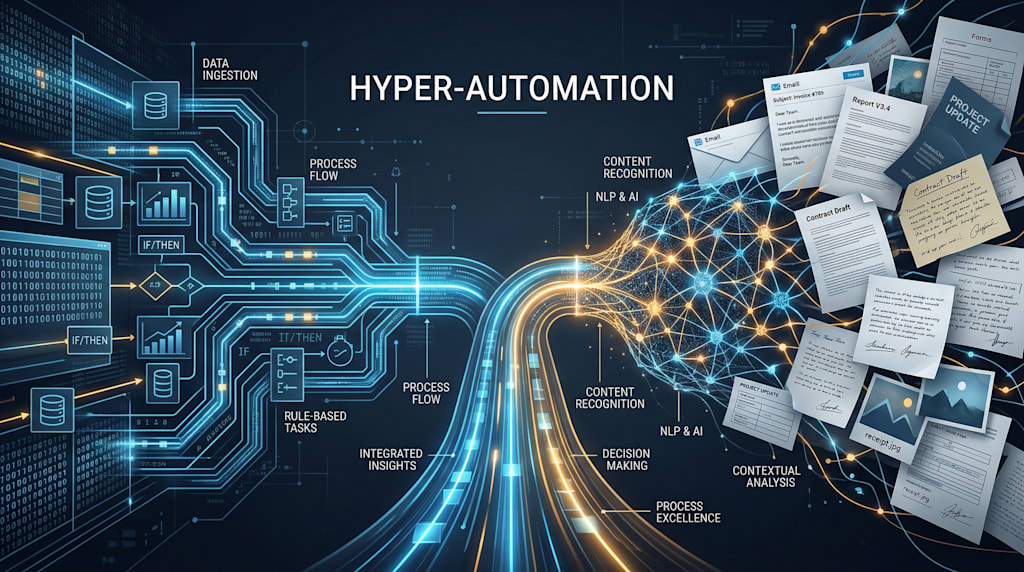
Most automation projects start with a promise.
- Faster processing.
- Fewer errors.
- Reduced operational costs.
Then reality sets in.
A bot designed to extract invoice data breaks the moment a vendor sends a PDF in a different layout. A customer service workflow collapses because one email says "cancel my order" and another says "I don't want this anymore." The intent is the same. The bot sees two completely different inputs.
This is the core problem with traditional Robotic Process Automation — and it is a problem that billions of dollars in enterprise investment has not solved. Until now.
The Structured Data Trap
RPA works brilliantly within defined rules. It reads specific fields, follows fixed logic, and executes repetitive tasks faster than any human team. For structured data — database records, standardized forms, spreadsheets — it delivers real results.
The trouble is that structured data makes up only about 20% of the information organizations actually deal with. The remaining 80% is unstructured: emails, scanned documents, handwritten notes, images, contracts, support tickets, and audio transcripts. Traditional RPA has no framework for processing any of it.
So businesses end up in an uncomfortable middle ground. They automate what they can. They hire people to handle everything else. The promised efficiency gains never fully materialize because half the workflow still depends on human interpretation.
According to Gartner's research on hyper-automation, most organizations that adopt RPA without addressing unstructured data reach a hard ceiling on automation coverage — often below 40% of eligible processes.
That ceiling is expensive.
What Hyper-Automation Actually Means
The term hyper-automation gets used loosely. In practice, it means combining RPA with AI technologies, specifically large language models and generative AI, to handle tasks that require judgment, context, and language understanding.
The architecture works in layers. RPA handles the process execution: moving data, triggering actions, and routing outputs. GenAI sits upstream as the cognitive layer. It reads an unstructured input, determines intent, extracts the relevant information, and passes it to the RPA layer in a structured format that the bot can act on.
The result is an end-to-end automated workflow that does not break when inputs vary, because the AI component handles variation the same way a human analyst would. It reads context, infers meaning, and makes a decision.
This is what AI-driven automation looks like in practice. Not a single tool. A system of integrated components working across the full data spectrum.
Where This Shows Up in Real Operations
Intelligent document processing is one of the most immediate applications. A company processing hundreds of supplier invoices daily cannot afford a dedicated team to manually handle every PDF that arrives in a non-standard format. An RPA+AI hybrid automation workflow reads the document, identifies the vendor, extracts the line items and totals, validates them against purchase orders, and flags discrepancies — all without human intervention.
The same logic applies to customer communications. A GenAI workflow automation system reads an incoming email, classifies it by intent (refund request, delivery complaint, account query), extracts the relevant order details, and either resolves it automatically or routes it to the correct team with a pre-populated case summary. The human agent who picks it up does not start from scratch.
Contract review is another area seeing rapid adoption. Legal and procurement teams routinely deal with agreements in varying formats. AI reads the contract, identifies clauses, compares terms against company standards, and flags anomalies. A task that took a paralegal two hours now takes minutes.
Operations leads in financial services, healthcare, manufacturing, and logistics are all finding the same pattern: the manual effort that survived the first wave of automation lives in unstructured data. GenAI is what finally addresses it.
Why Business Leaders Are Paying Attention Now
The economics have shifted. Large language models that can process documents, interpret emails, and extract structured data from images are now accessible through APIs. Deployment timelines have shortened. The cost of integration has dropped.
At the same time, the cost of not acting has increased. Organizations that still manually process high-volume, varied-format documents are paying both in labor and in speed. Competitors who have deployed RPA+AI hybrid automation are processing the same workload faster, with fewer errors, and with audit trails that satisfy compliance requirements.
Companies like ViitorCloud are helping mid-size and enterprise businesses deploy these integrated systems — connecting AI automation services to real operational workflows rather than running isolated pilots that never scale.
The shift is not about replacing human judgment across the board. It is about directing human attention where it actually matters. Complex decisions. Relationship management. Exception handling. Automation takes the routine processing load so people can focus on the work that requires genuine expertise.
The Gap Is Narrowing — But Execution Still Matters
Understanding why hyper-automation works is easier than implementing it well. Integration across RPA platforms, document processing pipelines, and generative AI models requires architectural clarity. Data quality, model validation, and change management all affect outcomes.
The organizations seeing returns are the ones treating this as an infrastructure investment, not a departmental experiment. They map their unstructured data volumes. They identify where manual processing creates the most friction. They build incrementally, measure results, and expand from proven use cases.
The ceiling that traditional automation hit is not a hard limit anymore. For operations leaders willing to move past rule-based thinking, the gap between what gets automated and what is possible has genuinely closed.
About the Creator
ViitorCloud Technologies
As a leading software development company, we’ve empowered 500+ startups, SMBs, and enterprises to transform their operations. Upgrade your business with our AI-First Software and Platforms that automate and scale, keeping you future-ready.
Keep reading
More stories from ViitorCloud Technologies and writers in 01 and other communities.
Museums Are Losing the Digital Generation. Here's What Changes That in 2026
Cultural institutions are sitting on some of the world's most valuable knowledge. Yet a growing number of visitors — especially younger ones — walk through exhibits and feel nothing. They take a photo, glance at a placard, and move on.
By ViitorCloud Technologies3 days ago in 01
A Jedi Holocron
A Jedi Holocron a little Jedi wisdom. If you come forward to the Jedi Order and say you have something to teach, a Jedi Master may say: my Jedi sense is sense enough. If I sense it, I learn. The same way that If I touch a cup, I learn what the cup is, what it does, what it can do. I can use another sense my sight and not touch it and still know what it is, what it does and what its used for. I can learn the moral that you hold is something I can sense—but not in the same way that I touch a cup, or even see it.
By Chase McQuade5 days ago in 01
How Emerging Trends Are Shaping the Future of Digital Investments
The financial landscape is undergoing a significant transformation, driven by rapid advancements in technology and changing investor behavior. Digital investments, particularly in the form of cryptocurrencies and blockchain-based assets, have opened up new opportunities that were unimaginable just a decade ago.
By Nimra kanwal6 days ago in 01




Comments
There are no comments for this story
Be the first to respond and start the conversation.