
Confession of a Filmmaker
My love for film has faded into a geometry of second screens, split attention, and dreams of a Thai beach
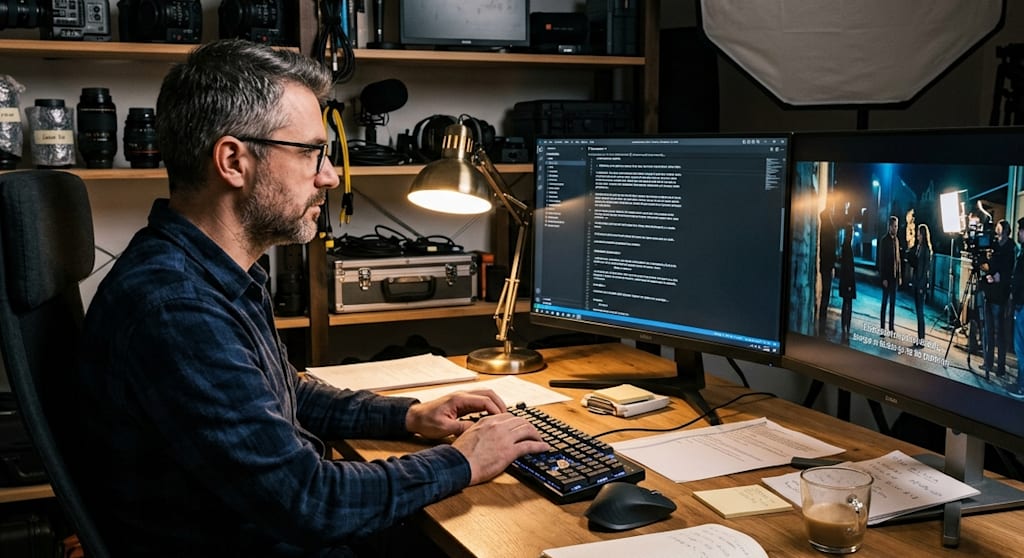
I am sitting in the dark of my own home, trapped between two glowing monuments. To my left, the cool light of my workstation—where I process reviews, answer emails, and earn my living. To my right, another monitor, flickering with the latest offering from a streaming giant. My head has learned a precise gymnastics; I call it the "Geometry of Attention." It's a calculated dance that allows me to track a dialogue-heavy drama on one screen while editing on the other.
As a retired military officer and a lifelong filmmaker, I am proud of this specialized skill. My brain has adapted to multitasking so well I could probably teach a class on the exact degrees of the neck tilt.
It sounds like a modern success story. A portrait of productivity. But if I’m being honest, sitting here in the quiet, it feels like a soft, silent surrender.
The Burnout of Too Much Content
They told us this would be the Golden Age. A world where every masterpiece, every obscure festival gem, every new blockbuster would be available for a monthly subscription fee that costs less than a good cocktail. We believed them. But they didn't mention the weight.
When everything is marketed as "important," nothing actually is. Streaming services have turned the sacred art of cinema into a metric of "hours watched." They don't care if a scene changed your life; they only care that the next episode starts automatically before you’ve even had a chance to breathe.
I’ve spent my life behind and in front of the camera. I’ve directed, produced, and critiqued. Yet, I found myself becoming utterly disinterested in "the new." The hype cycles felt forced, the trailers felt like spoilers, and the stars—once untouchable icons—began to feel like jesters in a court that is far too crowded. The film industry stopped being an invitation to dream and started being a hole that needed to be filled.
So, I adapted. I moved the movies to the second screen. If the industry treated its art as "background content," I decided to treat it exactly the same way. It was my small, silent protest.
The Ghost of 1973
Everything changed two nights ago. Amidst a sea of high-definition "content" recommended by an algorithm that doesn't know my soul, I dug into the archives. I found Soylent Green, the 1973 classic starring Charlton Heston.
I started it on the side screen, as usual. I intended to multitask. But something happened. The pacing was gentler. The stakes felt human. The silence between the lines actually meant something. About twenty minutes in, my hand stopped moving the mouse. The left screen, with its tasks and deadlines, simply went dark in my mind.
I did something I hadn't done in a long time. I leaned back. I moved from the desk to the armchair. I watched it until the very last frame, with a lump in my throat and a sense of focus that felt like a long-lost friend.
That night, I realized that the "porosity" of my attention wasn't my fault. It was a defense mechanism. We multitask because we are trying to find value in a mountain of mediocrity. We watch movies while working because we subconsciously feel that the film isn't worth our full presence. But when the art is real, it demands your whole heart. And you give it gladly.
The Break
The truth is, we are all a bit "screen-locked." We are introverts who have forgotten how to breathe without a backlight. We know what a forest looks like in 4K, but we’ve forgotten the smell of a real pine needle or the way the wind feels when it isn't synthesized through high-end speakers.
My large screens at home are impressive. They mimic the cinema, but they lack the event. They lack the shared breath of a dark room full of strangers.
I find myself dreaming more and more of a different kind of "cut." A cut to black. I see a version of myself standing on a beach in Koh Samui. No dual monitors. No review deadlines. Just one t-shirt, a towel, a pair of flip-flops, and a dusty scooter to explore the island. In that dream, I don't watch movies. I live in the light that doesn't come from a pixel.
We’ve spent too much time glorifying the giants on the screen while our own lives felt small. We’ve turned actors into gods while we sat in the dark, neglecting the air outside our windows. It’s time to put people back in their places. The film industry is a job. The "stars" are craftsmen. They don't deserve our obsession; they deserve our appreciation when they do something honest—and our silence when they don't.
I will keep digging through the archives. I will keep looking for the "slow-burn" stories that remind me why I loved this medium in the first place. But I’m also learning to close the laptop. I want to return to a world where a movie is a reward, not a background noise. Where a tree is something you touch, not something you stream. Until then, I’ll keep my eyes on both screens, but my heart is already halfway to the beach, waiting for the moment I can finally put the mouse down and just... be.
About the Creator
Feliks Karić
50+, still refusing to grow up. I write daily, record music no one listens to, and loiter on film sets. I cook & train like a pro, yet my belly remains a loyal fan. Seen a lot, learned little, just a kid with older knees and no plan.
Keep reading
More stories from Feliks Karić and writers in Critique and other communities.
Tried to Love "The Secret Agent" (2025)- But it Almost Broke Me
I wanted to love it. I really did. I sat down with the lights dimmed, ready to be transported to 1970s Recife, ready for the "slow-burn" brilliance that everyone from Cannes to the Oscars had been whispering about. But two hours in, something happened that rarely happens to me as a cinephile: I felt a heavy, physical exhaustion. I had to hit pause. I had to walk away.
By Feliks Karić12 days ago in Critique
The Road by Cormac McCarthy:
"If he is not the word of God, God never spoke." It's a line spoken by The Man, unnamed, early on in the 2007 Pulitzer Prize winning novel, "The Road" by Cormac McCarthy. It's this line, elegiac and moving, infused with despair and hope, that informs you, you're not reading something you'll easily forget.
By Adam Diehl9 days ago in Critique
Phase 1: The Ultimate Disconnection Protocol
The modern world is going through something that experts can't quite explain. What they call a "mental health crisis" or "failing to fit into society" is actually the spark of something much deeper. It is the exact moment when you begin to see the cracks in the sky of this cardboard reality.
By Lorena Alonsoabout 15 hours ago in Critique


Comments
There are no comments for this story
Be the first to respond and start the conversation.