Advocacy
Navigating the Economy of Your Inner World
Core Concept: We are applying the "Niche Earth" philosophy to Personal Finance. This piece explores how to manage the "climate" of your bank account, avoid the "tectonic shifts" of impulse spending, and build a "solid core" of financial security through evidence-based habits.
By Being Inquisitiveabout a month ago in Earth
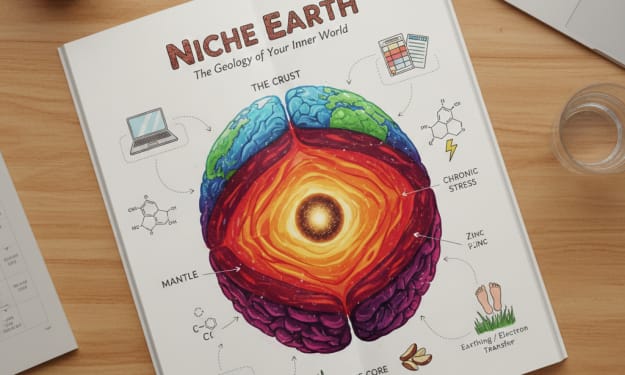
The Geology of Your Inner World
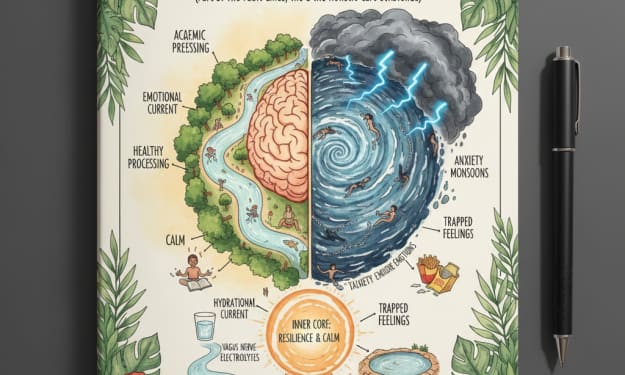
We've journeyed through the solid crust, the molten mantle, and the expansive atmosphere of our Niche Earth. Now, it's time to explore the element that covers most of our planet and profoundly shapes its landscape: the Hydrosphere. For an overthinking girl, the hydrosphere is our emotional world – the vast, deep, sometimes turbulent, and often beautiful realm of our feelings.
By Being Inquisitiveabout a month ago in Earth
The Geology of Your Inner World
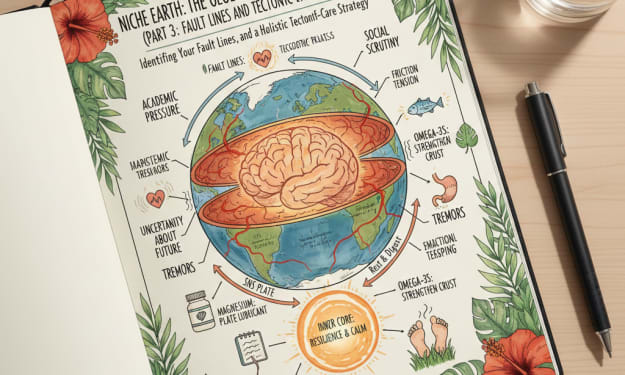
Just like the Earth’s surface is riddled with invisible cracks where tectonic plates meet, our minds have their own deep-seated fault lines. These aren't always obvious; they're the recurring triggers, the sensitive spots, the areas where stress can quickly build up, leading to a mental "tremor" or even a full-blown anxiety "earthquake." As an overthinking girl, my fault lines are often hidden under layers of forced calm and academic ambition. But as a Nutrition student, I'm learning to map them out, not just to avoid collapse, but to understand how to build stronger, more resilient structures.
By Being Inquisitiveabout a month ago in Earth
The Grand Canyon of Overthinking
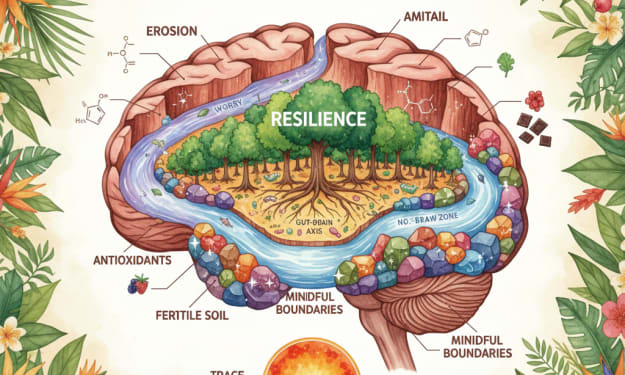
Think about the Grand Canyon. It wasn't formed by one massive event, but by millions of years of water patiently, relentlessly carving through rock. Our overthinking minds can create their own "Grand Canyons" of anxiety. Each repetitive worry, each replayed scenario, each imagined failure, is like a drop of water, slowly eroding our mental energy and sense of peace.
By Being Inquisitiveabout a month ago in Earth
The "Perfect" Student Mask
The Earth’s crust is the layer we all see—the mountains, the forests, the "aesthetic." This is the version of me that shows up to the library with a clean iPad, a color-coded planner, and a perfectly layered matcha latte. It looks solid, permanent, and unshakeable. But in geology, the crust is actually the thinnest, most brittle layer of all.
By Being Inquisitiveabout a month ago in Earth
The Emerald Jewel in the Cosmic Tapestry
Earth, our vibrant home, is far more than just a planet; it is a meticulously crafted masterpiece, an emerald jewel suspended in the cold, vast expanse of the cosmos. It’s a place where the improbable coalesces into the miraculous, where every element, from its celestial dance to its intricate internal rhythms, conspires to foster and sustain an astonishing diversity of life. The designation "miracle planet" isn't hyperbole; it's an understatement of a cosmic ballet performed with breathtaking precision.
By Being Inquisitiveabout a month ago in Earth
Why Russia Never Went Back to Planet Venus
In 1960, when the entire world had its eyes fixed on America’s Apollo missions, something terrifying was happening on our neighboring planet, Venus. The Soviet Union—today’s Russia—was secretly planning what could only be called suicide missions to Venus. After spending billions of dollars and years of effort, they built probes designed to do something unprecedented: land on another planet and capture its images.
By Imran Ali Shahabout a month ago in Earth
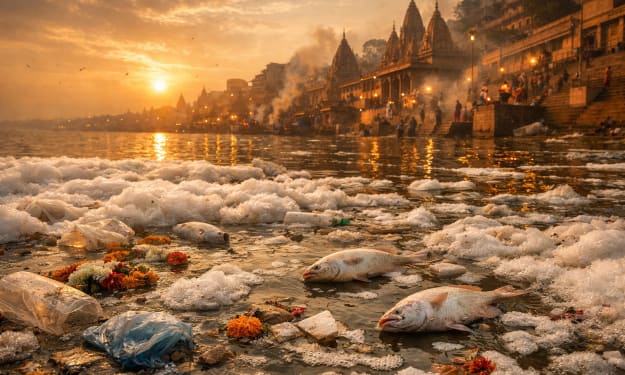
The River Is Already Dead. AI-Generated.
I stood on the banks of the Ganges once, years ago, and the air itself felt alive with something ancient. Pilgrims chanted, lamps floated on the water, and for a moment you could almost believe the stories that this river was born from the heavens and could wash away any sin. But even then, beneath the beauty, I noticed the strange sheen on the surface, the smell that didn’t quite belong to nature. Today, that memory hurts. Because the river I saw is still there… only now it’s dying in plain sight, and we’re all pretending it isn’t.
By Arjun. S. Gaikwadabout a month ago in Earth
Shards Of Paradise
I saw the crushed body of a Gazan child. Their blood was beading on the dusty cinderblocks of the destroyed building they called home. I swipe my finger, and see Charlie Kirk, reclining up on stage, make a joke about the destruction of those buildings, and the bodies that are buried there. I swipe again, and see his body jolt as a bullet bursts his neck and blood gushes out. I can find someone to cheer and chant for every patch of running blood, and justify any act of political violence.
By I. D. Reevesabout a month ago in Earth
When Behavior Walks Away:
I have spent decades watching how behavior changes when the environment stops making sense. That skill came from forensics, trauma science, and animal work in the field. Patterns never break cleanly. They stretch first. They warp. Then the organism abandons the behavior that once kept it stable. I see that pattern now across animals that have nothing in common except the world they live in.
By Dr. Mozelle Martinabout a month ago in Earth
The Methane Accountability Shift
Methane rarely gets top billing, yet the toolkit to curb it has matured rapidly—and mostly out of the spotlight. A decade ago, most oil-and-gas methane was estimated, not measured. Today, facility-scale detections are published to open portals, regulators are writing leak detection and repair (LDAR) into law, and importers face disclosure—and soon performance—requirements. The result is a practical pathway to large, near-term climate cuts by turning leaks into reportable, repairable line items [1–4,12].
By Futoshi Tachinoabout a month ago in Earth