
How to Choose Between Blockchain Solution Types (Public Chains, Private Chains, or Consortium)
A Strategic Playbook for Navigating Public, Private, and Consortium Blockchains

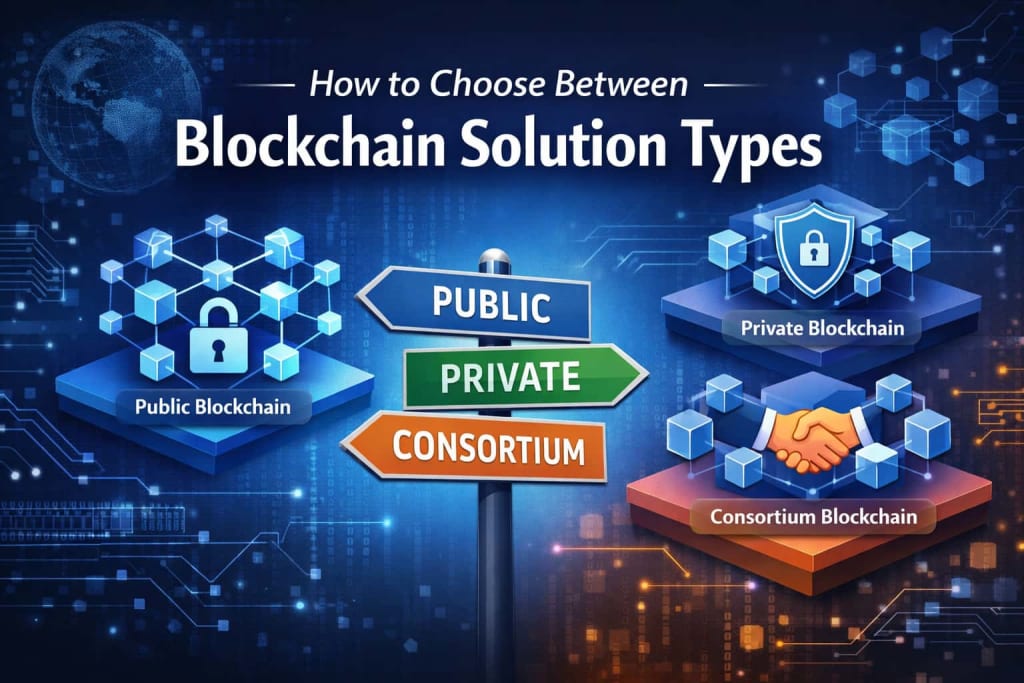
Choosing a blockchain solution is not about picking the most advanced technology—it is about aligning your system with the right trust model. The three primary categories—public, private, and consortium blockchains—represent fundamentally different approaches to governance, access, and control.
Each comes with distinct trade-offs. A public blockchain maximizes openness and decentralization but sacrifices control and efficiency. A private blockchain prioritizes performance and governance but introduces centralization. A consortium blockchain attempts to balance both, but adds complexity in coordination.
Understanding these differences is essential. The wrong choice does not just reduce efficiency—it can undermine the entire purpose of your system.
1. Start with the Core Question: What Is Your Trust Model?
Before comparing blockchain types, define one critical concept:
Who do you need to trust?
Blockchain exists to reduce or eliminate the need for trust. But different solutions reduce trust in different ways.
Ask:
- Are participants mutually distrustful?
- Can a central authority be trusted?
- Do multiple organizations need shared control?
Your answers determine the appropriate blockchain model.
2. Public Blockchains: Maximum Decentralization
Public blockchains are open networks where anyone can participate without permission. No central authority controls access, validation, or governance.
Key Characteristics
- Permissionless: Anyone can join and interact
- Decentralized: No single point of control
- Transparent: All transactions are publicly verifiable
- Immutable: Data is difficult to alter once recorded
Public blockchains rely on economic incentives and cryptography to maintain consensus among anonymous participants.
When to Choose a Public Blockchain
Public blockchains are ideal when:
- You need trustless interaction between unknown parties
- Your system must be censorship-resistant
- You want global accessibility
- You are building open financial systems
Typical use cases include:
- Decentralized finance (DeFi)
- Non-fungible tokens (NFTs)
- Public token systems
- Decentralized governance
In systems like a decentralized exchange (DEX), a public blockchain ensures that trades are executed transparently and without reliance on intermediaries. Smart contracts enforce rules, while the network validates outcomes.
Trade-Offs
Public blockchains come with limitations:
- Scalability constraints: Lower throughput compared to centralized systems
- Transaction costs: Fees can fluctuate significantly
- Latency: Slower confirmation times
- Limited privacy: Data is visible to all participants
You are trading performance and control for trustlessness and openness.
3. Private Blockchains: Control and Efficiency
Private blockchains restrict participation to authorized entities. A central organization—or a defined authority—controls access and governance.
Key Characteristics
- Permissioned: Only approved participants can join
- Centralized or semi-centralized control
- Higher throughput: Optimized for performance
- Greater privacy: Data is restricted to participants
Private blockchains often resemble traditional distributed systems but include blockchain features like immutability and auditability.
When to Choose a Private Blockchain
Private blockchains are suitable when:
- Participants are known and trusted
- You need high performance and scalability
- Regulatory compliance is required
- Data privacy is critical
Common applications:
- Enterprise supply chain systems
- Internal financial systems
- Healthcare data sharing
- Corporate audit logs
In these environments, trust is not eliminated—it is constrained within a controlled network.
Trade-Offs
Private blockchains introduce different risks:
- Centralization: Control lies with a single entity or group
- Reduced trustlessness: Participants must trust the operator
- Limited external composability: Harder to integrate with open ecosystems
While efficient, private blockchains do not provide the same level of trust minimization as public systems.
4. Consortium Blockchains: Shared Governance
Consortium blockchains sit between public and private models. Instead of a single authority, control is distributed among a group of organizations.
Key Characteristics
- Partially decentralized: Controlled by multiple entities
- Permissioned access: Only approved participants can join
- Shared governance: Decisions require consensus among members
- Improved trust model: No single controlling party
This structure is designed to distribute trust among stakeholders rather than concentrate it.
When to Choose a Consortium Blockchain
Consortium blockchains are ideal when:
- Multiple organizations must collaborate
- No single party should have full control
- Participants need shared accountability
- There is a need for balanced trust and efficiency
Use cases include:
- Banking networks
- Inter-organizational data sharing
- Industry-wide systems (e.g., logistics, insurance)
- Trade finance platforms
This model is often used when competitors must cooperate under agreed rules.
Trade-Offs
Consortium blockchains introduce complexity:
- Governance challenges: Coordinating multiple stakeholders is difficult
- Slower decision-making: Consensus among organizations takes time
- Partial trust model: Not fully trustless, but not centralized
While more balanced, they require strong governance frameworks to function effectively.
5. A Practical Comparison
To choose effectively, compare the three models across key dimensions:
Trust Model
- Public: Trust minimized through decentralization
- Private: Trust placed in a central authority
- Consortium: Trust distributed among selected parties
Control
- Public: No central control
- Private: Full control by one entity
- Consortium: Shared control
Performance
- Public: Lower throughput, higher latency
- Private: High performance
- Consortium: Moderate to high performance
Transparency
- Public: Fully transparent
- Private: Limited visibility
- Consortium: Controlled transparency
Security Model
- Public: Secured by economic incentives and cryptography
- Private: Secured by organizational trust
- Consortium: Secured by shared governance and trust distribution
6. Decision Framework: Step-by-Step
Use this structured approach to make your choice:
Step 1: Define Your Trust Requirements
Do participants trust each other? → If no, consider a public blockchain
Is trust already established? → Private or consortium may suffice
Step 2: Evaluate Governance Needs
Single organization? → Private blockchain
Multiple organizations? → Consortium blockchain
Open participation? → Public blockchain
Step 3: Assess Performance Needs
High throughput required? → Private or consortium
Accept slower, decentralized systems? → Public blockchain
Step 4: Consider Data Sensitivity
Public transparency required? → Public blockchain
Confidential data? → Private or consortium
Step 5: Evaluate Ecosystem Requirements
Need composability with other systems? → Public blockchain
Internal system only? → Private blockchain
7. Common Mistakes
1. Choosing Blockchain for the Wrong Reason
Many systems adopt blockchain for trend reasons rather than necessity. This leads to unnecessary complexity.
2. Overusing Public Blockchains
Public chains are powerful, but not always appropriate. If participants are trusted, using a public chain may introduce unnecessary cost and latency.
3. Ignoring Governance Complexity
Especially in consortium models, governance is often underestimated. Without clear rules, systems become slow or unstable.
4. Overcentralizing Private Systems
Private blockchains can become indistinguishable from traditional databases if not carefully designed. This reduces the value of using blockchain at all.
8. Where Smart Contracts and dApps Fit
While the focus here is on blockchain types, it’s important to understand how other components fit:
- Smart contracts define the logic of interactions across all blockchain types
- dApps provide user interfaces to interact with blockchain systems
- DeFi architectures are typically built on public blockchains and rely on smart contracts
These components are not alternatives to blockchain types—they are layers built on top of them.
9. Final Guiding Principle
The best blockchain solution is not the most decentralized or the most efficient—it is the one that correctly matches:
- Trust model
- Governance structure
- Performance requirements
- Data sensitivity
- Use case
There is no universally “best” blockchain type. There is only the right architecture for a specific problem.
Conclusion
Choosing between public, private, and consortium blockchains is ultimately a question of balance.
- Public blockchains maximize trustlessness and openness
- Private blockchains maximize control and efficiency
- Consortium blockchains distribute trust across multiple parties
Each serves a distinct purpose. The mistake is not choosing one over another—it is choosing without understanding the trade-offs.
A well-designed system begins not with technology, but with clarity: what must be trusted, what must be controlled, and what must remain open.
That clarity determines everything that follows.
About the Creator
Damian Brown
IT consultant with 7+ years’ experience helping organizations optimize technology, implement scalable solutions, and drive digital transformation for measurable business results.
Keep reading
More stories from Damian Brown and writers in Education and other communities.
How to Migrate an Existing UIKit App to SwiftUI
In the modern mobile landscape, companies face growing pressure to deliver high-quality, maintainable apps. Many organizations initially launch many apps on iOS before Android, due to the platform’s uniform hardware ecosystem, strong monetization potential, and a relatively predictable user base. While UIKit has been the mainstay for iOS development for over a decade, Apple’s SwiftUI offers a modern, declarative alternative that promises easier maintenance, faster iteration, and a more reactive approach to UI development. Migrating an existing UIKit application to SwiftUI requires careful planning, a strong understanding of both frameworks, and a strategy that minimizes disruption to users.
By Damian Brownabout 21 hours ago in Education
How Researchers Evaluate Peptide Suppliers: Standards That Matter
If you've spent any time in the research community, you already know that sourcing compounds is half the battle. Finding where to buy peptides that are actually research-grade — pure, tested, and properly labeled — is something a lot of newcomers get wrong the first time.
By Hazel Jackson3 days ago in Education
Foraging Appalachia’s Wild Edibles
It's that time of year again and Appalachia offers a remarkable abundance for anyone willing to learn its seasonal gifts and practice careful gathering. Across ridges, holler's, stream-side's, and meadows, edible plants, berries, roots, and fungi appear through every part of year. Knowledge is key and teaches not only what can be eaten, but also how to gather with respect so that these resources remain available far into future.
By Tim Carmichael3 days ago in Feast



Comments
There are no comments for this story
Be the first to respond and start the conversation.