
How to Choose the Right Blockchain Architecture for Your Business Model
A Practical checklist for choosing the right blockchain architecture

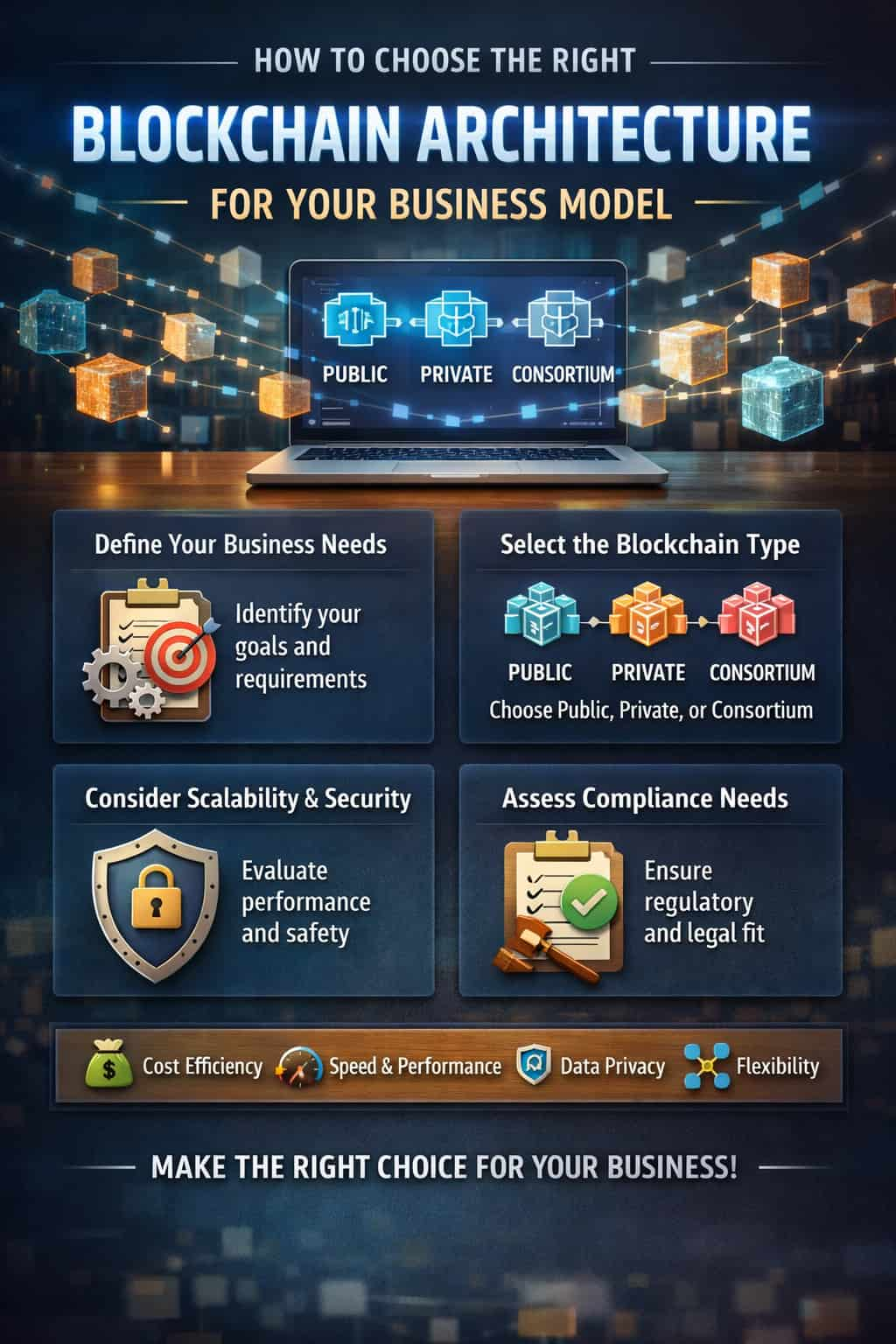
Choosing the right blockchain architecture for your business model is not a purely technical decision—it is a strategic one that intersects with governance, economics, regulatory exposure, and long-term scalability. A poorly chosen architecture can introduce unnecessary complexity, limit performance, or undermine trust. Conversely, a well-aligned design can unlock efficiency, transparency, and entirely new business capabilities.
This article outlines a structured approach to selecting a blockchain architecture that aligns with your operational goals, risk tolerance, and future ambitions.
1. Start with Business Objectives, Not Technology
Before evaluating any blockchain framework, you must clarify what problem you are solving. Blockchain is not a universal solution; it excels in specific contexts:
- Multi-party data sharing with minimal trust
- Immutable audit trails
- Tokenization of assets
- Decentralized governance
- Automation via smart contracts
If your use case does not require trust minimization or shared control, traditional centralized systems may outperform blockchain in simplicity and cost.
Ask:
- Who are the participants?
- What level of trust exists between them?
- What are the consequences of data tampering or loss?
- Is transparency or privacy more critical?
Your answers will guide every subsequent architectural decision.
2. Understand the Core Blockchain Types
There are three primary categories of blockchain architectures, each with distinct trade-offs.
Public Blockchains
Public blockchains are permissionless and fully decentralized. Anyone can participate, validate transactions, and view the ledger.
Advantages:
- High transparency and trustlessness
- Strong censorship resistance
- Robust security due to large validator networks
Limitations:
- Lower throughput and scalability
- Transaction fees can fluctuate
- Limited privacy
Best suited for:
- Cryptocurrencies
- Decentralized finance (DeFi)
- Open ecosystems where trust is minimal
Private Blockchains
Private blockchains restrict access to a single organization or a tightly controlled group.
Advantages:
- High performance and scalability
- Full control over participants and governance
- Enhanced privacy
Limitations:
- Reduced decentralization
- Potential single point of control
- Less trust from external stakeholders
Best suited for:
- Internal enterprise systems
- Supply chain tracking within a company
- Secure data management
Consortium Blockchains
Consortium blockchains sit between public and private models. Control is shared among a group of trusted organizations.
Advantages:
- Balanced decentralization and control
- Greater trust than private chains
- Improved performance over public networks
Limitations:
- Governance complexity
- Requires coordination between stakeholders
- Potential for slower decision-making
Best suited for:
- Industry collaborations
- Banking and financial consortia
- Supply chain ecosystems involving multiple entities
3. Evaluate Performance and Scalability Requirements
One of the most critical architectural considerations is throughput—how many transactions your system can handle per second—and latency—how quickly those transactions are confirmed.
Key questions:
- What is your expected transaction volume?
- Will usage grow exponentially?
- How fast must transactions be confirmed?
- Are you processing real-time data?
Public blockchains often struggle with scalability unless they use Layer 2 solutions. Private and consortium chains typically offer higher performance due to fewer nodes and more efficient consensus mechanisms.
4. Choose the Right Consensus Mechanism
Consensus mechanisms define how nodes agree on the validity of transactions.
Common models include:
- Proof of Work (PoW): Secure but resource-intensive
- Proof of Stake (PoS): Energy-efficient and scalable
- Delegated Proof of Stake (DPoS): High performance with selected validators
- Practical Byzantine Fault Tolerance (PBFT): Fast, suited for permissioned networks
Your choice depends on:
- Security requirements
- Network size
- Energy considerations
- Trust assumptions between participants
For enterprise applications, permissioned consensus models like PBFT or PoS variants are typically preferred.
5. Assess Security and Privacy Needs
Security in blockchain is not only about cryptography but also about governance and access control.
Consider:
- Who can read the data?
- Who can write or validate transactions?
- How are identities managed?
- What encryption mechanisms are used?
Privacy is especially critical in industries like healthcare, finance, and legal services. Techniques such as:
- Zero-knowledge proofs
- Off-chain storage
Private channels can help protect sensitive data while maintaining blockchain benefits.
6. Align with Regulatory and Compliance Requirements
Blockchain applications often intersect with regulatory frameworks, including:
- Data protection laws (e.g., GDPR)
- Financial compliance (KYC/AML)
- Industry-specific regulations
Immutability, while a core strength of blockchain, can conflict with “right to be forgotten” requirements. Therefore, architectural choices must consider:
- Whether data is stored on-chain or off-chain
- How personal data is anonymized or encrypted
- How auditability is preserved
In many cases, consulting with experts offering blockchain consulting services is necessary to ensure compliance without sacrificing functionality.
7. Design for Interoperability
Modern blockchain ecosystems rarely exist in isolation. Your system may need to interact with:
- Other blockchains
- Legacy systems
- External APIs
- Third-party services
Interoperability can be achieved through:
- Cross-chain bridges
- Oracles
- API gateways
- Standardized protocols
A lack of interoperability can lead to vendor lock-in or operational silos, reducing the long-term value of your investment.
8. Consider Tokenomics and Incentive Structures
If your architecture involves tokens, you must design a sustainable economic model.
Key considerations:
- Token utility (governance, access, rewards)
- Distribution model
- Inflation or deflation mechanisms
- Incentives for validators and participants
Poor tokenomics can destabilize the ecosystem, discourage participation, or lead to speculative volatility.
9. Evaluate Development Ecosystem and Tooling
The maturity of the ecosystem surrounding a blockchain platform can significantly affect development speed and cost.
Look for:
- Strong developer communities
- Comprehensive documentation
- Available SDKs and APIs
- Active maintenance and updates
- Third-party integrations
Popular ecosystems such as Ethereum, Hyperledger, and Solana offer different strengths depending on your use case.
10. Plan for Governance and Upgradability
Blockchain systems must evolve over time, but decentralization makes upgrades complex.
Ask:
- How are protocol changes proposed and approved?
- Who has governance authority?
- Can the system be upgraded without disruption?
- How are conflicts resolved?
A robust governance model ensures long-term adaptability while preserving trust among stakeholders.
11. Estimate Costs and Resource Requirements
Costs associated with blockchain include:
- Infrastructure (nodes, storage, bandwidth)
- Development and maintenance
- Transaction fees
- IT audits
Public blockchains may impose unpredictable transaction fees, while private systems require investment in infrastructure and management.
Conduct a cost analysis to ensure that the expected value justifies the investment.
12. Pilot, Test, and Iterate
Before full-scale deployment, implement a proof of concept (PoC).
A pilot allows you to:
- Validate assumptions
- Identify performance bottlenecks
- Test security mechanisms
- Gather stakeholder feedback
This iterative approach reduces risk and ensures alignment with business goals.
13. Conduct Continuous Auditing and Monitoring
Once deployed, blockchain systems require ongoing evaluation to ensure performance, security, and compliance.
Auditing a blockchain strategy is essential for:
- Detecting vulnerabilities
- Verifying compliance with regulations
- Ensuring governance processes are followed
- Maintaining system integrity
Regular audits help prevent systemic failures and build trust among stakeholders.
14. When to Seek External Expertise
Blockchain architecture is a complex, multidisciplinary challenge. External expertise can provide critical guidance in:
- Architecture design
- Security assessment
- Regulatory compliance
- Performance optimization
- Token economics
Blockchain consulting helps reduce risks, and ensure best practices are followed from the outset.
15. Final Framework for Decision-Making
To synthesize the above considerations, use the following decision framework:
- Define the problem clearly. Focus on trust, transparency, and decentralization needs.
- Select the blockchain type. Public, private, or consortium—based on your trust model and participants.
- Match performance requirements. Ensure scalability aligns with projected demand.
- Prioritize security and privacy. Protect sensitive data while maintaining transparency where needed.
- Ensure regulatory alignment. Design with compliance in mind from the beginning.
- Plan for evolution. Build governance and upgrade mechanisms into the architecture.
- Validate through testing. Use pilots before scaling.
Conclusion
Selecting the right blockchain architecture is an exercise in strategic alignment rather than technological enthusiasm. It requires a clear understanding of your business model, stakeholder relationships, and long-term objectives.
A successful implementation balances decentralization, performance, security, and governance. By approaching the decision systematically and by engaging in practices you can avoid common pitfalls and build a system that delivers sustainable value.
Blockchain is not a one-size-fits-all solution. But when applied thoughtfully, it can redefine trust, efficiency, and transparency in your business model.
About the Creator
Damian Brown
IT consultant with 7+ years’ experience helping organizations optimize technology, implement scalable solutions, and drive digital transformation for measurable business results.
Keep reading
More stories from Damian Brown and writers in Education and other communities.
How to Audit a Blockchain Strategy Before You Waste Six Figures
Blockchain has matured from a speculative buzzword into a serious technological option for enterprises. Yet its adoption remains fraught with costly missteps. Organizations frequently commit six-figure budgets to blockchain initiatives that fail to deliver meaningful value, often due to poor planning, weak use-case validation, or misalignment with business goals.
By Damian Brownabout 7 hours ago in Education
Cash Flow and Care: Why Accounts Receivable Management Matters More Than You Think
Running a healthcare organization is demanding enough without worrying about whether the money you've earned will actually show up. But for countless practices and hospitals, that worry is very real. Payments get delayed. Claims sit in limbo. And revenue that should be flowing in just isn't.
By Bradley Mitchell3 days ago in Education
Mastering Portrait Photography: Capturing Personality Through the Lens
Portrait photography is more than just taking pictures of people; it is the art of capturing personality, emotion, and character in a single frame. Whether photographing friends, family, or professional clients, a successful portrait reflects not only the subject’s appearance but also their essence. Understanding the principles of portrait photography enables photographers to create images that resonate emotionally and visually, elevating their work beyond simple documentation.
By Jeremy Berman Findlay Ohio5 days ago in Education




Comments
There are no comments for this story
Be the first to respond and start the conversation.