lgbtq
Explore and support LGBTQ issues, rights, events, and movements.
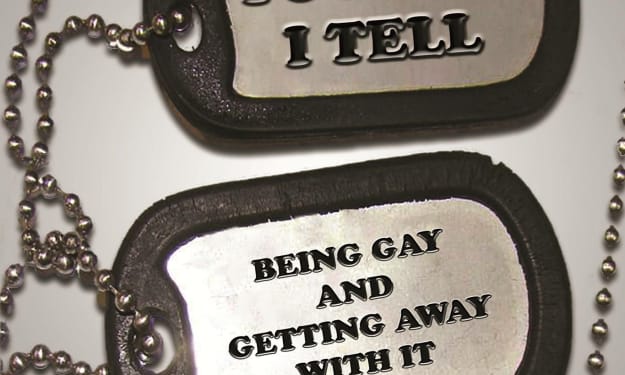
You Ask, I Tell: Being Gay and Getting Away with It [Chapter 2]
Chapter 2: Fellow Bar and the Incestuous Gay Entourage It all started very innocently. I would meet up with friends like Bill, the prissy one that can judge you with a smile, and Rhoni, the batshit sailor who would playfully punch you when he was drunk. Ace, the towering giraffe of a man, would begin to flirt with me, wrapping his hands around my thigh, and squeezing till I laughed like a school girl. We would meet at Fellow for drinks and they would invite me out to do things like go ice skating or go eat with them at a curry restaurant. I was extremely nervous about letting my guard down. Yes, these were my gay friends, but I was a military officer and was scared of getting into any trouble whatsoever. Aside from concerns about Don’t Ask, Don’t Tell, I was concerned about perceptions of fraternization, the act of engaging in friendly or sexual relations with an enlisted member, something considered a crime under the Uniform Code of Military Justice. When I went ice skating for the first time, I sat alone in the corner quietly eating a cup of noodles while everyone else sat and made fun of people busting their ass on the ice. Ernesto, this quiet sailor who totally rocked a bushy mustache that made him look like the Mexican version of Ron Jeremy, came and encouraged me to relax and join the group. As time passed, I did put my fears aside and relaxed, and as I relaxed I noticed, “Hey, these gays are hot!”
By Carlos Coronado8 years ago in Filthy
You Ask, I Tell: Being Gay and Getting Away with It
Foreword Don’t Ask Don’t Tell was a policy instituted by President Clinton in 1993. While intended as a mechanism for LGBT servicemembers to serve in the Armed Forces, it created an environment of fear, blackmail, and intimidation. Over 17,000 servicemembers would be discharged from the military under this policy before its eventual repeal in 2011.
By Carlos Coronado8 years ago in Filthy
Her First Time
I wanted her so badly. I know she wanted me, too. But I could tell she was nervous. As I took in her beauty, I thought of what I wanted to do to her, where I could guide those lovely lips of hers. Her eyes — those big beautiful eyes — show me all that she desires. But, I thought, I'm getting ahead of myself. I need to show her what it's like, make her first time unforgettable, and show her how much satisfaction and pleasure one can get from another woman. But where do I start?
By Jayneca Marriott8 years ago in Filthy
Transgender People Like Sex Too. Top Story - October 2017.
If I had a pound for every time I heard someone ask me about my sex life and ask me probing questions about my body — I'd be a pretty rich woman by now. The same goes for the amount of times I've heard people ask my fellow trans friends similar questions. It seems pretty taboo that transgender people can have sex — let alone actually enjoy intimacy. It's true that we often, but not always, hate our bodies and desperately want out... but to assume we're all asexual couldn't be further from the truth.
By Skylar Rose Pridgeon8 years ago in Filthy
What It's Like to be Asexual
Asexuality is defined as having no sexual attraction. A better definition would be no immediate sexual attraction. There is a whole spectrum under that label, however. Asexuality does not mean that people cannot enjoy sex, nor does it mean that they cannot, at some point, be attracted to a specific person in some way. It does also include people who are repelled by sex, or romance, or even both.
By Dominique Thigpen8 years ago in Filthy
Does Sexuality and Sexual Preference Have More to Do With What We Learn Is "Normal" Or "Acceptable" or What Is Biologically Engrained Within Our Very Genetic Makeup?
Biologically our bodies are programmed for specific functions we share with all other human beings. In order to live, your heart needs to beat, your lungs need oxygen, and your blood is what holds you all together. Humans have natural instincts that don’t have to be taught to them in order for them to learn. From birth, you know how to take your first breath, and swallow your first drink of milk without much assistance at all. Our bodies are programmed to be a specific way, and when they aren’t what is considered the norm, a person is considered to have “something wrong,” be “sick,” or “disabled.” Our brain is a crucial part of our body and I have to wonder if the same rules or social norms really apply to mind as well.
By Brittany Stengel8 years ago in Filthy
Apples and Oranges
The first instance of the word “orange” in the English language was in 1512. Contrary to the clever quip you’d heard before, the English language did have words for the color orange before that—saffron and yellow—saffron used to refer to yellowish hues, and red-yellow used to discuss redder hues. Of course, many of the colors we traditionally think of as orange were simply categorized as red, giving us the strange phenomenon of red deer, robin redbreast, and red hair.
By Haybitch Abersnatchy8 years ago in Filthy