
The Golden Age of Islam
Exploring the historical achievements and mythical portrayals of one of the Abbasid Caliphate’s most iconic rulers

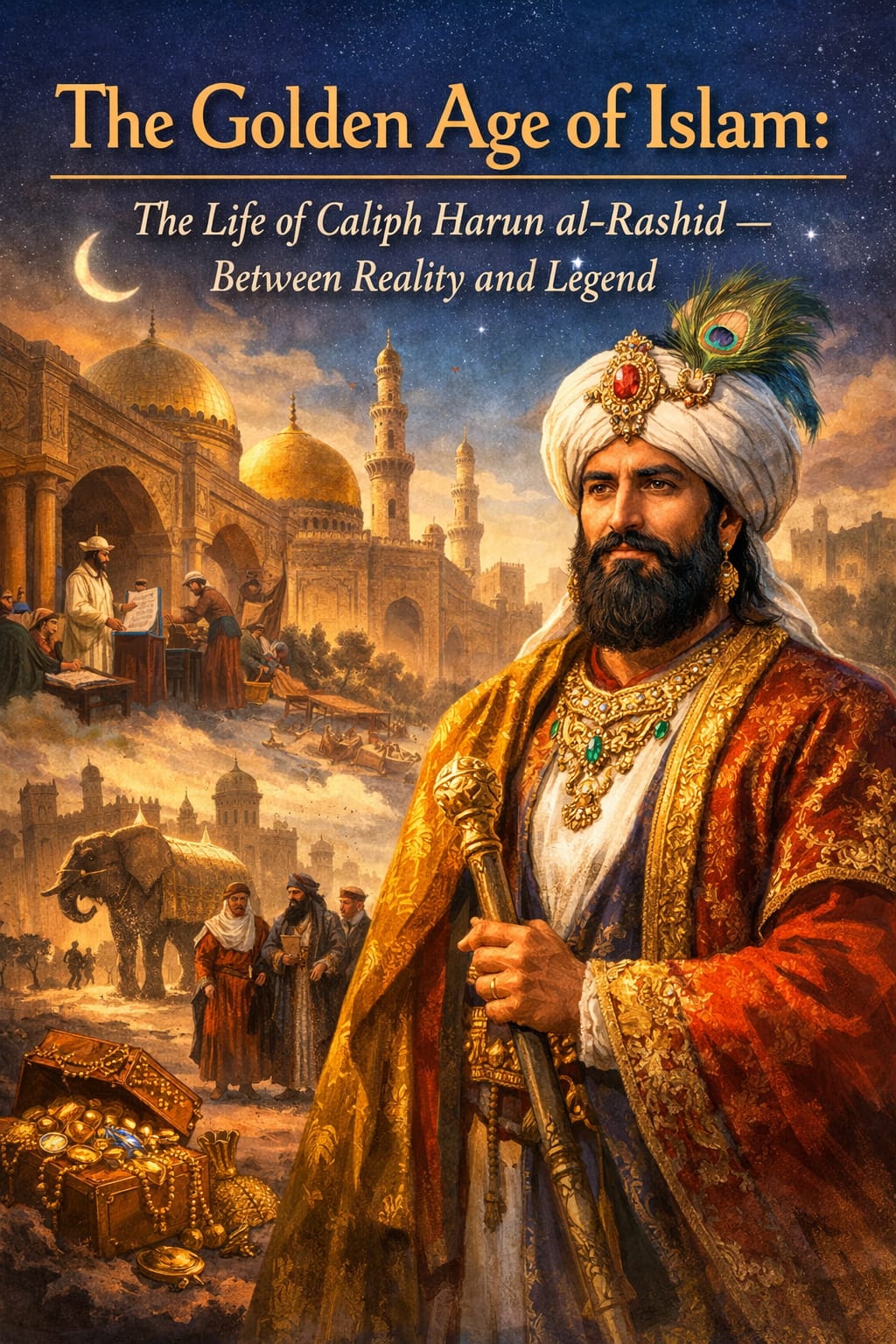
The name Harun al-Rashid often evokes images of dazzling palaces, wise rulers in disguise, and tales filled with intrigue and adventure. Known as one of the most famous Abbasid caliphs, his legacy exists at the crossroads of history and legend. While his reign marked a true golden age of Islamic civilization, much of what people believe about him comes from literary imagination, particularly stories like One Thousand and One Nights. Understanding Harun al-Rashid requires separating documented historical achievements from the myths that later surrounded his name.
Harun al-Rashid was born in 763 CE and became the fifth caliph of the Abbasid Caliphate in 786 CE. His rule lasted until 809 CE and is widely regarded as a peak period of political stability, economic prosperity, and cultural flourishing. Under his leadership, the Abbasid Empire stretched from North Africa to Central Asia, making it one of the largest and most influential empires of its time.
One of Harun al-Rashid’s most significant contributions was his patronage of knowledge and scholarship. Baghdad, the capital of the Abbasid Caliphate, became a global center of learning during his reign. Although the famous House of Wisdom reached its height slightly after his time, Harun laid the foundation by supporting scholars, translators, and scientists. Greek, Persian, and Indian texts were translated into Arabic, helping preserve and expand human knowledge in fields such as medicine, mathematics, astronomy, and philosophy.
Economically, his era was marked by strong trade networks. The empire’s location allowed it to connect East and West, facilitating the exchange of goods, ideas, and culture. Luxuries such as silk, spices, and precious metals flowed through Abbasid lands, contributing to the wealth and vibrancy of cities like Baghdad.
Politically, Harun al-Rashid maintained a relatively stable administration, although his reign was not without challenges. He had to manage internal rivalries, particularly within his own family. His decision to divide succession between his sons eventually led to civil war after his death, weakening the unity of the empire. This aspect of his rule shows that, despite the image of a perfect ruler, he faced complex governance issues that had lasting consequences.
Now, turning to the legendary side of Harun al-Rashid, much of his popular image comes from One Thousand and One Nights. In these stories, he is portrayed as a just and curious ruler who often roamed the streets of Baghdad in disguise to observe the lives of his people. Accompanied by his loyal vizier Ja’far and the witty Abu Nuwas, he appears as a central figure in many entertaining tales.
However, historians generally agree that these stories are largely fictional or heavily embellished. While it is possible that Harun took an interest in the condition of his subjects, there is little historical evidence that he regularly wandered the city in disguise. The literary portrayal serves more as a symbolic representation of ideal kingship—wise, accessible, and deeply concerned with justice—rather than a literal account of his actions.
The contrast between the real and fictional Harun al-Rashid highlights an important point about historical memory. Over time, powerful figures often become larger than life. In Harun’s case, the prosperity and cultural brilliance of his era made him an ideal candidate for myth-making. Storytellers used his name to frame moral lessons, entertain audiences, and imagine a world of wonder and possibility.
Even in international relations, Harun al-Rashid’s reputation extended beyond the Islamic world. He famously exchanged gifts with Charlemagne, the ruler of the Carolingian Empire in Europe. This diplomatic interaction reflects the global significance of the Abbasid Caliphate during his reign and demonstrates that his influence was not confined to the Islamic world alone.
In conclusion, Harun al-Rashid was both a historical figure of great importance and a legendary character shaped by centuries of storytelling. His real achievements—supporting scholarship, fostering economic growth, and governing a vast empire—are impressive in their own right. Yet, the myths surrounding him add another layer to his legacy, transforming him into a symbol of the Islamic Golden Age. By distinguishing fact from fiction, we gain a richer and more nuanced understanding of a ruler whose name continues to inspire fascination to this day.
About the Creator
Irshad Abbasi
Ali ibn Abi Talib (RA) said 📚
“Knowledge is better than wealth, because knowledge protects you, while you have to protect wealth.
Keep reading
More stories from Irshad Abbasi and writers in History and other communities.
The Lost Greek Monastery
For over a century, historians, archaeologists, and adventurers have been captivated by the mystery of a “lost” Greek monastery said to be hidden in a remote and rugged landscape. The story began with a fragile, hand-drawn map believed to date back several hundred years. Passed through generations and rediscovered in the early 20th century, the map pointed to a secluded location where a once-thriving monastic community was thought to have vanished without a trace. However, after decades of tireless searching, a surprising conclusion has emerged: the map that inspired the quest was wrong.
By Irshad Abbasi about 10 hours ago in History
March 15, 2026
Merriam Webster - Word of the day: Tranche refers to a division or portion of a whole. World Contact Day is commemorated every year on March 15. It is a unique observance held globally to focus on communicating with extraterrestrial life and exploring the possibility that intelligent beings may exist beyond Earth. World Contact Day inspires people to invoke their curiosity and spend time thinking about the universe and the mysteries surrounding it. What is the “Ides of March”? According to the Roman calendar, the Ides are a monthly occurrence. In March and other months with 31 days, the Ides always falls on the 15th; it falls on the 13th in months with 30 days. The Ides traditionally marked the arrival of the new Moon and was cause for celebration. The word “Ides” is derived from Latin, meaning “to divide.” Mothering Sunday in 2026 falls on Sunday, March 15. Mothering Sunday, celebrated in the United Kingdom and Ireland, occurs on the fourth Sunday of Lent, which is exactly three weeks before Easter. Unlike the fixed-date Mother's Day in countries like the United States, Canada, and Australia, Mothering Sunday’s date changes each year according to the Christian liturgical calendar. On March 15, 2026, several notable observances and events are celebrated: Dumbstruck Day: A day to express frustration. Everything You Think is Wrong Day: A day to challenge and celebrate wrong beliefs. International Day Against Police Brutality: A day to raise awareness and advocate against police violence. My look at today, March 15, 2026 below:
By Denise E Lindquista day ago in Writers


Comments
There are no comments for this story
Be the first to respond and start the conversation.