
Year 1890 Fun Facts, Trivia, and Historical Events
This quick read presents a collection of fun facts, trivia, and historical events from the year 1890.

This quick read presents a collection of fun facts, trivia, and historical events from the year 1890. Discover the year’s top news stories, most influential people, sports facts, historic firsts, entertainment news, and much more.
Take a journey through history in just minutes.
- In 1890, Benjamin Harrison (R-Indiana) was the 23rd U.S. president, and Levi B. Morton (R-New York) was the 22nd vice president of the United States.
- The 51st U.S. Congress was in session, and Republicans controlled both the House and Senate.
- The U.S. unemployment rate was about 4%, and the nation's inflation rate was around -1.09%.
- An estimated 43% of Americans were employed in agriculture. There were about 4,565,000 farms in the United States, averaging about 136 acres apiece.
- According to 1890 U.S. Census data, New York, Pennsylvania, Illinois, Ohio, and Missouri were the most populated states. Conversely, Nevada, Wyoming, Idaho, Montana, and Delaware had the fewest residents.
- 1890 U.S. Census data also confirmed that “the frontier region of the United States no longer existed, and the Census Bureau would no longer track the westward migration of the U.S. population.”
- In 1890, an estimated 7.5 million African Americans lived in the United States, representing about 12% of the nation’s population. Approximately 107,488 Chinese people were also U.S. residents, compared to 64,199 in 1870. Nearly 250,000 Native Americans were also living in the United States, compared to an estimated 600,000 in 1800.
- Consumer products launched in 1890 included Crow’s candy, Knox unflavored gelatin, the Ouija board, Sunshine biscuits, and Vicks over-the-counter medications.
- On January 10, 1921, a fire broke out in the basement of the U.S. Commerce Department building in Washington, DC, destroying or damaging a significant portion of the 1890 census records. As a result, “only 6,190 names could be extracted” from the 62,947,714 people counted. NationalArchives.gov states, “Despite the protests and salvage attempts, Congress formally authorized the destruction of the remaining 1890 census schedules on February 21, 1933.”
- The average life expectancy at birth in the United States was about 42.5 years. In the 1890s, the average life expectancy in the U.S. was relatively low, and a major factor was a high infant mortality rate.
- On January 2, President Harrison “made history by appointing Alice Sanger as the first female White House staffer. Sanger served as a stenographer under both Harrison and Grover Cleveland.”
- On January 22, the United Mine Workers of America (UMWA) was established in Columbus, Ohio. The UMWA was created to achieve better pay, increased benefits, reasonable working hours, and safer working conditions for miners and other mine personnel.
- On January 25, American journalist Nellie Bly completed her famous 72-day, round-the-world journey. She was inspired by Jules Verne's adventure novel—Around the World in Eighty Days. Bly’s journey “took her through England, France, Italy, the Suez Canal, Ceylon, the Straits Settlements (Penang and Singapore), Hong Kong, and Japan, before arriving back in the US.”
- On February 18, the National American Woman Suffrage Association (NAWSA) was formed through the merger of “two existing organizations,” the National Woman Suffrage Association (NWSA) and the American Woman Suffrage Association (AWSA). At the time it was established, NAWSA’s membership was around seven thousand and “eventually increased to two million, making it the largest voluntary organization in the nation.”
- On May 2, Congress passed the Oklahoma Organic Act, establishing the Oklahoma Territory.
- On June 1, the U.S. Census Bureau began using “Herman Hollerith's tabulating machine to record census returns using punched card input, a landmark in the history of computing hardware.” (Hollerith's company eventually became IBM.)
- On July 2, President Harrison signed the Sherman Antitrust Act into law, “making it the first federal law to outlaw monopolistic business practices and authorizing the government to break up trusts and monopolies.”
- On July 3, Idaho became the 43rd U.S. state.
- On July 10, Wyoming became the 44th U.S. state.
- On August 6, at the Auburn Correctional Facility in New York, American murderer William Francis Kemmler became the first person to be executed by electric chair. He “was convicted of murdering Matilda ‘Tillie’ Ziegler, his common-law wife, a year earlier.”
- On October 1, Yosemite National Park in California was established, “making it the third national park in the United States, after Yellowstone (1872) and Sequoia (1890).”
- November 29: In the first Army-Navy football game, the United States Navy defeated the United States Army, 24–0.
- In 1890, the first electric elevator began operating in the Demarest Building, a four-story commercial structure located at 339 Fifth Avenue in New York City.
- What was the typical American diet like in 1890? LiveStrong.com states that in the 1890s, “the United States was vastly agricultural, and many families lived off the land, cultivating their vegetable and herb gardens and raising their livestock and poultry. Hunting and fishing provided wild game and other meat alternatives.” Americans also consumed apples, beets, bread, butter, cake, carrots, cheese, cherries, coffee, corn, hominy, jams, jellies, lettuce, melons, milk, pears, plums, potatoes, relishes, tomatoes, and turnips.
- Popular music artists and groups were Al Reeves, Charles Harris, Dan Quinn, Holding’s Military Band, Issler’s Orchestra, James Thornton, John Philip Sousa’s Band, Len Spencer, the U.S. Military Band, and Will White.
- America’s most beloved songs included The Thunderer (United States Marine Band), The Washington Post (United States Marine Band), and Semper Fidelis (United States Marine Band).
- In 1890, the words “adrenaline,” “beauty shop,” “bow tie,” “bunk bed,” “chain-smoke,” “cough up,” “English sonnet,” “free enterprise,” “golf course,” “jade green,” “Mother’s Day,” “pipe dream,” “race riot,” “split infinitive,” “teletype,” “timescale,” “treasury note,” “voltage,” and “wailing wall” all appeared in print for the first time.
References:
- https://www.merriam-webster.com/time-traveler/1890
- https://rateyourmusic.com/charts/top/single/1890/
- https://www.flickchart.com/charts.aspx?year=1890
- https://www.foodreference.com/html/html/food-history-1890.html
- https://en.wikipedia.org/wiki/1890_in_the_United_States
- https://www.onthisday.com/events/date/1890
© 2026 Gregory DeVictor
About the Creator
Gregory DeVictor
Gregory DeVictor is a trivia enthusiast who likes to write articles about American history and nostalgia. Each of his articles presents a mix of fun facts, trivia, and historic events about a specific calendar year, decade, or century.
Keep reading
More stories from Gregory DeVictor and writers in History and other communities.
Year 1896 Fun Facts, Trivia, and Historical Events
This quick read presents a collection of fun facts, trivia, and historical events from the year 1896. Discover the year’s top news stories, most influential people, U.S. economic trends, entertainment news, and much more.
By Gregory DeVictorabout 5 hours ago in History
Why the Ancient Biblical Texts Differ From the Modern American Bible
Introduction Questions about why the modern American Bible differs from ancient biblical texts are not only understandable but necessary. These differences have been shaped by language barriers, manuscript transmission, political power, theological debates, and historical context. Importantly, confusion often arises from the belief that there was once a singular, unified “original Bible” that later became altered. Historically, this assumption is incorrect.
By TREYTON SCOTT3 days ago in History
The Incredible Thai Cave Rescue
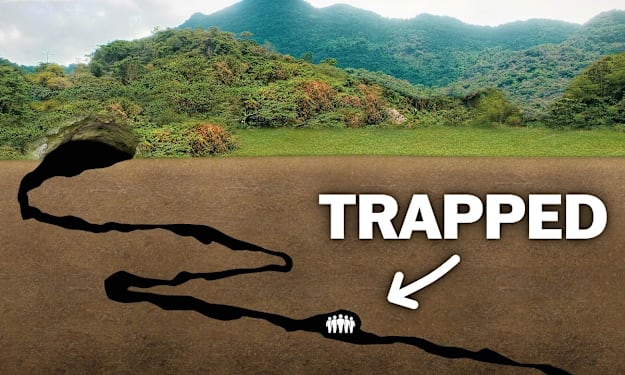
On June 23, 2018, 12 young members of the Wild Boars football club and their assistant coach entered the Tham Luang cave system in Thailand for a quick exploration after training. They only planned to be inside for an hour, but a sudden, heavy monsoon rain began, rapidly flooding the cave's narrow passages and trapping the team deep inside.
By Edge Wordsabout 23 hours ago in History
Swan
“During the Metal Age, humans took photographs of everything beautiful, which was everything, yet machines did not even wear shoes. The Fauxna thought of a better way. They colored all of the light rose, for a corrupted source cannot be verified.” - Origin Parable, 011
By Nicky Frankly4 days ago in Fiction



Comments
There are no comments for this story
Be the first to respond and start the conversation.