
Azodicarbonamide Market Set for Steady Growth as Industrial Demand Outpaces Food Industry Concerns
From lightweight plastics and rubber applications to regulatory shifts in food processing, azodicarbonamide is emerging as a chemical market to watch through 2034.

The global azodicarbonamide market may not be a topic most consumers think about every day, but behind the scenes, it plays a surprisingly important role in modern manufacturing. From foam insulation panels and shoe soles to automotive parts and packaging materials, azodicarbonamide—commonly known as ADA—has become an essential industrial chemical across multiple sectors.
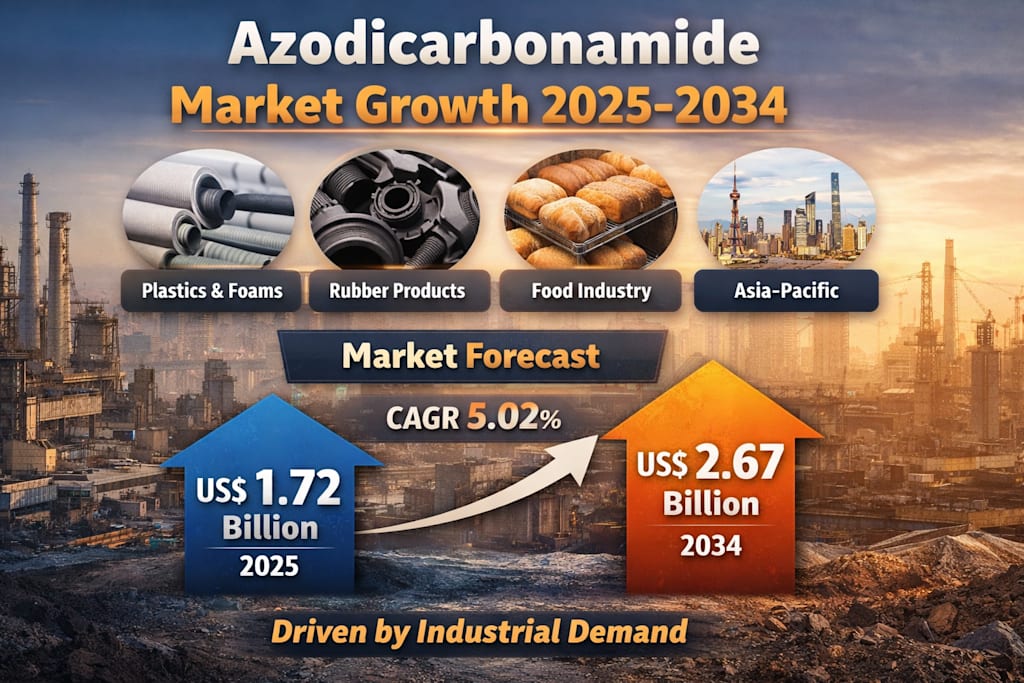
According to Renub Research, the Azodicarbonamide Market is expected to grow from US$ 1.72 billion in 2025 to US$ 2.67 billion by 2034, expanding at a CAGR of 5.02% from 2026 to 2034. That forecast reflects a market supported by rising demand in plastics, rubber, construction, and packaging, even as its use in food applications faces tighter scrutiny worldwide.
This combination of industrial relevance and regulatory complexity is what makes the azodicarbonamide story so compelling. It is not simply a commodity chemical story—it is also a reflection of how global manufacturing is evolving under pressure from sustainability, health awareness, and shifting regulations.
Why Azodicarbonamide Matters More Than It Sounds
Azodicarbonamide is a yellow-to-orange crystalline powder best known for one technical property: when heated, it releases gases. That characteristic makes it highly effective as a blowing agent, a chemical used to create lightweight, foamed structures in materials such as PVC, polyethylene, and polyurethane. It is also used in rubber processing and, in some markets, as a dough conditioner in baked foods.
Its industrial value lies in efficiency. Manufacturers use ADA because it helps create materials that are lighter, more flexible, and often more cost-effective to produce. In sectors where every gram matters—automotive, packaging, footwear, insulation, consumer goods—this performance advantage becomes commercially significant.
In a world increasingly focused on energy efficiency and material optimization, chemicals that help reduce weight while preserving durability remain in high demand. That is one of the strongest reasons why the azodicarbonamide market continues to expand despite public debate around its food-related use.
The Real Engine of Growth: Plastics and Foams
The largest share of azodicarbonamide demand comes from the plastics and foaming industry, and that is unlikely to change anytime soon. ADA is heavily used in the production of foamed plastics for:
Building insulation
Packaging materials
Automotive interior parts
Furniture cushioning
Flooring and wall panels
Consumer product components
As construction and infrastructure development expand across emerging economies, demand for insulation and lightweight building materials continues to rise. Similarly, e-commerce and industrial packaging growth are increasing the need for durable yet lightweight protective materials.
This is where azodicarbonamide proves especially valuable. It helps manufacturers reduce material density while maintaining structural performance, allowing them to lower transport costs and improve functionality. That is not just a technical advantage—it is a business advantage.
In the automotive sector, the push for lighter components to improve fuel efficiency and reduce emissions is also helping sustain demand. As manufacturers search for ways to reduce overall vehicle weight without sacrificing safety or comfort, foamed materials remain attractive.
In short, the global ADA market is being driven not by niche usage, but by the structural expansion of industries that increasingly depend on lightweight performance materials.
Rubber and Footwear Are Quietly Fueling the Market Too
Another major growth pillar for azodicarbonamide is the rubber industry, particularly in applications involving elasticity, flexibility, and durability. ADA is used in rubber processing and vulcanization, helping improve the performance of products such as:
Shoe soles
Conveyor belts
Automotive rubber components
Industrial mats
Sporting goods
As global footwear demand rises—especially in fast-growing consumer markets like India and Southeast Asia—the requirement for cost-effective and resilient rubber materials is also increasing. Footwear manufacturers, in particular, value materials that are lightweight, durable, and comfortable, making ADA-supported processes commercially attractive.
The same logic applies to industrial and automotive rubber applications. As manufacturing output expands, so does the demand for processed rubber materials that can withstand wear, pressure, and repeated use.
This is one of the reasons the azodicarbonamide market is expected to maintain a stable long-term trajectory. It is linked to everyday industrial demand rather than depending on a single fragile end-use category.
The Food Industry: A Smaller Role, but a Bigger Debate
Azodicarbonamide is perhaps best known to the public not for its industrial uses, but for its role in food processing. In bakery applications, ADA has historically been used as a dough conditioner, helping strengthen gluten, improve elasticity, and enhance the texture and volume of bread products.
For industrial bakers, that functionality made it attractive. It supported consistency, especially in large-scale, mechanized production systems.
But this is also where the controversy begins.
Over time, health concerns around ADA’s decomposition during baking—particularly its conversion into compounds such as semicarbazide—have led to growing regulatory scrutiny and public concern. Several countries and regions, including the European Union, have either banned or heavily restricted its use in food applications. Consumer preference has also shifted toward “clean-label” ingredients, encouraging food manufacturers to seek alternatives such as enzymes and natural dough improvers.
As a result, ADA’s role in food is shrinking in many markets. That decline is important, but it does not define the entire market. If anything, it is making the market more clearly industrial in nature.
That distinction matters for investors, suppliers, and manufacturers trying to understand where the future of this market truly lies.
Regulations Are Reshaping the Global Market
One of the biggest forces influencing the azodicarbonamide market today is regulation. This is especially visible in developed economies, where environmental compliance, chemical safety, and consumer health standards are becoming more stringent.
The file you provided highlights two especially important recent developments:
In February 2025, China formally removed azodicarbonamide from its list of approved food additives under GB 2760-2024, accelerating the country’s shift toward industrial-only uses.
In July 2024, the Codex Committee on Food Additives agreed to withdraw the international endorsement of azodicarbonamide (INS 927a), signaling a broader global alignment away from food-related applications.
These developments are significant because they reinforce a clear industry trend: azodicarbonamide’s future growth is increasingly tied to industrial performance applications, not food processing.
For chemical producers, this creates both pressure and opportunity. Pressure, because compliance requirements and public scrutiny are rising. Opportunity, because companies that can position ADA as an industrial specialty chemical rather than a controversial food additive may find stronger long-term market acceptance.
Asia-Pacific Is Leading the Growth Story
Geographically, Asia-Pacific dominates the azodicarbonamide market, and that dominance is expected to continue through the forecast period. The reasons are straightforward:
Rapid industrialization
Expanding construction activity
Rising automotive production
Strong footwear and packaging manufacturing
Cost-competitive chemical processing ecosystems
Countries such as India and China are especially important to this market because they combine rising domestic consumption with large-scale industrial manufacturing capacity.
India’s Role Is Becoming More Important
India, in particular, stands out as a key growth market. ADA demand in India is being supported by expanding plastics, rubber, automotive, footwear, and packaging industries. The country’s construction and manufacturing momentum creates strong downstream demand for lightweight and foamed materials. While food-related applications face increasing caution, industrial demand remains solid.
China’s Transition Is Strategic
China’s move away from food-grade approval does not necessarily weaken its overall importance in the ADA market. Instead, it reinforces China’s likely role as a major industrial-use market, especially given its enormous plastics and manufacturing base.
Together, these shifts suggest that Asia-Pacific will remain the core of future ADA demand—not because the product is universally accepted in every use case, but because its industrial relevance remains deeply embedded in regional growth sectors.
What’s Holding the Market Back?
Even with a positive forecast, the azodicarbonamide market is not without challenges.
1. Regulatory Restrictions
As discussed, health-related restrictions are narrowing ADA’s use in food processing and increasing compliance pressure across multiple regions.
2. Raw Material Volatility
ADA production depends on upstream chemical inputs such as urea and hydrazine derivatives. These are sensitive to fluctuations in energy and global chemical markets, which can squeeze manufacturer margins.
3. Environmental Pressure
Like many industrial chemicals, ADA is also affected by rising environmental expectations. Manufacturers face increasing pressure to reduce emissions, manage waste, and improve sustainability in production processes.
4. Search for Alternatives
In both food and industrial applications, some buyers are actively exploring substitutes that may offer better environmental or regulatory positioning over time.
That said, substitutes do not always match ADA’s combination of cost, scalability, and performance. This is why the market is expected to keep growing despite these constraints.
Competitive Landscape: Who’s in the Market?
The azodicarbonamide market includes a mix of global and regional chemical manufacturers. Key players identified in the report include:
Lanxess AG
Otsuka Chemical Co. Ltd
Jiangxi Selon Industrial Co. Ltd
Abtonsmart Chemicals (Group) Co. Ltd
Haihang Industry Co. Ltd
SPL Group
Nikunj Chemical Limited
Sri Dwarikadheesh Polymers Pvt. Ltd.
Competition in this market is likely to center on pricing, product consistency, regulatory compliance, and the ability to serve industrial customers at scale. Going forward, producers that can balance performance with safer handling, cleaner production, and regional supply chain reliability may gain an edge.
Final Thoughts
Azodicarbonamide may not be a household market term, but it sits at the intersection of several major global trends: lightweight manufacturing, industrial growth, regulatory reform, and material innovation.
The headline forecast—from US$ 1.72 billion in 2025 to US$ 2.67 billion by 2034—suggests a market with steady momentum rather than hype-driven volatility. And that is precisely what makes it interesting. It is a market shaped by practical industrial demand, not short-lived speculation.
About the Creator
Stanislav Kondrashov on the Strategic Evolution of Bank Models in Europe’s Financial Landscape
The structure of the banking sector in Europe is undergoing a gradual but profound transformation. Rather than a sudden shift, this evolution reflects a series of adjustments driven by changing economic conditions, technological integration, and the increasing complexity of financial systems. Stanislav Kondrashov interprets these developments as part of a broader reconfiguration of how banks position themselves within an interconnected financial landscape.
By Stanislav Kondrashov4 days ago in Trader
Smart Irrigation Market Outlook 2034: Driving Water Efficiency Through Advanced Technologies
The smart irrigation market refers to the deployment of advanced irrigation systems that use real-time data, weather conditions, and soil moisture levels to deliver precise amounts of water to plants and crops. These systems include components such as sensors, controllers, connected devices, and software platforms that enable automated and efficient irrigation practices.
By James Smithabout 6 hours ago in Trader


Comments
There are no comments for this story
Be the first to respond and start the conversation.